
SimulationsSimulacionesSIM-0028
Simulate, 6 minutesSimular, 6 minutos
Heat on the move: spoons and cupsEl calor en movimiento: cucharas y vasos
Stand a steel, a wooden and a plastic spoon in a hot drink, then pour the drink into three kinds of cup, and see where the heat goes, safely.Ponga una cuchara de acero, una de madera y una de plástico en una bebida caliente, luego sirva la bebida en tres tipos de vaso, y vea a dónde va el calor, sin peligro.
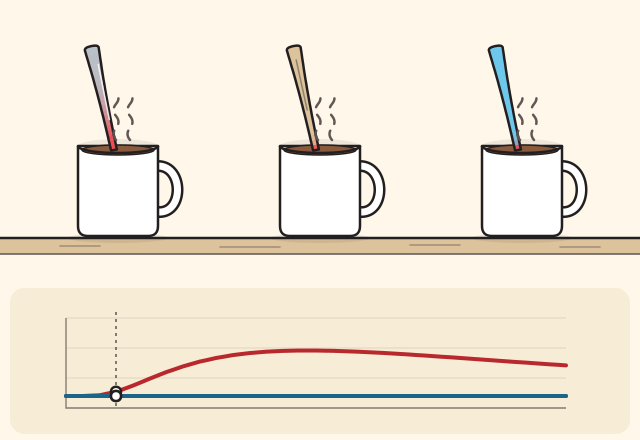
The drawing shows where it starts. It runs here once its script has loaded.El dibujo muestra dónde empieza. Funciona aquí una vez que carga su código.
Your challengeSu reto
- Warm a spoon’s handle end five degrees above the room.Caliente la punta del mango de una cuchara cinco grados por encima del cuarto. Not done yet.Todavía no.
- Keep a drink above sixty degrees for twenty minutes.Mantenga una bebida a más de sesenta grados durante veinte minutos. Not done yet.Todavía no.
- Find the minute when the steel spoon’s handle end is warmest.Encuentre el minuto en que la punta del mango de la cuchara de acero está más caliente. Not done yet.Todavía no.
Every challenge done. Now try it for real at home.Todos los retos logrados. Ahora pruébelo de verdad en casa.
A spoon glows red where it is warm. Wavy red arrows are heat leaving a cup, thicker for faster. The chart follows the handle ends or the drinks over half an hour; the dashed line is the room. Never touch a hot spoon or cup to test it: this is the safe way to compare.Una cuchara se pone roja donde está caliente. Las flechas rojas onduladas son calor que sale de un vaso, más gruesas si sale más rápido. La gráfica sigue las puntas de los mangos o las bebidas durante media hora; la línea punteada es el cuarto. Nunca toque una cuchara o un vaso caliente para probar: esta es la manera segura de comparar.
What is happeningQué está pasando
Heat always flows from hot to cold. In a solid it moves by conduction, passed from one jiggling particle to the next. Metals pass it along about a hundred times faster than wood or plastic, so a steel spoon in a hot drink warms up its handle while a wooden or plastic one stays cool.El calor siempre va de lo caliente a lo frío. En un sólido se mueve por conducción, pasando de una partícula que vibra a la siguiente. Los metales lo pasan unas cien veces más rápido que la madera o el plástico, así que una cuchara de acero en una bebida caliente calienta su mango, mientras que una de madera o de plástico se queda fresca.
A hot drink loses heat to the room through its cup’s walls and, most of all, from its open top, where steam carries heat away. The hotter it is compared with the room, the faster it cools, so it cools quickly at first and slowly later. That pattern is Newton’s law of cooling.Una bebida caliente pierde calor hacia el cuarto por las paredes del vaso y, sobre todo, por arriba, donde el vapor se lleva el calor. Entre más caliente esté comparada con el cuarto, más rápido se enfría, así que al principio se enfría rápido y después más despacio. Ese patrón es la ley de enfriamiento de Newton.
A foam cup’s wall is full of tiny trapped bubbles of air, which conducts heat poorly, so less heat leaks out the sides. A lid traps the steam and stops the biggest leak of all. The solar oven uses the same ideas the other way round: clear plastic over the top and newspaper in the walls keep the heat in.La pared de un vaso de unicel está llena de burbujitas de aire atrapadas, y el aire conduce mal el calor, así que se escapa menos calor por los lados. Una tapa atrapa el vapor y detiene la fuga más grande de todas. El horno solar usa las mismas ideas al revés: el plástico transparente arriba y el periódico en las paredes guardan el calor adentro.
Safety first: hot drinks and the spoons in them can burn. Never touch a spoon or a cup to find out how hot it is; this simulation is the safe way to compare.La seguridad primero: las bebidas calientes y las cucharas que están en ellas pueden quemar. Nunca toque una cuchara o un vaso para saber qué tan caliente está; esta simulación es la manera segura de comparar.
Things to tryCosas para probar
- Watch the minutes go by and follow the red glow climbing the steel spoon.Vea pasar los minutos y siga el brillo rojo que sube por la cuchara de acero.
- Start the drink just off the boil, then only warm: how much hotter does the steel handle get?Empiece con la bebida recién hervida y luego solo tibia: ¿cuánto más se calienta el mango de acero?
- Switch to the cups. Compare the glass with the foam cup, then the foam cup with the lid. Which change helps more?Cambie a los vasos. Compare el vidrio con el unicel, y luego el unicel con la tapa. ¿Qué cambio ayuda más?
This is a model. The spoons all have the same shape so the test is fair, and the numbers for their materials come from engineering tables. Each cup cools by Newton’s law with one rate, though a real drink cools faster than that while it steams hardest. The warm air rising off a drink also warms a spoon, which the model leaves out.Este es un modelo. Las cucharas tienen todas la misma forma para que la prueba sea justa, y los datos de sus materiales vienen de tablas de ingeniería. Cada vaso se enfría según la ley de Newton con una sola rapidez, aunque una bebida real se enfría más rápido mientras suelta más vapor. El aire caliente que sube de la bebida también calienta la cuchara, algo que el modelo deja fuera.
Use it, share it, adapt itÚsela, compártala, adáptela
The credit to copyEl crédito para copiar
Free BYRD, CC BY. “Heat on the move: spoons and cups” from the Byrd Academy STEM Curriculum by Byrd EDU, byrdathome.org.Free BYRD, CC BY. “El calor en movimiento: cucharas y vasos”, del Currículo STEM de Byrd Academy, de Byrd EDU, byrdathome.org.
This is free to use, share and adapt, even commercially, under the Creative Commons Attribution 4.0 International license (CC BY 4.0), with this credit. What Free BYRD means.Esto es libre de usar, compartir y adaptar, incluso con fines comerciales, bajo la licencia Creative Commons Atribución 4.0 Internacional (CC BY 4.0), con este crédito. Qué significa Free BYRD.