

SimulationsSimulacionesSIM-0020
Simulate, 5 minutesSimular, 5 minutos
Volts, ohms and amps: Ohm's lawVoltios, ohmios y amperios: la ley de Ohm
Light a bulb from a battery, add a resistor in a row or side by side, and read the volts and amps on a multimeter, the way an electrician checks a circuit.Encienda un foco con una pila, agregue una resistencia en fila o lado a lado, y lea los voltios y amperios en un multímetro, como revisa un circuito un electricista.
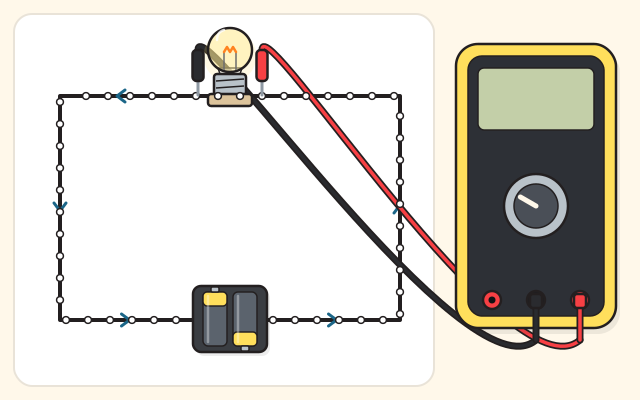
The drawing shows where it starts. It runs here once its script has loaded.El dibujo muestra dónde empieza. Funciona aquí una vez que carga su código.
Your challengeSu reto
- Light the bulb to its full brightness, but no brighter.Encienda el foco a toda su luz, pero no más. Not done yet.Todavía no.
- In a row, find the resistor that shares the battery's volts about equally with the bulb.En fila, encuentre la resistencia que se reparte los voltios de la pila casi por igual con el foco. Not done yet.Todavía no.
- Side by side, make the battery give at least twice the bulb's current.Lado a lado, haga que la pila dé por lo menos el doble de la corriente del foco. Not done yet.Todavía no.
- Set the meter to amps and make it read one hundred milliamps from the battery, give or take three.Ponga el medidor en amperios y haga que marque cien miliamperios de la pila, tres más o tres menos. Not done yet.Todavía no.
Every challenge done. Now try it for real at home.Todos los retos logrados. Ahora pruébelo de verdad en casa.
Current through the bulbCorriente por el foco
The meter readsEl medidor marca
Current from the batteryCorriente de la pila
Ohm's law for the bulb ofLey de Ohm para el foco de :
Current is volts divided by ohms. The dots are the moving charge, out of the battery's plus side, through the parts and back. The meter reads volts with its probes on both ends of a part; to read amps, the current must flow through it, so it goes into the loop. The bar fills at what the bulb is made for.La corriente es los voltios divididos entre los ohmios. Los puntos son la carga en movimiento: sale del lado positivo de la pila, pasa por las partes y regresa. El medidor lee voltios con sus puntas en los dos extremos de una parte; para leer amperios, la corriente tiene que pasar por él, así que se pone dentro del circuito. La barra se llena con lo que aguanta el foco.
What is happeningQué está pasando
A battery pushes, and its push is measured in volts. A part holds the current back, and its hold is measured in ohms. The current that flows is measured in amps, and it is the push divided by the hold: amps equal volts divided by ohms. That is Ohm's law. More volts give more current; more ohms give less.Una pila empuja, y su empuje se mide en voltios. Una parte frena la corriente, y lo que frena se mide en ohmios. La corriente que pasa se mide en amperios, y es el empuje dividido entre lo que frena: los amperios son los voltios divididos entre los ohmios. Esa es la ley de Ohm. Más voltios dan más corriente; más ohmios dan menos.
Put a resistor in a row with the bulb and there is only one path, so the same current flows through both. Their ohms add up, so less current flows, and the battery's volts are shared between them: the bulb gets only part of the push, and it is dimmer.Si pone una resistencia en fila con el foco, hay un solo camino, así que la misma corriente pasa por los dos. Sus ohmios se suman, así que pasa menos corriente, y los voltios de la pila se reparten entre ellos: el foco recibe solo parte del empuje, y brilla menos.
Put them side by side and each one gets the battery's full push. The bulb is just as bright as alone, the resistor takes its own current too, and the battery has to give both currents at once, so it runs down faster.Si los pone lado a lado, cada uno recibe todo el empuje de la pila. El foco brilla igual que solo, la resistencia también toma su propia corriente, y la pila tiene que dar las dos corrientes a la vez, así que se gasta más rápido.
A multimeter measures both. To read volts, touch its two probes to the two ends of a part. To read amps, the current has to flow through the meter, so you open the loop and put the meter into it.Un multímetro mide las dos cosas. Para leer voltios, toque con sus dos puntas los dos extremos de una parte. Para leer amperios, la corriente tiene que pasar por el medidor, así que se abre el circuito y se pone el medidor dentro.
Things to tryCosas para probar
- Add one cell at a time and watch the current climb. Does it climb by the same amount each time?Agregue una pila a la vez y vea cómo sube la corriente. ¿Sube lo mismo cada vez?
- Put the resistor in a row with the bulb and measure the volts across each part. Add them up.Ponga la resistencia en fila con el foco y mida los voltios en cada parte. Súmelos.
- Switch from in a row to side by side and watch what happens to the bulb and to the battery's current.Cambie de en fila a lado a lado y vea qué les pasa al foco y a la corriente de la pila.
- Try the smallest resistor side by side with six cells. What would happen to a real resistor?Pruebe la resistencia más pequeña lado a lado con seis pilas. ¿Qué le pasaría a una resistencia de verdad?
This is a model. It holds the bulb at the resistance it has when lit; a real bulb's wire has much less resistance when cold, so at low voltage a real bulb takes more current than shown. Real batteries lose a little voltage as they work and as they run down, and a real meter takes a tiny bit from the circuit.Esto es un modelo. Mantiene el foco con la resistencia que tiene encendido; el alambre de un foco real tiene mucha menos resistencia en frío, así que con poco voltaje un foco real toma más corriente de la que se muestra. Las pilas reales pierden un poco de voltaje al trabajar y al gastarse, y un medidor real le quita un poquito al circuito.
Use it, share it, adapt itÚsela, compártala, adáptela
The credit to copyEl crédito para copiar
Free BYRD, CC BY. “Volts, ohms and amps: Ohm's law” from the Byrd Academy STEM Curriculum by Byrd EDU, byrdathome.org.Free BYRD, CC BY. “Voltios, ohmios y amperios: la ley de Ohm”, del Currículo STEM de Byrd Academy, de Byrd EDU, byrdathome.org.
This is free to use, share and adapt, even commercially, under the Creative Commons Attribution 4.0 International license (CC BY 4.0), with this credit. What Free BYRD means.Esto es libre de usar, compartir y adaptar, incluso con fines comerciales, bajo la licencia Creative Commons Atribución 4.0 Internacional (CC BY 4.0), con este crédito. Qué significa Free BYRD.