

SimulationsSimulacionesSIM-0032
Simulate, 10 minutesSimular, 10 minutos
Build a tower the fan cannot tipConstruya una torre que el ventilador no pueda volcar
Stack light blocks into a tower, set a fan blowing on it, and find out what keeps it standing: a wider base, a shorter tower, or a lump of clay in the right place.Apile bloques ligeros en una torre, ponga un ventilador a soplarle y descubra qué la mantiene de pie: una base más ancha, una torre más baja o una bolita de plastilina en el lugar correcto.
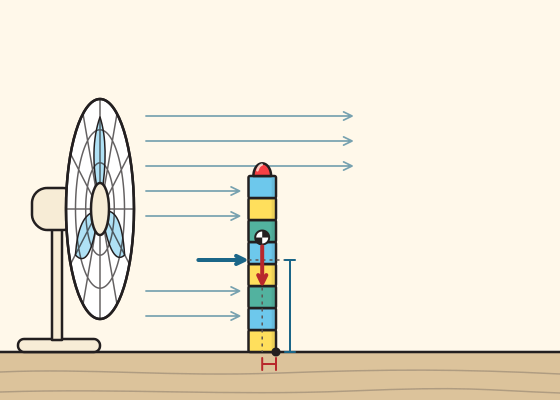
The drawing shows where it starts. It runs here once its script has loaded.El dibujo muestra dónde empieza. Funciona aquí una vez que carga su código.
Your challengeSu reto
- Turn up the fan until the tower tips over.Suba el ventilador hasta que la torre se vuelque. Not done yet.Todavía no.
- Tip a tower, then keep the same tower standing in the same wind by moving only the clay.Vuelque una torre y luego mantenga de pie la misma torre, con el mismo viento, moviendo solo la plastilina. Not done yet.Todavía no.
- With the fan at its strongest and blocks seven centimeters wide, build the tallest tower that does not tip.Con el ventilador lo más fuerte y bloques de siete centímetros de ancho, construya la torre más alta que no se vuelque. Not done yet.Todavía no.
Every challenge done. Now try it for real at home.Todos los retos logrados. Ahora pruébelo de verdad en casa.
Turning effect of the wind, toward the far sideEfecto de giro del viento, hacia el lado lejano
Turning effect of the weight, back toward the fanEfecto de giro del peso, de regreso hacia el ventilador
The wind’s push:El empuje del viento:
The tower’s weight:El peso de la torre:
The blue arrow is the wind’s push, and the blue mark beside the tower is its height above the table. The red arrow is the tower’s weight, pulling straight down at its balance point, the quartered circle; the red mark on the table is how far that is from the tipping edge, the edge on the far side from the fan. A turning effect is a push or a weight times its distance from the tipping edge, in grams times centimeters; the push is given as the weight it equals. Each block is four centimeters tall and weighs five grams for every four centimeters of width, and the clay weighs twenty grams.La flecha azul es el empuje del viento, y la marca azul junto a la torre es su altura sobre la mesa. La flecha roja es el peso de la torre, que jala derecho hacia abajo en su punto de equilibrio, el círculo dividido en cuartos; la marca roja sobre la mesa es qué tan lejos está del borde de vuelco, el borde del lado lejano del ventilador. Un efecto de giro es un empuje o un peso por su distancia al borde de vuelco, en gramos por centímetros; el empuje se da como el peso al que equivale. Cada bloque mide cuatro centímetros de alto y pesa cinco gramos por cada cuatro centímetros de ancho, y la plastilina pesa veinte gramos.
What is happeningQué está pasando
The fan’s wind pushes on the side of the tower. That push tries to turn the tower over the edge of its base on the far side from the fan, its tipping edge. The tower’s weight pulls straight down from its balance point, the average place of all its weight, and turns it back the other way.El viento del ventilador empuja el costado de la torre. Ese empuje trata de girar la torre sobre el borde de su base del lado lejano del ventilador, su borde de vuelco. El peso de la torre jala derecho hacia abajo desde su punto de equilibrio, el lugar promedio de todo su peso, y la gira de regreso hacia el otro lado.
How hard each one turns the tower is its turning effect: the push times its height above the table, and the weight times how far the balance point sits from the tipping edge, measured along the table. When the wind’s turning effect is bigger, the tower tips over that edge and falls the way the wind blows.Qué tan fuerte gira cada uno a la torre es su efecto de giro: el empuje por su altura sobre la mesa, y el peso por qué tan lejos queda el punto de equilibrio del borde de vuelco, medido a lo largo de la mesa. Cuando el efecto de giro del viento es mayor, la torre se vuelca sobre ese borde y cae hacia donde sopla el viento.
A taller tower catches more wind, and that wind pushes higher up, so its turning effect grows fast: twice as tall turns it four times as hard, while the weight’s turning effect only doubles. A wider base helps twice over: wider blocks weigh more, and their weight sits farther from the edge.Una torre más alta atrapa más viento, y ese viento empuja más arriba, así que su efecto de giro crece rápido: el doble de alta la gira cuatro veces más fuerte, mientras que el efecto de giro del peso solo se duplica. Una base más ancha ayuda por partida doble: los bloques más anchos pesan más, y su peso queda más lejos del borde.
Where the weight sits matters too. Clay on the side the fan blows from is farthest from the tipping edge, so it holds the tower best, and clay on the far side helps the least. Watch the balance point move toward the fan as the clay does.También importa dónde va el peso. La plastilina del lado de donde sopla el ventilador queda más lejos del borde de vuelco, así que es la que mejor sostiene la torre, y la plastilina del lado lejano es la que menos ayuda. Observe cómo el punto de equilibrio se mueve hacia el ventilador cuando la plastilina se mueve.
Things to tryCosas para probar
- Set the fan at its strongest and add blocks one at a time. How tall does the tower get before it tips?Ponga el ventilador lo más fuerte y agregue bloques uno por uno. ¿Qué tan alta llega la torre antes de volcarse?
- Move the clay from the far side to the fan side and watch the balance point and the red mark on the table.Mueva la plastilina del lado lejano al lado del ventilador y observe el punto de equilibrio y la marca roja sobre la mesa.
- Make the base twice as wide. How many more blocks can the tower hold up in the same wind?Haga la base el doble de ancha. ¿Cuántos bloques más puede tener la torre con el mismo viento?
- Build a tower of light blocks or small boxes in front of a fan at home, and see which way it falls.Construya una torre de bloques ligeros o cajitas frente a un ventilador en casa, y vea hacia dónde cae.
A model: the wind’s push comes from the drag equation, with the density of air at sea level and the drag of a flat face square to the wind, and the wind blows evenly over the whole tower. The blocks are light foam, four centimeters tall, weighing five grams for every four centimeters of width, and the clay twenty grams; both are the model’s choices. The bottom block never slides, though on a slippery table a short, wide tower may slide instead of tipping, and the fallen blocks are drawn lying in a row where real ones would bounce and scatter. A real fan’s wind is strongest in front of its middle and comes in gusts, so your own tower may tip a little sooner or later.Un modelo: el empuje del viento sale de la ecuación de arrastre, con la densidad del aire al nivel del mar y el arrastre de una cara plana de frente al viento, y el viento sopla parejo sobre toda la torre. Los bloques son de espuma ligera, de cuatro centímetros de alto, y pesan cinco gramos por cada cuatro centímetros de ancho, y la plastilina veinte gramos; las dos cosas son elecciones del modelo. El bloque de abajo nunca se resbala, aunque en una mesa resbalosa una torre baja y ancha puede deslizarse en vez de volcarse, y los bloques caídos se dibujan acostados en fila, donde los reales rebotarían y se esparcirían. El viento de un ventilador real es más fuerte frente a su centro y llega en ráfagas, así que su torre puede volcarse un poco antes o un poco después.
Use it, share it, adapt itÚsela, compártala, adáptela
The credit to copyEl crédito para copiar
Free BYRD, CC BY. “Build a tower the fan cannot tip” from the Byrd Academy STEM Curriculum by Byrd EDU, byrdathome.org.Free BYRD, CC BY. “Construya una torre que el ventilador no pueda volcar”, del Currículo STEM de Byrd Academy, de Byrd EDU, byrdathome.org.
This is free to use, share and adapt, even commercially, under the Creative Commons Attribution 4.0 International license (CC BY 4.0), with this credit. What Free BYRD means.Esto es libre de usar, compartir y adaptar, incluso con fines comerciales, bajo la licencia Creative Commons Atribución 4.0 Internacional (CC BY 4.0), con este crédito. Qué significa Free BYRD.