

SimulationsSimulacionesSIM-0005
Simulate, 5 minutesSimular, 5 minutos
The trap’s trigger: a stick held by gripEl gatillo de la trampa: un palito sostenido por el agarre
A box sits propped on a stick over the gold. Tie the string higher or lower, step back, and pull: find out which end of the stick lets go first, and how to spring the trap with the gentlest tug.Una caja está apoyada en un palito sobre el oro. Amarre la cuerda más arriba o más abajo, aléjese y jale: descubra qué extremo del palito se suelta primero, y cómo soltar la trampa con el jalón más suave.
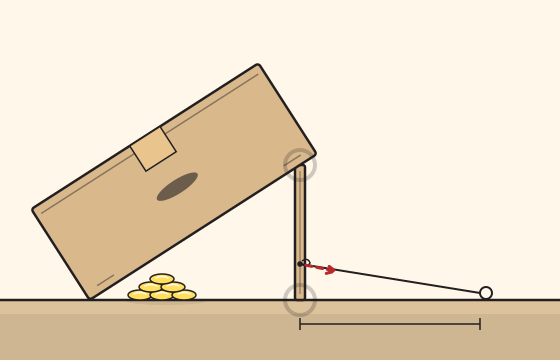
The drawing shows where it starts. It runs here once its script has loaded.El dibujo muestra dónde empieza. Funciona aquí una vez que carga su código.
Your challengeSu reto
- Spring the trap by sliding the stick’s foot out.Suelte la trampa haciendo que la base del palito se resbale. Not done yet.Todavía no.
- Spring the trap by sliding the stick’s top out from under the box.Suelte la trampa haciendo que la punta del palito se resbale de debajo de la caja. Not done yet.Todavía no.
- Put a book on the box and spring it with a pull of two newtons or less.Ponga un libro sobre la caja y suéltela con un jalón de dos newtons o menos. Not done yet.Todavía no.
Every challenge done. Now try it for real at home.Todos los retos logrados. Ahora pruébelo de verdad en casa.
Grip used at the topAgarre usado arriba
Grip used at the footAgarre usado abajo
It springs at a pull ofSe suelta con un jalón de
The string runs down from level byLa cuerda baja desde lo horizontal
Each red ring shows how much of a grip is in use: the top's, where the box presses on the stick, and the foot's, on the table. When a ring closes, that end slides and the trap springs. A newton is about the weight of a small apple held in your hand.Cada anillo rojo muestra cuánto agarre se está usando: el de la punta, donde la caja aprieta el palito, y el de la base, sobre la mesa. Cuando un anillo se cierra, ese extremo se resbala y la trampa se suelta. Un newton es más o menos el peso de una manzana pequeña en la mano.
What is happeningQué está pasando
Nothing glues the stick to the box or to the table. It stands up only because of grip, the friction where it touches: at its top, where the heavy box presses down on it, and at its foot, on the table. A heavier box presses harder, so both grips get stronger and the trap takes a bigger pull.Nada pega el palito a la caja ni a la mesa. Se sostiene solo por el agarre, la fricción donde toca: en su punta, donde la caja pesada lo aprieta, y en su base, sobre la mesa. Una caja más pesada aprieta más, así que los dos agarres se hacen más fuertes y la trampa necesita un jalón más grande.
A sideways pull on the stick is shared between its two grips, like a seesaw. Tie the string high and most of the pull lands on the top, so the top slides out from under the box. Tie it low and most lands on the foot, so the foot slides out across the table. Tie it in the middle and the pull is shared, so it takes the most pull of all.Un jalón de lado sobre el palito se reparte entre sus dos agarres, como un subibaja. Amarre la cuerda arriba y la mayor parte del jalón cae en la punta, así que la punta se resbala de debajo de la caja. Amárrela abajo y la mayor parte cae en la base, así que la base se resbala por la mesa. Amárrela en el centro y el jalón se reparte, así que hace falta el jalón más grande de todos.
Only the sideways part of your pull slides the stick. From close by, the string runs steeply down to your hand, and the downward part presses the foot into the table and makes its grip stronger. From across the room the string runs almost flat, so nearly all of your pull goes sideways.Solo la parte de lado de su jalón resbala el palito. De cerca, la cuerda baja empinada hasta su mano, y la parte hacia abajo aprieta la base contra la mesa y hace más fuerte su agarre. Desde el otro lado del cuarto la cuerda va casi plana, así que casi todo su jalón va hacia un lado.
Things to tryCosas para probar
- Leave everything as it is and press Pull slowly. Which ring closes first?Deje todo como está y presione Jalar despacio. ¿Qué anillo se cierra primero?
- Tie the string near the foot, in the middle, then near the top, and compare the pull each one needs.Amarre la cuerda cerca de la base, en el centro y luego cerca de la punta, y compare el jalón que necesita cada una.
- Stand close with the string tied low, then step back across the room, and watch the angle of the string.Párese cerca con la cuerda amarrada abajo, luego aléjese al otro lado del cuarto, y observe el ángulo de la cuerda.
- Put a book on the box: what do you have to change to spring it gently now?Ponga un libro sobre la caja: ¿qué tiene que cambiar para soltarla con suavidad ahora?
A simple model: the stick stands straight and has no width, the box puts half its weight on the stick, and each grip is the same friction, four tenths of the push on it, a value near what paperboard measures. Real sticks lean, rock on the corner of their foot and bend, and real grips change with the surfaces, so your own trap will need a different pull.Un modelo sencillo: el palito está derecho y no tiene grosor, la caja pone la mitad de su peso en el palito, y cada agarre es la misma fricción, cuatro décimas del empuje que recibe, un valor cercano a lo que mide el cartón. Los palitos reales se inclinan, se mecen sobre la esquina de su base y se doblan, y los agarres reales cambian con las superficies, así que su trampa necesitará otro jalón.
Use it, share it, adapt itÚsela, compártala, adáptela
The credit to copyEl crédito para copiar
Free BYRD, CC BY. “The trap’s trigger: a stick held by grip” from the Byrd Academy STEM Curriculum by Byrd EDU, byrdathome.org.Free BYRD, CC BY. “El gatillo de la trampa: un palito sostenido por el agarre”, del Currículo STEM de Byrd Academy, de Byrd EDU, byrdathome.org.
This is free to use, share and adapt, even commercially, under the Creative Commons Attribution 4.0 International license (CC BY 4.0), with this credit. What Free BYRD means.Esto es libre de usar, compartir y adaptar, incluso con fines comerciales, bajo la licencia Creative Commons Atribución 4.0 Internacional (CC BY 4.0), con este crédito. Qué significa Free BYRD.