ExploreExplorarBH-0009
Test the strength of trianglesPonga a prueba la fuerza de los triángulos
Push on a square and a triangle made of sticks, see which one holds its shape, then build a paper tower that stands on shape, not tape.Empuje un cuadrado y un triángulo hechos de palitos, vea cuál conserva su forma y luego construya una torre de papel que se sostenga por su forma, no por la cinta.
- Ways in:Formas de empezar:
- Read, 3 minutesLeer, 3 minutos
- Do, 30 minutesHacer, 30 minutos
- Simulate, 5 minutesSimular, 5 minutos
- AgesEdades
- Every age. Best for ages 5 and up.Todas las edades. Ideal desde los 5 años.
- CostCosto
- Things already at homeCosas que ya hay en casa
- From the curriculumDel currículo
- STEM-ES-01
The MESH'D components this item uses:Los componentes MESH'D que usa:ManufacturingManufacturaHolistic DesignDiseño integral
Do, about 30 minutesHacer, unos 30 minutos
Build it at homeConstrúyalo en casa
StepsPasos
- Join four sticks into a square, with a small ball of play dough at each corner. Join three more sticks into a triangle the same way.Una cuatro palitos en forma de cuadrado, con una bolita de plastilina en cada esquina. Una otros tres palitos en forma de triángulo de la misma manera.
- Lay both shapes flat and push gently on one corner of each. Tally which one leans and which one holds.Ponga las dos figuras planas sobre la mesa y empuje con cuidado una esquina de cada una. Anote cuál se inclina y cuál se mantiene.
- Add one stick across the square from corner to corner, making two triangles, and push again.Agregue un palito que cruce el cuadrado de esquina a esquina, formando dos triángulos, y empuje otra vez.
- Try to stand a flat sheet of paper on its edge. Then roll a sheet into a tight tube, tape it and stand it up. Fold another into an accordion and stand that up too.Intente parar una hoja de papel plana sobre su borde. Luego enrolle una hoja en un tubo apretado, péguelo con cinta y póngalo de pie. Doble otra como acordeón y párela también.
- Build a tower from your tubes and folds, using triangles wherever you can. Measure its height.Construya una torre con sus tubos y dobleces, usando triángulos donde pueda. Mida su altura.
- Run a fair load test: set a flat card on top and add coins one at a time, counting, until it bends or falls.Haga una prueba de carga justa: ponga una tarjeta plana encima y agregue monedas una por una, contando, hasta que se doble o se caiga.
What you needLo que necesita
- Craft sticks or drinking straws, or tight tubes rolled from paperPalitos de manualidades o popotes, o tubos bien enrollados de papel
- Play dough or modeling clay, to join the corners so they can swingPlastilina o masa para modelar, para unir las esquinas de modo que puedan girar
- Sheets of paperHojas de papel
- Tape and scissorsCinta adhesiva y tijeras
- A pile of coins of one kind, or washers, to count the loadUn montón de monedas de un mismo tipo, o arandelas, para contar la carga
- A ruler or a tape measureUna regla o una cinta métrica
Things already at home.Cosas que ya hay en casa.
Scissors stay pointed down and are passed handle first, and a grown-up does any hard cutting. Coins are a choking hazard, so keep them away from babies and toddlers. Ask a grown-up before you post your build or results online.Las tijeras van con la punta hacia abajo y se pasan por el mango, y una persona adulta hace los cortes difíciles. Las monedas son un peligro de asfixia, así que manténgalas lejos de bebés y niños pequeños. Pregunte a una persona adulta antes de publicar su construcción o sus resultados en internet.
Read, 3 minutesLeer, 3 minutos
The big ideaLa gran idea
A triangle is the only shape with straight sides that holds its shape even when its corners can swing. Push on the corner of a square and it leans over into a diamond, because nothing stops its corners from turning. Push on a triangle and it stays put: three sides of fixed lengths can make only one triangle, so each side holds the other two in place, which is why bridges, towers and roof frames are full of triangles. Paper follows the same rule: a flat sheet flops, but rolled into a tube or folded like an accordion it stands tall, because shape, not tape, holds a structure up.El triángulo es la única figura de lados rectos que conserva su forma aunque sus esquinas puedan girar. Si empuja la esquina de un cuadrado, se inclina hasta volverse un rombo, porque nada impide que sus esquinas giren. Si empuja un triángulo, no se mueve: con tres lados de largo fijo solo se puede formar un triángulo, así que cada lado sostiene a los otros dos en su lugar, y por eso los puentes, las torres y los techos están llenos de triángulos. El papel sigue la misma regla: una hoja plana se dobla, pero enrollada en un tubo o doblada como acordeón se mantiene de pie, porque lo que sostiene una estructura es su forma, no la cinta.
Simulate, 5 minutesSimular, 5 minutos
How shape makes paper strongCómo la forma hace fuerte al papel
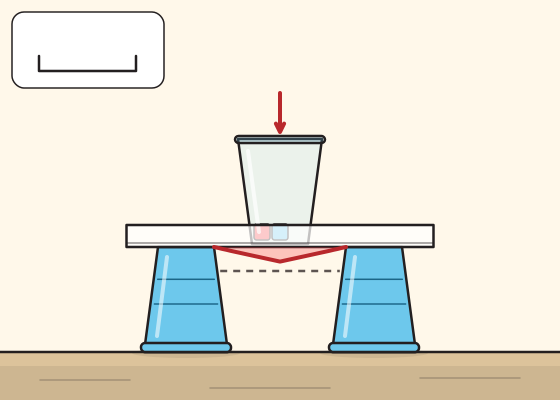
Fold one sheet of paper four ways, set it across two cups and load it block by block. Watch where the bridge bends hardest and where it gives way, then move the cups and try again.Doble una hoja de papel de cuatro maneras, póngala entre dos vasos y cárguela bloque por bloque. Observe dónde se dobla más el puente y dónde cede, y luego mueva los vasos y pruebe otra vez.
The drawing shows where it starts. It runs here once its script has loaded.El dibujo muestra dónde empieza. Funciona aquí una vez que carga su código.
Your challengeSu reto
- Find a gap where even a flat sheet holds the empty cup.Encuentre una distancia en la que hasta una hoja plana aguante el vaso vacío. Not done yet.Todavía no.
- Load a folded bridge until it crumples, and see where it gives way.Cargue un puente doblado hasta que se aplaste, y vea dónde cede. Not done yet.Todavía no.
- Fold the sheet so it holds ten blocks.Doble la hoja para que aguante diez bloques. Not done yet.Todavía no.
- With the cups as far apart as they go, hold five blocks.Con los vasos lo más separados posible, aguante cinco bloques. Not done yet.Todavía no.
Every challenge done. Now try it for real at home.Todos los retos logrados. Ahora pruébelo de verdad en casa.
Strength used in the middleResistencia usada en el centro
The load, cup and blocksLa carga, vaso y bloques
How far it sagsCuánto se hunde
The most it holds hereLo más que aguanta aquí
The red wedge under the bridge shows how hard the paper is bent at each place: hardest in the middle, under the cup. The dashed line is as much bending as this fold can take; past it, the bridge gives way. The box in the corner shows the sheet from its end.La cuña roja bajo el puente muestra cuánto se dobla el papel en cada lugar: más en el centro, debajo del vaso. La línea punteada es lo más que aguanta este doblez; si la pasa, el puente cede. El recuadro de la esquina muestra la hoja vista desde un extremo.
What is happeningQué está pasando
A sheet of paper laid flat across two cups bends under almost nothing. It is so thin that even its own weight makes it sag. Folding it over into a thicker strip barely helps, because the loose layers slide past each other and each one bends on its own.Una hoja de papel puesta plana entre dos vasos se dobla casi con nada. Es tan delgada que hasta su propio peso la hace hundirse. Doblarla para hacer una tira más gruesa casi no ayuda, porque las capas sueltas se deslizan una sobre otra y cada una se dobla sola.
Folding walls up its edges, or folding it into zigzags, stands paper up, away from the middle of the sheet. That is what makes a bridge stiff: the farther the paper sits from the middle, the harder it is to bend, and that distance counts three times over.Doblar paredes en sus bordes, o doblarla en zigzag, pone el papel de pie, lejos del centro de la hoja. Eso es lo que hace rígido a un puente: entre más lejos del centro queda el papel, más cuesta doblarlo, y esa distancia cuenta tres veces.
A bridge is bent hardest in the middle, right under the load, so that is where it gives way. A flat sheet sags until it folds through; a folded one crumples where the tops of its folds are squeezed the most.Un puente se dobla más en el centro, justo debajo de la carga, así que ahí es donde cede. Una hoja plana se hunde hasta doblarse por completo; una doblada se aplasta donde la parte de arriba de sus dobleces se aprieta más.
Every bridge gets weaker as the gap grows. With the cups twice as far apart, a folded bridge holds about half as much before it crumples, and a flat one sags eight times as far.Todo puente se debilita a medida que crece la distancia. Con los vasos al doble de separación, un puente doblado aguanta como la mitad antes de aplastarse, y uno plano se hunde ocho veces más.
Things to tryCosas para probar
- Start with walls and press Add a block until it crumples. Watch the red wedge reach the dashed line first.Empiece con paredes y presione Agregar un bloque hasta que se aplaste. Observe cómo la cuña roja llega primero a la línea punteada.
- Switch to zigzags at the same gap: how many blocks does it hold now?Cambie a zigzag con la misma distancia: ¿cuántos bloques aguanta ahora?
- Choose a flat sheet, then move the cups as close as they go.Escoja la hoja plana y luego acerque los vasos lo más que se pueda.
- Look at the box in the corner: the deeper the fold seen from the end, the stronger the bridge.Mire el recuadro de la esquina: entre más alto es el doblez visto desde el extremo, más fuerte es el puente.
This is a model. The bending uses the real beam formulas for paper, with the sheet's own weight, but the squeeze at which folded paper crumples is a rule of thumb chosen so the folds rank the way they did in the episode, not a measurement. Each block counts as ten grams, and the blocks are drawn smaller than real ones. Real paper also slips on the cups and its walls spread apart, so your own bridge will hold a different number.Esto es un modelo. El doblez usa las fórmulas reales de una viga de papel, con el peso de la propia hoja, pero el apretón con el que el papel doblado se aplasta es una regla práctica elegida para que los dobleces queden en el mismo orden que en el episodio, no una medición. Cada bloque cuenta como diez gramos, y los bloques se dibujan más pequeños que los reales. El papel real también se resbala sobre los vasos y sus paredes se abren, así que su puente aguantará otro número.
Open the simulation on its own pageAbrir la simulación en su propia página
Your engineering challengeSu reto de ingeniería
Build the tallest paper tower you can that stands on its own, then the one that holds the most coins on top. Explain your best design choice with shape words: triangle, tube, fold.Construya la torre de papel más alta que pueda y que se sostenga sola, y luego la que aguante más monedas encima. Explique su mejor decisión de diseño con palabras de formas: triángulo, tubo, doblez.
Make it an experimentConviértalo en un experimento
Science is about changing one thing and watching what happens. Write down your guess, your hypothesis, before you start.La ciencia se trata de cambiar una cosa y observar qué pasa. Escriba su suposición, su hipótesis, antes de empezar.
- Add more tape to the square's corners and push again. Does tape alone stop it from leaning, or does one stick across the middle, making two triangles?Ponga más cinta en las esquinas del cuadrado y empuje otra vez. ¿La cinta sola evita que se incline, o lo logra un palito en diagonal, que forma dos triángulos?
- Make the same tower from flat sheets, from tubes and from accordion folds, and count how many coins each one holds.Haga la misma torre con hojas planas, con tubos y con dobleces de acordeón, y cuente cuántas monedas aguanta cada una.
- When a build breaks, look at where it broke first. The break is the data, not a failure.Cuando una construcción se rompa, fíjese dónde se rompió primero. La ruptura es un dato, no un fracaso.
Use it, share it, adapt itÚsela, compártala, adáptela
The credit to copyEl crédito para copiar
Free BYRD, CC BY. “Test the strength of triangles” from the Byrd Academy STEM Curriculum by Byrd EDU, byrdathome.org.Free BYRD, CC BY. “Ponga a prueba la fuerza de los triángulos”, del Currículo STEM de Byrd Academy, de Byrd EDU, byrdathome.org.
This is free to use, share and adapt, even commercially, under the Creative Commons Attribution 4.0 International license (CC BY 4.0), with this credit. What Free BYRD means.Esto es libre de usar, compartir y adaptar, incluso con fines comerciales, bajo la licencia Creative Commons Atribución 4.0 Internacional (CC BY 4.0), con este crédito. Qué significa Free BYRD.
Keep goingSiga adelante
What to do nextQué hacer después
Make it harderHágalo más difícil
Build a paper bridge between two stacks of books, once as a flat beam and once with a folded truss of triangles, and measure the distance it crosses in centimeters. Then hold a tournament with a materials budget: everyone gets the same few sheets and the same strip of tape, and the bridge that holds the most coins wins.Construya un puente de papel entre dos pilas de libros, una vez como viga plana y otra con una armadura doblada de triángulos, y mida en centímetros la distancia que cruza. Luego hagan un torneo con un presupuesto de materiales: todos reciben las mismas pocas hojas y la misma tira de cinta, y gana el puente que aguante más monedas.
For a younger onePara alguien más pequeño
Make one square and one triangle from sticks and play dough, and let the younger one push each. Ask: which one wiggles, and which one stays strong?Haga un cuadrado y un triángulo con palitos y plastilina, y deje que la niña o el niño empuje cada uno. Pregunte: ¿cuál se tambalea y cuál se queda firme?
Try this nextPruebe esto después
How shape makes paper strongCómo la forma hace fuerte al papel
Fold one sheet of paper four ways, set it across two cups and load it block by block. Watch where the bridge bends hardest and where it gives way, then move the cups and try again.Doble una hoja de papel de cuatro maneras, póngala entre dos vasos y cárguela bloque por bloque. Observe dónde se dobla más el puente y dónde cede, y luego mueva los vasos y pruebe otra vez.
- Ways in:Formas de empezar:
- SimulateSimular
Best for ages 5 and upIdeal desde los 5 años
ManufacturingManufacturaDesignDiseño
Free BYRD, CC BYSimulationSimulación
 BH-0003
 One sheet of paper, many triesUna hoja de papel, muchos intentos
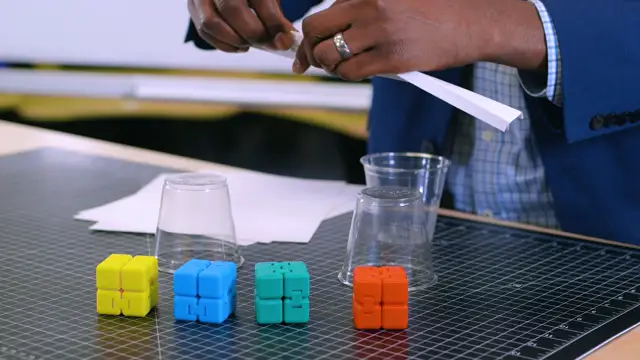
Keep a cup of blocks off the table with only one sheet of paper, by improving your design one try at a time.Mantenga un vaso con bloques lejos de la mesa con una sola hoja de papel, mejorando su diseño intento tras intento.
- Ways in:Formas de empezar:
- ReadLeer
- DoHacer
- SimulateSimular
Best for ages 5 and upIdeal desde los 5 años
ManufacturingManufacturaDesignDiseño
Free BYRD, CC BYLessonLección
 BH-0002
 Prototype a house in cardboardHaga el prototipo de una casa en cartón
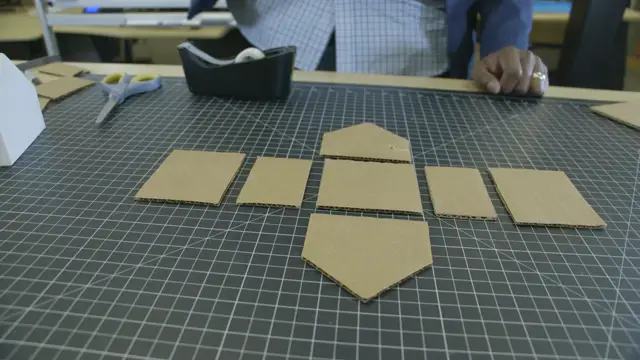
Draw a house as flat pieces, cut them from cardboard, and fold and tape them into a model you can hold.Dibuje una casa en piezas planas, recórtelas de cartón y dóblelas y péguelas hasta tener un modelo que pueda sostener.
- Ways in:Formas de empezar:
- ReadLeer
- DoHacer
- SimulateSimular
Best for ages 6 to 14Ideal de 6 a 14 años
ManufacturingManufacturaDesignDiseño
Free BYRD, CC BYLessonLección
Race ramp racers with a fair testHaga carreras en rampa con una prueba justa
Build a cardboard racer, roll it down a ramp, and change one thing at a time, three runs each, to find out what really makes it go farther.Construya un carrito de cartón, láncelo por una rampa y cambie una sola cosa a la vez, tres veces cada una, para descubrir qué lo hace llegar más lejos.
- Ways in:Formas de empezar:
- ReadLeer
- DoHacer
- SimulateSimular
Best for ages 6 to 12Ideal de 6 a 12 años
ManufacturingManufacturaSoftwareSoftware
Free BYRD, CC BYHome activityActividad en casa