

ExploreExplorarBH-0050
Build gears from lids and cardboardConstruya engranajes con tapas y cartón
Wrap plastic lids and bottle caps in ridged cardboard so the ridges mesh like teeth, pin them to a box, and count turns to find the trade between speed and strength.Envuelva tapas de plástico y taparroscas con cartón corrugado para que las ondas encajen como dientes, clávelas a una caja y cuente vueltas para descubrir el cambio entre velocidad y fuerza.
- Ways in:Formas de empezar:
- Read, 3 minutesLeer, 3 minutos
- Do, 45 minutesHacer, 45 minutos
- Simulate, 5 minutesSimular, 5 minutos
- AgesEdades
- Every age. Best for ages 8 and up.Todas las edades. Ideal desde los 8 años.
- CostCosto
- Things already at homeCosas que ya hay en casa
The MESH'D components this item uses:Los componentes MESH'D que usa:ManufacturingManufacturaHolistic DesignDiseño integral
Do, about 45 minutesHacer, unos 45 minutos
Build it at homeConstrúyalo en casa
StepsPasos
- A grown-up cuts long strips of the box, about a finger wide, and peels the flat paper off one side so the ridges show.Una persona adulta corta tiras largas de la caja, como del ancho de un dedo, y despega el papel liso de un lado para que se vean las ondas.
- Wrap a strip around the edge of each lid with the ridges facing out, and glue or tape it so the ends meet neatly. The ridges are the teeth.Envuelva una tira alrededor del borde de cada tapa con las ondas hacia afuera, y péguela para que las puntas se junten bien. Las ondas son los dientes.
- Draw a dot near the edge of each lid so you can count its turns.Dibuje un punto cerca del borde de cada tapa para poder contar sus vueltas.
- A grown-up pushes a pin through the center of each lid into a flat side of the box, loosely enough that each lid spins.Una persona adulta clava una tachuela en el centro de cada tapa sobre un lado plano de la caja, sin apretar, para que cada tapa gire.
- Place two lids so their ridges mesh, then turn one slowly and watch the other.Acomode dos tapas para que sus ondas encajen, luego gire una despacio y observe la otra.
- Turn the first gear five times and count how many times the dot on the second one goes around.Gire el primer engranaje cinco veces y cuente cuántas veces da la vuelta el punto del segundo.
- Swap in other lids, add a third gear, and record each result in a table.Cambie por otras tapas, agregue un tercer engranaje y anote cada resultado en una tabla.
What you needLo que necesita
- Plastic lids of different sizes: bottle caps, a food tub lid, a jar lidTapas de plástico de varios tamaños: taparroscas, la tapa de un recipiente de comida, la tapa de un frasco
- A cardboard box made of the kind with ridges insideUna caja de cartón corrugado, del que tiene ondas por dentro
- Glue or tapePegamento o cinta adhesiva
- Push pins, for the grown-upTachuelas, para la persona adulta
- Scissors and a markerTijeras y un marcador
Things already at home.Cosas que ya hay en casa.
A grown-up handles the pins and the scissors, and every pin stays pointed into the cardboard. Count the pins out and back in, and keep them away from babies and toddlers. Fingers stay out of the spot where gear teeth meet: on real machines that pinch point can cause severe injuries, which is why machines cover their gears.Una persona adulta maneja las tachuelas y las tijeras, y cada tachuela queda clavada con la punta dentro del cartón. Cuente las tachuelas al sacarlas y al guardarlas, y manténgalas lejos de bebés y niños pequeños. Los dedos no van en el lugar donde se juntan los dientes: en las máquinas de verdad ese punto de pellizco puede causar lesiones graves, y por eso las máquinas cubren sus engranajes.
Read, 3 minutesLeer, 3 minutos
The big ideaLa gran idea
Gears are wheels with teeth that push each other around. When two gears mesh, their teeth pass one for one, so a small gear with half as many teeth as a big one must turn twice for every turn of the big one. That is a trade. Turn the big gear and the small one spins faster but more weakly; turn the small gear and the big one turns more slowly but harder. Engineers call this gearing up and gearing down, and bicycles and cars use both. Two meshed gears always turn opposite ways, and a gear placed between them flips the direction back without changing the speed.Los engranajes son ruedas con dientes que se empujan entre sí. Cuando dos engranajes encajan, sus dientes pasan uno por uno, así que un engranaje chico con la mitad de dientes que uno grande tiene que dar dos vueltas por cada vuelta del grande. Eso es un cambio. Si gira el grande, el chico da vueltas más rápido pero con menos fuerza; si gira el chico, el grande da vueltas más despacio pero con más fuerza. Los ingenieros le llaman multiplicar y reducir la velocidad, y las bicicletas y los carros usan las dos cosas. Dos engranajes que encajan siempre giran en sentidos contrarios, y un engranaje puesto entre ellos regresa el sentido sin cambiar la velocidad.
Simulate, 5 minutesSimular, 5 minutos
Gears: faster or strongerEngranajes: más rápido o más fuerte
Mesh two or three gears, choose their teeth and turn the crank. See the trade between speed and turning force, and how an idler gear flips the direction.Acople dos o tres engranajes, escoja sus dientes y gire la manivela. Vea el cambio entre velocidad y fuerza de giro, y cómo un engranaje intermedio voltea el sentido.
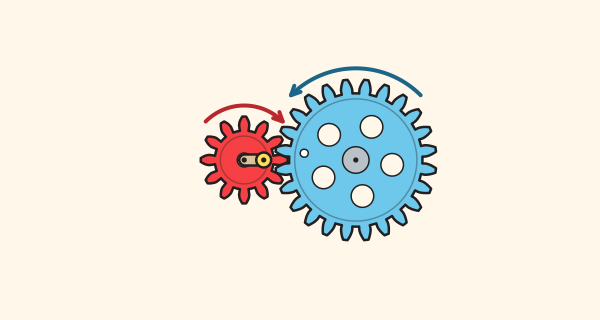
The drawing shows where it starts. It runs here once its script has loaded.El dibujo muestra dónde empieza. Funciona aquí una vez que carga su código.
Your challengeSu reto
- Make the output gear spin faster than the crank.Haga que el engranaje de salida gire más rápido que la manivela. Not done yet.Todavía no.
- Make the output turn with three times your hand’s turning force.Haga que la salida gire con tres veces la fuerza de giro de su mano. Not done yet.Todavía no.
- Put an idler between the gears so the output turns the same way as the crank.Ponga un engranaje intermedio para que la salida gire hacia el mismo lado que la manivela. Not done yet.Todavía no.
- With the idler in, make the output spin exactly twice as fast as the crank.Con el intermedio puesto, haga que la salida gire exactamente al doble de rápido que la manivela. Not done yet.Todavía no.
Every challenge done. Now try it for real at home.Todos los retos logrados. Ahora pruébelo de verdad en casa.
How fast the output turnsQué tan rápido gira la salida
How hard the output turnsQué tan fuerte gira la salida
Teeth, output to crank:Dientes, salida a manivela:
The output turnsLa salida gira
Turns counted:Vueltas contadas:
Your hand turns the crank thirty times a minute, clockwise, with a turning force of one newton meter: a push of ten newtons, about the weight of a liter of water, on a handle ten centimeters out. The arrows show which way each gear turns; rpm means turns a minute. These gears are ideal, with no rubbing.Su mano gira la manivela treinta veces por minuto, en el sentido de las manecillas del reloj, con una fuerza de giro de un newton metro: un empuje de diez newtons, más o menos el peso de un litro de agua, en una manija a diez centímetros del centro. Las flechas muestran hacia dónde gira cada engranaje; rpm quiere decir vueltas por minuto. Estos engranajes son ideales, sin roce.
What is happeningQué está pasando
Gears are wheels with teeth that push each other around. Their teeth pass one for one: when a gear with twelve teeth turns once, twelve teeth push past, and a gear with twenty-four teeth turns only half a turn.Los engranajes son ruedas con dientes que se empujan entre sí. Sus dientes pasan uno por uno: cuando un engranaje de doce dientes da una vuelta, pasan doce dientes, y un engranaje de veinticuatro dientes da solo media vuelta.
So gears trade speed for turning force. A big gear turning a small one makes it spin faster but turn more weakly; a small gear turning a big one makes it spin slower but turn harder. The gears of a bicycle and of a hand drill make this same trade.Así, los engranajes cambian velocidad por fuerza de giro. Un engranaje grande que mueve uno pequeño lo hace girar más rápido pero con menos fuerza; uno pequeño que mueve uno grande lo hace girar más despacio pero con más fuerza. Los engranajes de una bicicleta y de un taladro de mano hacen este mismo cambio.
Two meshed gears always turn opposite ways. Put an idler gear between them and the output turns the same way as the crank again, yet its speed does not change: every tooth that comes into the idler goes out the other side.Dos engranajes acoplados siempre giran en sentidos opuestos. Ponga un engranaje intermedio entre ellos y la salida vuelve a girar hacia el mismo lado que la manivela, pero su velocidad no cambia: cada diente que entra al intermedio sale por el otro lado.
Things to tryCosas para probar
- Give the crank gear and the output the same teeth. What changes, and what stays the same?Ponga los mismos dientes en el engranaje de la manivela y en el de salida. ¿Qué cambia y qué sigue igual?
- Turn the crank and count: how many turns does the output make for each turn of the crank?Gire la manivela y cuente: ¿cuántas vueltas da la salida por cada vuelta de la manivela?
- With three gears, change only the idler’s teeth. Does the output’s speed change?Con tres engranajes, cambie solo los dientes del intermedio. ¿Cambia la velocidad de la salida?
- With a grown-up, look for gears at home: in an egg beater, a can opener or an old wind-up toy.Con una persona adulta, busque engranajes en casa: en un batidor de huevos de manivela, un abrelatas o un juguete viejo de cuerda.
A model of ideal gears: nothing rubs and nothing bends. Real gears lose a little at each mesh to rubbing, and need a little room between their teeth. The teeth are drawn in the curved shape gear makers use, so they fit together the way real ones do.Un modelo de engranajes ideales: nada roza y nada se dobla. Los engranajes reales pierden un poco en cada acople por el roce, y necesitan un poco de espacio entre sus dientes. Los dientes están dibujados con la forma curva que usan quienes fabrican engranajes, así que encajan como los reales.
Open the simulation on its own pageAbrir la simulación en su propia página
Your engineering challengeSu reto de ingeniería
Build a gear train that turns a paper flag slowly from a fast crank, or fast from a slow one. Then add a guard: a cardboard cover that keeps fingers away from the spot where the teeth meet, the way real machines guard their gears.Arme un tren de engranajes que gire una bandera de papel despacio con una manivela rápida, o rápido con una lenta. Luego agregue una protección: una cubierta de cartón que mantenga los dedos lejos del lugar donde se juntan los dientes, como las máquinas de verdad protegen sus engranajes.
Make it an experimentConviértalo en un experimento
Science is about changing one thing and watching what happens. Write down your guess, your hypothesis, before you start.La ciencia se trata de cambiar una cosa y observar qué pasa. Escriba su suposición, su hipótesis, antes de empezar.
- Keep the crank gear the same and change only the gear it drives, first a bigger one, then a smaller one. Count the driven gear's turns for five turns of the crank.Deje igual el engranaje de la manivela y cambie solo el que mueve, primero uno más grande y luego uno más chico. Cuente las vueltas del engranaje movido por cada cinco vueltas de la manivela.
- Add a third gear between the first two. Does the last gear change direction? Does its number of turns change?Agregue un tercer engranaje entre los dos primeros. ¿Cambia de sentido el último engranaje? ¿Cambia su número de vueltas?
- Count the ridges on each gear. Does the ratio of ridges match the ratio of turns you counted?Cuente las ondas de cada engranaje. ¿La proporción de ondas coincide con la proporción de vueltas que contó?
Use it, share it, adapt itÚsela, compártala, adáptela
The credit to copyEl crédito para copiar
Free BYRD, CC BY. “Build gears from lids and cardboard” from the Byrd Academy STEM Curriculum by Byrd EDU, byrdathome.org.Free BYRD, CC BY. “Construya engranajes con tapas y cartón”, del Currículo STEM de Byrd Academy, de Byrd EDU, byrdathome.org.
This is free to use, share and adapt, even commercially, under the Creative Commons Attribution 4.0 International license (CC BY 4.0), with this credit. What Free BYRD means.Esto es libre de usar, compartir y adaptar, incluso con fines comerciales, bajo la licencia Creative Commons Atribución 4.0 Internacional (CC BY 4.0), con este crédito. Qué significa Free BYRD.