

ExploreExplorarBH-0075
Build a marble coaster from foam pipe insulationConstruya una montaña rusa de canicas con espuma aislante para tubos
Cut a foam pipe insulation tube into a long channel, tape it into a drop and two hills, and find out how tall each hill can be before the marble no longer makes it to the cup.Corte un tubo de espuma aislante en un canal largo, péguelo con cinta formando una bajada y dos colinas, y descubra qué tan alta puede ser cada colina antes de que la canica ya no llegue al vaso.
- Ways in:Formas de empezar:
- Read, 3 minutesLeer, 3 minutos
- Do, 40 minutesHacer, 40 minutos
- Simulate, 10 minutesSimular, 10 minutos
- AgesEdades
- Every age. Best for ages 5 and up.Todas las edades. Ideal desde los 5 años.
- CostCosto
- Under a few dollarsMenos de unos pocos dólares
The MESH'D components this item uses:Los componentes MESH'D que usa:ManufacturingManufacturaHolistic DesignDiseño integral
Do, about 40 minutesHacer, unos 40 minutos
Build it at homeConstrúyalo en casa
StepsPasos
- A grown-up opens the slit along the foam tube and cuts along it and then along the other side with scissors, to make two long channels. You need one.Una persona adulta abre la abertura a lo largo del tubo de espuma y corta por ahí y luego por el otro lado con tijeras, para hacer dos canales largos. Usted necesita uno.
- Tape one end of the channel, open side up, to the side of the tall box or the seat of the chair, and let the rest curve down to the floor.Pegue con cinta un extremo del canal, con el lado abierto hacia arriba, al costado de la caja alta o al asiento de la silla, y deje que el resto baje en curva hasta el piso.
- Make the first hill: slide a smaller box or a stack of books under the channel a little way along the floor and tape the channel on top. Make it lower than the start.Haga la primera colina: meta una caja más pequeña o una pila de libros bajo el canal, un poco más adelante sobre el piso, y pegue el canal encima. Hágala más baja que la salida.
- Make a second hill the same way, lower than the first, then lay the cup on its side at the end of the channel, its open mouth to the track, and tape it down.Haga una segunda colina de la misma forma, más baja que la primera, y luego acueste el vaso al final del canal, con la boca abierta hacia la pista, y péguelo con cinta.
- Measure the start and the top of each hill from the floor, and write them down.Mida desde el piso la salida y la cima de cada colina, y anótelas.
- Hold a marble at the top of the channel and let go without pushing. Does it reach the cup?Sostenga una canica en lo alto del canal y suéltela sin empujarla. ¿Llega al vaso?
- Change one hill at a time: raise it until the marble just fails to get over, then lower it a little. Write each try in a table, three tries for each height.Cambie una colina a la vez: súbala hasta que la canica apenas no logre pasar, y luego bájela un poco. Anote cada intento en una tabla, tres intentos por cada altura.
- When you finish, count the marbles back into their cup, and a grown-up puts them away.Al terminar, cuenten las canicas al guardarlas en su vaso, y una persona adulta las guarda.
What you needLo que necesita
- One piece of foam pipe insulation, the kind made for half-inch pipes, about as long as a grown-up is tallUn tramo de espuma aislante para tubos, del tipo para tubos de media pulgada, más o menos del largo de la estatura de una persona adulta
- Two or three glass marblesDos o tres canicas de vidrio
- Masking tapeCinta adhesiva de papel
- A paper cupUn vaso de papel
- A tall box or a chair, and two smaller boxes or stacks of booksUna caja alta o una silla, y dos cajas más pequeñas o pilas de libros
- Scissors, for the grown-upTijeras, para la persona adulta
- A measuring tape, paper and a pencilUna cinta métrica, papel y un lápiz
Under a few dollars.Menos de unos pocos dólares.
A grown-up does all the cutting, with scissors along the slit the foam comes with, and puts the scissors away after. Marbles are a choking hazard: keep them away from children under three and from anyone who still puts things in their mouth, never throw them, and count them back into their cup when you finish. Pick up a marble that rolls onto the floor right away, because a marble underfoot can make someone slip and fall. Build on the floor, and tape the boxes and the track down so nothing tips over.Una persona adulta hace todos los cortes, con tijeras a lo largo de la abertura que trae la espuma, y guarda las tijeras al terminar. Las canicas son un peligro de asfixia: manténgalas lejos de los niños menores de tres años y de cualquiera que todavía se lleve cosas a la boca, nunca las lancen, y cuéntenlas al guardarlas en su vaso al terminar. Recoja de inmediato una canica que ruede al piso, porque una canica bajo el pie puede hacer que alguien se resbale y se caiga. Construya en el piso, y pegue con cinta las cajas y la pista para que nada se vuelque.
Read, 3 minutesLeer, 3 minutos
The big ideaLa gran idea
A marble at the top of a track has energy stored in its height. Let it go, and as it rolls down that energy turns into speed; as it climbs the next hill the speed turns back into height. It can never climb higher than where it started, and on a real track friction takes a little on every bit of the way, so it always comes back a little lower. That is why every hill after the start of a roller coaster must be lower than the start, and lower again for each hill after it. A rolling marble also spins, and the spin uses some of its energy too.Una canica en lo alto de una pista tiene energía guardada en su altura. Al soltarla, mientras baja esa energía se convierte en rapidez; al subir la siguiente colina, la rapidez se vuelve a convertir en altura. Nunca puede subir más alto que de donde salió, y en una pista real la fricción se lleva un poco en cada tramo del camino, así que siempre regresa un poco más abajo. Por eso cada colina después de la salida de una montaña rusa debe ser más baja que la salida, y más baja todavía cada colina que sigue. Una canica que rueda también gira, y el giro también usa parte de su energía.
Simulate, 10 minutesSimular, 10 minutos
Build a marble coasterConstruya una montaña rusa de canicas
Let a marble go at the top of a foam or paper track and watch its height turn into speed and back. Shape two hills so it rolls all the way to the cup, with friction taking its share.Suelte una canica en lo alto de una pista de espuma o de papel y vea cómo su altura se convierte en rapidez y otra vez en altura. Dele forma a dos colinas para que ruede hasta el vaso, mientras la fricción se lleva su parte.
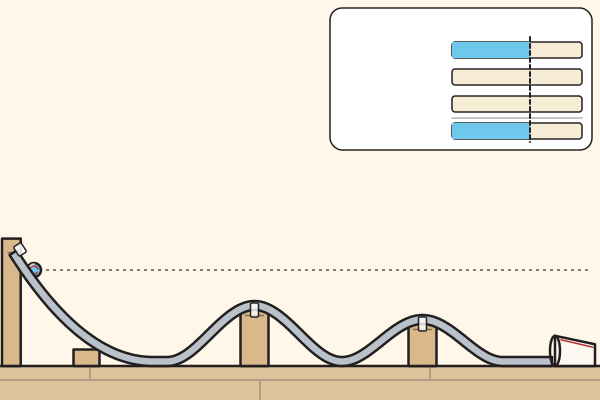
The drawing shows where it starts. It runs here once its script has loaded.El dibujo muestra dónde empieza. Funciona aquí una vez que carga su código.
Your challengeSu reto
- Let it go and get the marble over both hills and into the cup.Suéltela y haga que la canica pase las dos colinas y caiga en el vaso. Not done yet.Todavía no.
- Make a hill taller than the start and see where the marble turns back.Haga una colina más alta que la salida y vea dónde se regresa la canica. Not done yet.Todavía no.
- With friction on, find a hill lower than the start that the marble still cannot get over.Con la fricción puesta, encuentre una colina más baja que la salida que la canica aun así no puede pasar. Not done yet.Todavía no.
- With friction on, find the tallest second hill the marble can still get over: five centimeters taller and it would not reach the cup.Con la fricción puesta, encuentre la segunda colina más alta que la canica todavía puede pasar: cinco centímetros más y ya no llegaría al vaso. Not done yet.Todavía no.
Every challenge done. Now try it for real at home.Todos los retos logrados. Ahora pruébelo de verdad en casa.
Speed nowRapidez ahora
At the bottom of the first dip:Al fondo de la primera hondonada:
At the top of the first hill:En la cima de la primera colina:
At the top of the second hill:En la cima de la segunda colina:
The card shows the marble's energy as heights. Blue is its height now, the energy it has stored. Red is its motion, the lighter red the part that goes into spinning. Gray is what friction, a bump or the cup took. The last row puts them end to end, and they always reach the dashed mark, the energy its starting height gave it. The dashed line across the track is the start's height. Heights are measured from the floor, where the track lies on it. You can also drag the marble at the start or the top of a hill up and down.La tarjeta muestra la energía de la canica como alturas. El azul es su altura ahora, la energía que tiene guardada. El rojo es su movimiento, y el rojo más claro la parte que se va en girar. El gris es lo que se llevaron la fricción, un golpe o el vaso. La última fila las pone una tras otra, y siempre llegan a la marca punteada, la energía que le dio su altura de salida. La línea punteada que cruza la pista es la altura de la salida. Las alturas se miden desde el piso, donde la pista descansa sobre él. También puede arrastrar hacia arriba o hacia abajo la canica en la salida o la cima de una colina.
What is happeningQué está pasando
A marble held up high has energy stored in its height. Let it go and it trades height for speed: the lower it gets, the faster it rolls. As it climbs a hill it trades the speed back for height, and slows down.Una canica sostenida en lo alto tiene energía guardada en su altura. Al soltarla, cambia altura por rapidez: entre más baja, más rápido rueda. Al subir una colina vuelve a cambiar la rapidez por altura, y se frena.
It can never climb higher than where it started, because all the energy it has came from its starting height. With no friction at all it would climb back to exactly that height, and no higher.Nunca puede subir más alto que de donde salió, porque toda la energía que tiene vino de su altura de salida. Sin nada de fricción volvería a subir justo a esa altura, y no más.
On a real track, friction takes a share on every bit of track, so the marble reaches each hill with a little less. That is why every hill after the start must be lower than the start by at least what friction takes on the way to it, and the second hill lower again.En una pista real, la fricción se lleva una parte en cada tramo, así que la canica llega a cada colina con un poco menos. Por eso cada colina después de la salida debe ser más baja que la salida, por lo menos en lo que la fricción se lleva en el camino, y la segunda colina más baja todavía.
A rolling marble also spins, and the spin takes a share of its motion energy, so it rolls a little slower than something sliding with no friction would. And a hilltop that curves over too sharply for the marble's speed cannot hold it on: the marble leaves the track.Una canica que rueda también gira, y el giro se lleva una parte de su energía de movimiento, así que rueda un poco más despacio de lo que iría algo que se desliza sin fricción. Y una cima que se curva demasiado para la rapidez de la canica no la puede sostener: la canica se sale de la pista.
Things to tryCosas para probar
- Turn friction off and make the first hill exactly as tall as the start. What does the marble do at the top?Quite la fricción y haga la primera colina exactamente tan alta como la salida. ¿Qué hace la canica en la cima?
- With friction on, switch from foam to paper. On which track can the second hill be taller?Con la fricción puesta, cambie de espuma a papel. ¿En qué pista puede ser más alta la segunda colina?
- Start high and make both hills low. Why does the marble leave the track?Salga desde muy alto y haga las dos colinas bajas. ¿Por qué la canica se sale de la pista?
- Build one at home from foam pipe insulation and a paper cup, and see whether your hills match the screen's.Construya una en casa con espuma aislante para tubos y un vaso de papel, y vea si sus colinas coinciden con las de la pantalla.
A model: the marble is a solid glass ball rolling without slipping, so two parts in seven of its motion energy go into its spin. Friction takes the same share of height on every meter of track, five centimeters a meter on foam and half that on paper, values chosen for the model and not measured; a real track loses more at its joints, bumps and sharp bends. There is no air drag, the track does not sag, a marble that hops off the track always comes down in it, and one that lands harder than a drop of about five centimeters bounces out of the channel. The marble and the channel are drawn larger than life.Un modelo: la canica es una esfera maciza de vidrio que rueda sin resbalar, así que dos de cada siete partes de su energía de movimiento se van en el giro. La fricción quita la misma parte de altura en cada metro de pista, cinco centímetros por metro en la espuma y la mitad en el papel, valores elegidos para el modelo y no medidos; una pista real pierde más en sus uniones, golpes y curvas cerradas. No hay resistencia del aire, la pista no se hunde, una canica que da un saltito fuera de la pista siempre cae dentro de ella, y una que cae más fuerte que una caída de unos cinco centímetros rebota fuera del canal. La canica y el canal están dibujados más grandes que en la realidad.
Open the simulation on its own pageAbrir la simulación en su propia página
Your engineering challengeSu reto de ingeniería
Build a track with two hills that the marble only just gets over: make each hill as tall as you can and still see the marble land in the cup.Construya una pista con dos colinas que la canica apenas logre pasar: haga cada colina tan alta como pueda y que aun así la canica caiga en el vaso.
Make it an experimentConviértalo en un experimento
Science is about changing one thing and watching what happens. Write down your guess, your hypothesis, before you start.La ciencia se trata de cambiar una cosa y observar qué pasa. Escriba su suposición, su hipótesis, antes de empezar.
- Change only the start: let go from three heights and see which hills the marble gets over each time.Cambie solo la salida: suéltela desde tres alturas y vea qué colinas pasa la canica cada vez.
- Change only the first hill: raise it a little at a time until the marble turns back, and measure how much lower than the start it has to be.Cambie solo la primera colina: súbala poco a poco hasta que la canica se regrese, y mida cuánto más baja que la salida tiene que ser.
- Change only the track: build a second one from card stock folded into a channel, and compare how tall its hills can be.Cambie solo la pista: construya otra con cartulina doblada en forma de canal, y compare qué tan altas pueden ser sus colinas.
Use it, share it, adapt itÚsela, compártala, adáptela
The credit to copyEl crédito para copiar
Free BYRD, CC BY. “Build a marble coaster from foam pipe insulation” from the Byrd Academy STEM Curriculum by Byrd EDU, byrdathome.org.Free BYRD, CC BY. “Construya una montaña rusa de canicas con espuma aislante para tubos”, del Currículo STEM de Byrd Academy, de Byrd EDU, byrdathome.org.
This is free to use, share and adapt, even commercially, under the Creative Commons Attribution 4.0 International license (CC BY 4.0), with this credit. What Free BYRD means.Esto es libre de usar, compartir y adaptar, incluso con fines comerciales, bajo la licencia Creative Commons Atribución 4.0 Internacional (CC BY 4.0), con este crédito. Qué significa Free BYRD.