

ExploreExplorarBH-0079
Measure a tree with a stick and two shadowsMida un árbol con un palo y dos sombras
On a sunny day, stand a stick beside a tree or a flagpole, measure both shadows at the same moment, and find out how tall the tree is without climbing it.En un día soleado, pare un palo junto a un árbol o un asta de bandera, mida las dos sombras en el mismo momento y descubra qué tan alto es el árbol sin subirse a él.
- Ways in:Formas de empezar:
- Read, 4 minutesLeer, 4 minutos
- Do, 30 minutesHacer, 30 minutos
- Simulate, 10 minutesSimular, 10 minutos
- AgesEdades
- Every age. Best for ages 5 and up.Todas las edades. Ideal desde los 5 años.
- CostCosto
- Things already at homeCosas que ya hay en casa
The MESH'D components this item uses:Los componentes MESH'D que usa:ManufacturingManufacturaHolistic DesignDiseño integral
Do, about 30 minutesHacer, unos 30 minutos
Build it at homeConstrúyalo en casa
StepsPasos
- Pick a time when the shadows are long but the tree’s whole shadow still lies on open, level ground, such as the middle of the morning or the afternoon.Escoja una hora en que las sombras sean largas pero toda la sombra del árbol quede sobre terreno abierto y a nivel, como a media mañana o a media tarde.
- A grown-up pushes the stick straight up into the ground in full sun, away from the tree’s shadow. Look at it from two sides to check that it stands straight.Una persona adulta clava el palo derecho en el suelo a pleno sol, lejos de la sombra del árbol. Mírenlo desde dos lados para revisar que esté derecho.
- Measure how tall the stick stands above the ground, and write it down.Mida qué tan alto queda el palo sobre el suelo y anótelo.
- Mark the tip of the stick’s shadow with chalk or a pebble, and measure from the bottom of the stick to the mark.Marque la punta de la sombra del palo con tiza o una piedrita, y mida desde la base del palo hasta la marca.
- Right away, before the shadows move, mark the tip of the tree’s shadow. Measure from the trunk to the mark, then add half the trunk’s thickness, because the top of the tree stands over the middle of the trunk.Enseguida, antes de que las sombras se muevan, marque la punta de la sombra del árbol. Mida desde el tronco hasta la marca y luego sume la mitad del grosor del tronco, porque la punta del árbol queda sobre el centro del tronco.
- Divide the tree’s shadow by the stick’s shadow to find how many times longer it is. Multiply the stick’s height by that number: that is the tree’s height.Divida la sombra del árbol entre la sombra del palo para saber cuántas veces más larga es. Multiplique la altura del palo por ese número: esa es la altura del árbol.
- An hour later, measure both shadows again and work it out again. The shadows changed: did your answer?Una hora después, mida otra vez las dos sombras y vuelva a hacer la cuenta. Las sombras cambiaron: ¿cambió su respuesta?
- A grown-up pulls up the stick and carries it in pointing down.Una persona adulta saca el palo y lo lleva adentro con la punta hacia abajo.
What you needLo que necesita
- A sunny day, and a tree or a flagpole on flat, level ground with its whole shadow on open groundUn día soleado, y un árbol o un asta de bandera en un suelo plano y a nivel, con toda su sombra sobre terreno abierto
- A straight stick, a yardstick or a meter stickUn palo derecho o una regla de un metro
- A long tape measure, or a ball of string and a rulerUna cinta métrica larga, o un rollo de cordón y una regla
- Sidewalk chalk or a few pebbles to mark each shadow’s tipTiza para el piso o unas piedritas para marcar la punta de cada sombra
- Paper and a pencil, and a calculator or a phone if you likePapel y un lápiz, y una calculadora o un teléfono si quiere
- Hats and sunscreenSombreros y protector solar
Things already at home.Cosas que ya hay en casa.
Never look at the sun, not even with sunglasses: keep your eyes on the shadows, the ground and the tape. Wear hats and sunscreen and take breaks in the shade; the sun’s rays are strongest from ten in the morning to four in the afternoon in summer time. Measure only in a yard, a park or a schoolyard, away from streets and driveways, and never step into a street to reach a shadow’s tip. A grown-up pushes the stick into the ground and carries it pointing down, away from faces. Never climb the tree: the shadows do the climbing for you.Nunca mire el sol, ni siquiera con lentes de sol: mantenga la vista en las sombras, el suelo y la cinta. Usen sombrero y protector solar y descansen a la sombra; los rayos del sol son más fuertes de las diez de la mañana a las cuatro de la tarde en horario de verano. Midan solo en un patio, un parque o el patio de una escuela, lejos de calles y entradas de autos, y nunca se metan a la calle para alcanzar la punta de una sombra. Una persona adulta clava el palo en el suelo y lo lleva con la punta hacia abajo, lejos de las caras. Nunca se suban al árbol: las sombras suben por ustedes.
Read, 4 minutesLeer, 4 minutos
The big ideaLa gran idea
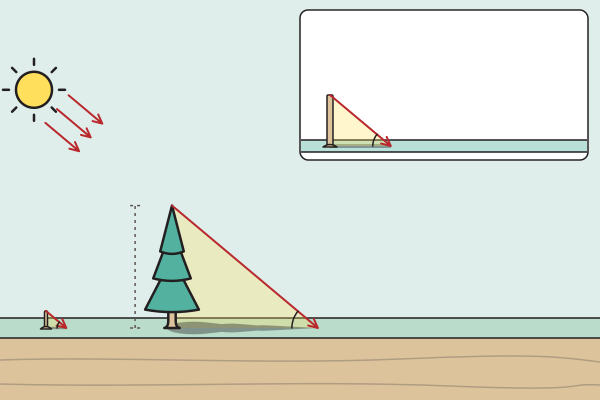
On a sunny day, everything standing straight up casts a shadow that points away from the sun. The sun is so far away that its light reaches your yard in parallel lines, so at any one moment every upright thing’s shadow is the same number of times as long as the thing is tall. That lets you measure something too tall to reach. Measure a stick and its shadow, then measure the tree’s shadow at the same moment. If the tree’s shadow is eight times as long as the stick’s, the tree is eight times as tall as the stick. The stick, its shadow and the sunbeam make a small triangle, and the tree, its shadow and the sunbeam make a big one with the same shape. Triangles like these are called similar triangles. As the day goes on, every shadow changes, so measure both shadows together.En un día soleado, todo lo que está parado derecho proyecta una sombra que apunta en dirección contraria al sol. El sol está tan lejos que su luz llega a su patio en líneas paralelas, así que en un mismo momento la sombra de cada cosa derecha es el mismo número de veces más larga que su altura. Eso le permite medir algo demasiado alto para alcanzarlo. Mida un palo y su sombra, y luego mida la sombra del árbol en ese mismo momento. Si la sombra del árbol es ocho veces más larga que la del palo, el árbol es ocho veces más alto que el palo. El palo, su sombra y el rayo de sol forman un triángulo pequeño, y el árbol, su sombra y el rayo de sol forman uno grande con la misma forma. A los triángulos así se les llama triángulos semejantes. Conforme pasa el día, cada sombra cambia, así que mida las dos sombras juntas.
Simulate, 10 minutesSimular, 10 minutos
Measure a tree by its shadowMida un árbol por su sombra
Stand a stick beside a tree or a flagpole in the sun, measure both shadows at the same moment, and work out how tall the tall one is without ever climbing it.Pare un palo junto a un árbol o un asta de bandera al sol, mida las dos sombras en el mismo momento y calcule qué tan alto es el más alto sin subirse nunca.
The drawing shows where it starts. It runs here once its script has loaded.El dibujo muestra dónde empieza. Funciona aquí una vez que carga su código.
Your challengeSu reto
- Measure the stick’s shadow and the tree’s shadow without moving the sun, and read how tall the tree is.Mida la sombra del palo y la sombra del árbol sin mover el sol, y lea qué tan alto es el árbol. Not done yet.Todavía no.
- Move the sun and measure both shadows of the same tree again. The shadows change: does the answer?Mueva el sol y vuelva a medir las dos sombras del mismo árbol. Las sombras cambian: ¿cambia la respuesta? Not done yet.Todavía no.
- Find how high the sun must be for the stick’s shadow to be exactly as long as the stick is tall.Encuentre qué tan alto debe estar el sol para que la sombra del palo sea exactamente tan larga como alto es el palo. Not done yet.Todavía no.
- Measure one shadow, move the sun, then measure the other. How far off is the answer? Then measure it right again.Mida una sombra, mueva el sol y luego mida la otra. ¿Qué tan desviada sale la respuesta? Luego vuelva a medirla bien. Not done yet.Todavía no.
Every challenge done. Now try it for real at home.Todos los retos logrados. Ahora pruébelo de verdad en casa.
The stick’s shadow:La sombra del palo:
The tree’s shadow:La sombra del árbol:
How many times longer:Cuántas veces más larga:
So it is this tall, the stick times that:Así que mide esto, el palo por eso:
Seen from the side, the sun on the left. Every shadow points away from the sun. The red lines are sunbeams that just graze each top and land at the tip of its shadow; they are parallel because the sun is so far away. Each yellow triangle is a thing, its shadow and its sunbeam, and the arcs mark the same angle in both. A tape measure stays where it was laid. The box at the top shows the stick three times bigger.Visto de lado, con el sol a la izquierda. Cada sombra apunta en dirección contraria al sol. Las líneas rojas son rayos de sol que apenas rozan cada punta y caen en la punta de su sombra; son paralelos porque el sol está muy lejos. Cada triángulo amarillo es una cosa, su sombra y su rayo de sol, y los arcos marcan el mismo ángulo en los dos. Una cinta métrica se queda donde se tendió. El cuadro de arriba muestra el palo tres veces más grande.
What is happeningQué está pasando
The sun is so far away that its light reaches a yard in parallel lines. A thing standing straight up blocks some of that light, and its shadow points straight away from the sun. The lower the sun, the longer every shadow.El sol está tan lejos que su luz llega a un patio en líneas paralelas. Una cosa parada derecha tapa parte de esa luz, y su sombra apunta justo en dirección contraria al sol. Mientras más bajo está el sol, más larga es cada sombra.
Each thing, its shadow and the sunbeam that just grazes its top make a right triangle. The beams are parallel, so the stick’s triangle and the tree’s have the same angles: the same shape in two sizes. Mathematicians call them similar triangles. So if the tree’s shadow is eight times as long as the stick’s, the tree is eight times as tall as the stick.Cada cosa, su sombra y el rayo de sol que apenas roza su punta forman un triángulo rectángulo. Los rayos son paralelos, así que el triángulo del palo y el del árbol tienen los mismos ángulos: la misma forma en dos tamaños. En matemáticas se llaman triángulos semejantes. Así que si la sombra del árbol es ocho veces más larga que la del palo, el árbol es ocho veces más alto que el palo.
For example, a stick one meter tall casts a shadow one and a quarter meters long, and at the same moment the tree’s shadow is ten meters long. Ten is eight times one and a quarter, so the tree is eight times one meter: eight meters tall.Por ejemplo, un palo de un metro proyecta una sombra de un metro y cuarto, y en ese mismo momento la sombra del árbol mide diez metros. Diez es ocho veces uno y cuarto, así que el árbol mide ocho veces un metro: ocho metros.
The two shadows must be measured at the same time. As the sun climbs, every shadow shrinks, but all of them together, so the answer stays the same. Measure one shadow, wait while the sun moves, then measure the other, and the answer goes wrong. When the sun is halfway up the sky, forty-five degrees, every shadow is exactly as long as its thing is tall.Las dos sombras deben medirse al mismo tiempo. Al subir el sol, cada sombra se encoge, pero todas juntas, así que la respuesta no cambia. Si mide una sombra, espera mientras el sol se mueve y luego mide la otra, la respuesta sale mal. Cuando el sol está a la mitad del cielo, a cuarenta y cinco grados, cada sombra mide exactamente lo mismo que la altura de su cosa.
Things to tryCosas para probar
- Make the stick twice as tall. What happens to its shadow? Does the tree’s answer change?Haga el palo el doble de alto. ¿Qué le pasa a su sombra? ¿Cambia la respuesta del árbol?
- Put the sun high and use the shortest stick. Its shadow is tiny: why is a tiny shadow hard to measure well?Ponga el sol alto y use el palo más corto. Su sombra es diminuta: ¿por qué es difícil medir bien una sombra diminuta?
- Measure the flagpole, then press Another one to measure and do it again. Is the ratio of the shadows the same for every one at the same sun?Mida el asta de bandera, luego presione Otro para medir y hágalo de nuevo. ¿Es igual la razón de las sombras para todos con el mismo sol?
- On a sunny day, stand a meter stick straight up beside a tree, measure both shadows at once with a tape measure, and work it out yourself.En un día soleado, pare derecha una regla de un metro junto a un árbol, mida las dos sombras a la vez con una cinta métrica y haga usted la cuenta.
A model: the ground is flat and level, and the stick, the tree and the flagpole stand straight up. The sun’s light is drawn as parallel lines; the real sun is a disc about half a degree wide, so a real shadow’s edge, most of all the tip of a long one, is a little blurred. The tree has a pointed top: the tip of a round-topped tree’s shadow is not the shadow of its highest point, so the same method makes a round tree come out a little too tall. Shadows are measured to the nearest centimeter. The drawing is to one scale, its ground squeezed in depth, with the stick and the pole drawn thicker than life.Un modelo: el suelo es plano y está a nivel, y el palo, el árbol y el asta están parados derechos. La luz del sol se dibuja como líneas paralelas; el sol real es un disco de como medio grado de ancho, así que el borde de una sombra real, sobre todo la punta de una sombra larga, se ve un poco borroso. El árbol tiene la punta en pico: la punta de la sombra de un árbol de copa redonda no es la sombra de su parte más alta, así que el mismo método hace que un árbol redondo salga un poco más alto de lo que es. Las sombras se miden al centímetro más cercano. El dibujo está a una sola escala, con el suelo achatado en profundidad, y el palo y el asta se dibujan más gruesos que en la realidad.
Open the simulation on its own pageAbrir la simulación en su propia página
Your engineering challengeSu reto de ingeniería
Measure the same tree in the middle of the morning and again in the afternoon. The shadows will be different lengths. Will your two answers for the tree’s height match?Mida el mismo árbol a media mañana y otra vez en la tarde. Las sombras tendrán largos distintos. ¿Coincidirán sus dos respuestas para la altura del árbol?
Make it an experimentConviértalo en un experimento
Science is about changing one thing and watching what happens. Write down your guess, your hypothesis, before you start.La ciencia se trata de cambiar una cosa y observar qué pasa. Escriba su suposición, su hipótesis, antes de empezar.
- Change only the time: measure both shadows, then again an hour later, and again in the afternoon. Do the shadows change? Does the height you work out?Cambie solo la hora: mida las dos sombras, luego otra vez una hora después y otra vez en la tarde. ¿Cambian las sombras? ¿Cambia la altura que calcula?
- Change only the stick: use a stick about twice as tall. Its shadow grows too. Does the tree’s answer stay the same?Cambie solo el palo: use un palo como del doble de alto. Su sombra también crece. ¿Se queda igual la respuesta del árbol?
- Change only what you measure: work out the height of a flagpole or the top bar of a swing set the same way, and check the swing set with the tape measure.Cambie solo lo que mide: calcule de la misma manera la altura de un asta de bandera o de la barra de arriba de un columpio, y compruebe la del columpio con la cinta métrica.
Use it, share it, adapt itÚsela, compártala, adáptela
The credit to copyEl crédito para copiar
Free BYRD, CC BY. “Measure a tree with a stick and two shadows” from the Byrd Academy STEM Curriculum by Byrd EDU, byrdathome.org.Free BYRD, CC BY. “Mida un árbol con un palo y dos sombras”, del Currículo STEM de Byrd Academy, de Byrd EDU, byrdathome.org.
This is free to use, share and adapt, even commercially, under the Creative Commons Attribution 4.0 International license (CC BY 4.0), with this credit. What Free BYRD means.Esto es libre de usar, compartir y adaptar, incluso con fines comerciales, bajo la licencia Creative Commons Atribución 4.0 Internacional (CC BY 4.0), con este crédito. Qué significa Free BYRD.
Keep goingSiga adelante
What to do nextQué hacer después
Make it harderHágalo más difícil
Every half hour from morning to afternoon, measure both shadows and work out the tree’s height, and keep a table. When are the shadows shortest, and how close do your answers stay to each other? A tree with a round top may come out a little tall: can you see why from where the tip of its shadow comes from?Cada media hora, de la mañana a la tarde, mida las dos sombras, calcule la altura del árbol y lleve una tabla. ¿Cuándo son más cortas las sombras, y qué tan parecidas se mantienen sus respuestas? Un árbol de copa redonda puede salir un poco más alto: ¿puede ver por qué, según de dónde sale la punta de su sombra?
For a younger onePara alguien más pequeño
A younger child can mark the shadows’ tips with pebbles, lay a piece of string along the stick’s shadow, and count how many string lengths fit along the tree’s shadow. The tree is about that many sticks tall.La niña o el niño más pequeño puede marcar las puntas de las sombras con piedritas, poner un cordón a lo largo de la sombra del palo y contar cuántos largos de cordón caben a lo largo de la sombra del árbol. El árbol mide más o menos esa cantidad de palos.
Try this nextPruebe esto después
Measure a tree by its shadowMida un árbol por su sombra
Stand a stick beside a tree or a flagpole in the sun, measure both shadows at the same moment, and work out how tall the tall one is without ever climbing it.Pare un palo junto a un árbol o un asta de bandera al sol, mida las dos sombras en el mismo momento y calcule qué tan alto es el más alto sin subirse nunca.
- Ways in:Formas de empezar:
- SimulateSimular
Best for ages 5 and upIdeal desde los 5 años
ManufacturingManufacturaDesignDiseño
Free BYRD, CC BYSimulationSimulación
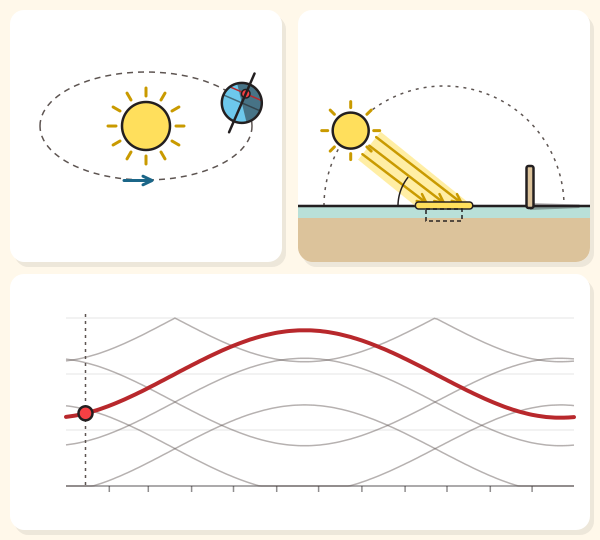 SIM-0012
 Why we have seasonsPor qué hay estaciones
Pick a place and a day, and see how the tilted Earth sets the noon sun’s height, the length of the day and the sunlight each square of ground gets.Elija un lugar y un día, y vea cómo la Tierra inclinada fija la altura del sol del mediodía, la duración del día y la luz que recibe cada cuadro de suelo.
- Ways in:Formas de empezar:
- SimulateSimular
Best for ages 5 and upIdeal desde los 5 años
DesignDiseño
Free BYRD, CC BYSimulationSimulación
Fold one paper fence into the biggest penDoble una cerca de papel en el corral más grande
Cut a paper fence twenty-four squares long, stand it on grid paper as one rectangle after another, and count the squares inside. Then push one side against a book and see the pen hold twice as many.Corte una cerca de papel de veinticuatro cuadros de largo, párela sobre papel cuadriculado en un rectángulo tras otro y cuente los cuadros de adentro. Luego pegue un lado a un libro y vea cómo el corral encierra el doble.
- Ways in:Formas de empezar:
- ReadLeer
- DoHacer
- SimulateSimular
Best for ages 5 and upIdeal desde los 5 años
ManufacturingManufacturaDesignDiseño
Free BYRD, CC BYHome activityActividad en casa
Keep a Moon diary for a monthLleve un diario de la Luna durante un mes
Draw the Moon's shape and where it sits in the sky on every day you can find it for a month, and discover the pattern that repeats about every twenty-nine and a half days.Dibuje la forma de la Luna y dónde está en el cielo cada día que la encuentre durante un mes, y descubra el patrón que se repite más o menos cada veintinueve días y medio.
- Ways in:Formas de empezar:
- ReadLeer
- DoHacer
- SimulateSimular
Best for ages 5 and upIdeal desde los 5 años
SoftwareSoftwareDesignDiseño
Free BYRD, CC BYHome activityActividad en casa