

SimulationsSimulacionesSIM-0030
Simulate, 10 minutesSimular, 10 minutos
Roll the dice: what chance looks likeTire los dados: cómo se ve la probabilidad
Roll one die or two, once, ten times or a thousand, and watch your tally settle onto the shape that chance predicts.Tire uno o dos dados, una vez, diez veces o mil, y vea cómo su conteo se acomoda a la forma que predice la probabilidad.
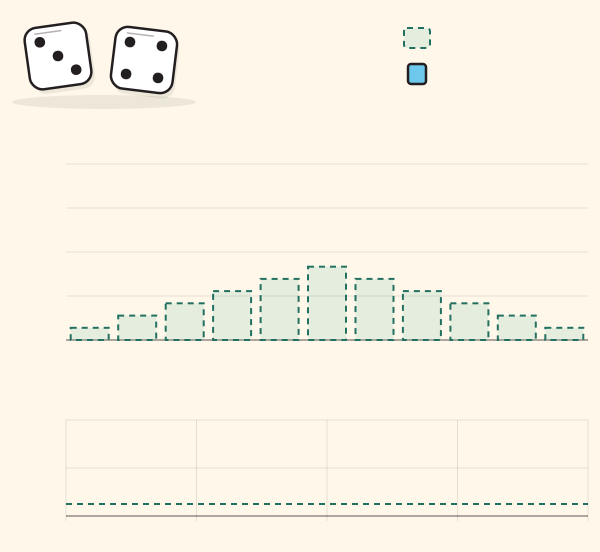
The drawing shows where it starts. It runs here once its script has loaded.El dibujo muestra dónde empieza. Funciona aquí una vez que carga su código.
Your challengeSu reto
- Roll ten times and compare the bars with the green boxes.Tire diez veces y compare las barras con las cajas verdes. Not done yet.Todavía no.
- Roll two dice at least a hundred times. Which sum comes up most?Tire dos dados al menos cien veces. ¿Qué suma sale más? Not done yet.Todavía no.
- Roll until the bars are off from the expected shape by less than five percent.Tire hasta que las barras estén a menos del cinco por ciento de la forma esperada. Not done yet.Todavía no.
- With one die, find a run of ten rolls with no six at all.Con un dado, encuentre una serie de diez tiradas sin ningún seis. Not done yet.Todavía no.
Every challenge done. Now try it for real at home.Todos los retos logrados. Ahora pruébelo de verdad en casa.
Last rollÚltima tirada
Comes up most so farLa que más ha salido
Off from the expected shapeLejos de la forma esperada
Run numberNúmero de serie
A green dashed box is the expected shape: how tall each bar would be if every result came up exactly as often as its chance says. A blue bar is your rolls, as a share of all of them. The red line is how far off the bars are: the share of rolls that would have to move to another bar to match the green boxes.Una caja verde punteada es la forma esperada: qué tan alta sería cada barra si cada resultado saliera exactamente tan seguido como dice su probabilidad. Una barra azul son sus tiradas, como parte del total. La línea roja es qué tan lejos están las barras: la parte de las tiradas que tendría que pasar a otra barra para igualar las cajas verdes.
What is happeningQué está pasando
A fair die gives each face the same chance: one in six. If you could roll forever, each face would come up on one roll out of every six, and the tally would be flat.Un dado justo le da a cada cara la misma probabilidad: una entre seis. Si pudiera tirar para siempre, cada cara saldría en una de cada seis tiradas, y el conteo sería plano.
Two dice are different. They can land in thirty-six ways. Six of those ways add up to seven (one and six, two and five, three and four, and each of those turned around), but only one way makes two and only one makes twelve. So the expected shape is a triangle with seven at the top.Dos dados son distintos. Pueden caer de treinta y seis maneras. Seis de esas maneras suman siete (uno y seis, dos y cinco, tres y cuatro, y cada una al revés), pero solo una da dos y solo una da doce. Por eso la forma esperada es un triángulo con el siete arriba.
A few rolls almost never look like the expected shape: luck decides a lot. As the rolls pile up, each bar’s share of all the rolls comes closer and closer to its chance. That is the law of large numbers. The counts keep wandering, but as a share of more and more rolls, the wandering matters less and less.Unas pocas tiradas casi nunca se parecen a la forma esperada: la suerte decide mucho. Al juntarse las tiradas, la parte de cada barra se acerca más y más a su probabilidad. Esa es la ley de los grandes números. Los conteos siguen variando, pero como parte de cada vez más tiradas, esa variación importa cada vez menos.
How far off the bars are is measured as the share of rolls that would have to move to another bar for the bars to match the expected shape exactly. Ten rolls are usually far off. A thousand rolls are usually off by only a few percent.Qué tan lejos están las barras se mide como la parte de las tiradas que tendría que pasar a otra barra para que las barras igualen exactamente la forma esperada. Diez tiradas suelen estar muy lejos. Mil tiradas suelen estar a solo unos pocos por ciento.
Things to tryCosas para probar
- Roll two dice ten times, then try another run and roll ten again. Do the two runs look alike? Now do the same with a thousand rolls.Tire dos dados diez veces, luego pruebe otra serie y tire diez más. ¿Se parecen las dos series? Ahora haga lo mismo con mil tiradas.
- Slide the rolls from one all the way to ten thousand and watch the red line fall.Deslice las tiradas desde una hasta diez mil y observe cómo baja la línea roja.
- At the same number of rolls, switch between one die and two dice and compare the shapes.Con el mismo número de tiradas, cambie entre un dado y dos dados y compare las formas.
- Roll two real dice thirty-six times at home and tally the sums. How close did you come to the triangle?Tire dos dados de verdad treinta y seis veces en casa y cuente las sumas. ¿Qué tanto se acercó al triángulo?
This is a model. The rolls come from a computer recipe that only looks random, and each run always gives the same rolls. Real dice are a little uneven and real throws are messy, but with fair dice you should see the same shapes.Este es un modelo. Las tiradas vienen de una receta de computadora que solo parece al azar, y cada serie siempre da las mismas tiradas. Los dados reales son un poco disparejos y los tiros reales son desordenados, pero con dados justos debería ver las mismas formas.
Use it, share it, adapt itÚsela, compártala, adáptela
The credit to copyEl crédito para copiar
Free BYRD, CC BY. “Roll the dice: what chance looks like” from the Byrd Academy STEM Curriculum by Byrd EDU, byrdathome.org.Free BYRD, CC BY. “Tire los dados: cómo se ve la probabilidad”, del Currículo STEM de Byrd Academy, de Byrd EDU, byrdathome.org.
This is free to use, share and adapt, even commercially, under the Creative Commons Attribution 4.0 International license (CC BY 4.0), with this credit. What Free BYRD means.Esto es libre de usar, compartir y adaptar, incluso con fines comerciales, bajo la licencia Creative Commons Atribución 4.0 Internacional (CC BY 4.0), con este crédito. Qué significa Free BYRD.