

SimulationsSimulacionesSIM-0024
Simulate, 6 minutesSimular, 6 minutos
Newton's cannonballLa bala de cañón de Newton
Fire a cannonball sideways from a mountain at the edge of space. Too slow and it falls back; fast enough and it falls all the way around the Earth.Dispare una bala de cañón de lado desde una montaña en el borde del espacio. Muy lenta, cae de vuelta; lo bastante rápida, cae alrededor de toda la Tierra.
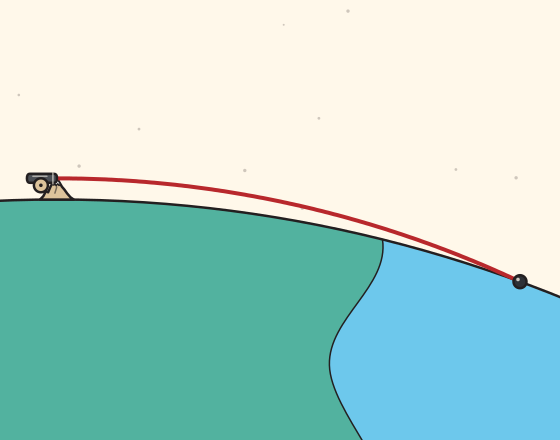
The drawing shows where it starts. It runs here once its script has loaded.El dibujo muestra dónde empieza. Funciona aquí una vez que carga su código.
Your challengeSu reto
- Fire the ball fast enough that it goes all the way around the Earth without landing.Dispare la bola tan rápido que dé la vuelta a toda la Tierra sin caer. Not done yet.Todavía no.
- Find the speed that makes the path a circle.Encuentre la rapidez que hace del camino un círculo. Not done yet.Todavía no.
- Stretch the path into an ellipse that climbs more than ten thousand kilometers above the ground.Estire el camino en una elipse que suba más de diez mil kilómetros sobre el suelo. Not done yet.Todavía no.
- Find the slowest speed that lets the ball escape the Earth for good.Encuentre la rapidez más lenta con la que la bola se escapa de la Tierra para siempre. Not done yet.Todavía no.
Every challenge done. Now try it for real at home.Todos los retos logrados. Ahora pruébelo de verdad en casa.
Height of the ball above the groundAltura de la bola sobre el suelo
Speed of the ballRapidez de la bola
The path:El camino:
Highest point:Punto más alto:
Time:Tiempo:
The Earth and the mountain are drawn to scale; the cannon and the ball are drawn much bigger than life. The red line is the ball's path. On the ball, the blue arrow is its speed and direction and the red arrow is gravity pulling it toward the center of the Earth, each as long as its size.La Tierra y la montaña están dibujadas a escala; el cañón y la bola, mucho más grandes que en la realidad. La línea roja es el camino de la bola. Sobre la bola, la flecha azul es su rapidez y dirección, y la flecha roja es la gravedad que la jala hacia el centro de la Tierra, cada una tan larga como su tamaño.
What is happeningQué está pasando
Gravity pulls the cannonball toward the center of the Earth the whole time, so the ball is always falling. Fired slowly, it falls back to the ground near the mountain. Fired faster, it travels farther sideways while it falls, so it lands farther away.La gravedad jala la bala hacia el centro de la Tierra todo el tiempo, así que la bala siempre está cayendo. Disparada despacio, cae de vuelta al suelo cerca de la montaña. Disparada más rápido, avanza más de lado mientras cae, así que cae más lejos.
The Earth is round, so the ground curves away beneath a ball that flies far. At about seven point nine kilometers a second, near the ground, the ground curves away just as fast as the ball falls. The ball keeps falling but never lands: it goes around and around. That is an orbit, and it is how the space station stays up.La Tierra es redonda, así que el suelo se curva bajo una bala que vuela lejos. A unos siete punto nueve kilómetros por segundo, cerca del suelo, el suelo se curva igual de rápido de lo que la bala cae. La bala sigue cayendo pero nunca toca el suelo: da vueltas y vueltas. Eso es una órbita, y así se mantiene arriba la estación espacial.
Faster than that, the ball climbs away on the far side, slows down as gravity pulls back on it, then falls back faster and faster: its path is a stretched circle called an ellipse. Gravity gets weaker far from the Earth, and at about eleven point two kilometers a second it can never pull the ball back. The ball escapes.Más rápido que eso, la bala sube alejándose por el otro lado, se frena mientras la gravedad la jala y luego cae cada vez más rápido: su camino es un círculo estirado llamado elipse. La gravedad es más débil lejos de la Tierra, y a unos once punto dos kilómetros por segundo ya nunca puede regresar la bala. La bala se escapa.
Newton's cannonball is a thought experiment drawn more than three hundred years ago, when the law of gravity was first written down. The same pull that drops an apple keeps the Moon going around the Earth.La bala de cañón de Newton es un experimento mental dibujado hace más de trescientos años, cuando se escribió por primera vez la ley de la gravedad. El mismo jalón que hace caer una manzana mantiene a la Luna dando vueltas alrededor de la Tierra.
Things to tryCosas para probar
- Start slow and speed up one step at a time. Watch where the ball lands each time.Empiece despacio y aumente la rapidez un paso a la vez. Observe dónde cae la bola cada vez.
- Find an ellipse and watch the blue arrow: where is the ball fastest, and where is it slowest?Encuentre una elipse y observe la flecha azul: ¿dónde va más rápida la bola y dónde va más lenta?
- Choose the whole Earth and compare a circle with an ellipse. How long does each take to go around?Elija toda la Tierra y compare un círculo con una elipse. ¿Cuánto tarda cada uno en dar la vuelta?
- Throw a ball across a yard, softly and then harder. A harder throw lands farther away, just like the cannonball.Lance una pelota en el patio, suave y luego más fuerte. Un lanzamiento más fuerte cae más lejos, igual que la bala de cañón.
The path comes from Newton's law of gravity worked out step by step, with the Earth's real size and pull. It leaves out the air, which would slow and burn a real ball, the Earth's spin, and the pull of the Moon and the Sun. No real mountain is this tall, and the cannon and ball are drawn much bigger than life.El camino sale de la ley de la gravedad de Newton calculada paso a paso, con el tamaño y el jalón reales de la Tierra. No toma en cuenta el aire, que frenaría y quemaría una bala real, el giro de la Tierra ni el jalón de la Luna y el Sol. Ninguna montaña real es tan alta, y el cañón y la bola están dibujados mucho más grandes que en la realidad.
Use it, share it, adapt itÚsela, compártala, adáptela
The credit to copyEl crédito para copiar
Free BYRD, CC BY. “Newton's cannonball” from the Byrd Academy STEM Curriculum by Byrd EDU, byrdathome.org.Free BYRD, CC BY. “La bala de cañón de Newton”, del Currículo STEM de Byrd Academy, de Byrd EDU, byrdathome.org.
This is free to use, share and adapt, even commercially, under the Creative Commons Attribution 4.0 International license (CC BY 4.0), with this credit. What Free BYRD means.Esto es libre de usar, compartir y adaptar, incluso con fines comerciales, bajo la licencia Creative Commons Atribución 4.0 Internacional (CC BY 4.0), con este crédito. Qué significa Free BYRD.