
Virtual toursRecorridos virtualesTOUR-0004

TOUR-0004

Virtual tour, 10 minutes, 8 stopsRecorrido virtual, 10 minutos, 8 paradas

Out to space: from the backyard to the far edgeHacia el espacio: del patio al borde lejano

Start with the sky over your backyard, ride a rocket up to the space station, then travel past the Moon, the Sun and every planet to the two Voyager spacecraft at the Sun's far edge.Empiece con el cielo sobre su patio, suba en un cohete hasta la estación espacial y luego viaje más allá de la Luna, el Sol y todos los planetas hasta las dos naves Voyager en el borde lejano del Sol.

AgesEdades
Every age. Best for ages 5 and up.Todas las edades. Ideal desde los 5 años.
TopicTema
Earth, sky and spaceTierra, cielo y espacio
HowCómo
Tap the ring, or use Go deeper or the arrow keys.Toque el anillo, o use Más adentro o las flechas del teclado.

The MESH'D components this tour shows:Los componentes MESH'D que muestra:Holistic DesignDiseño integral

The stopsLas paradas

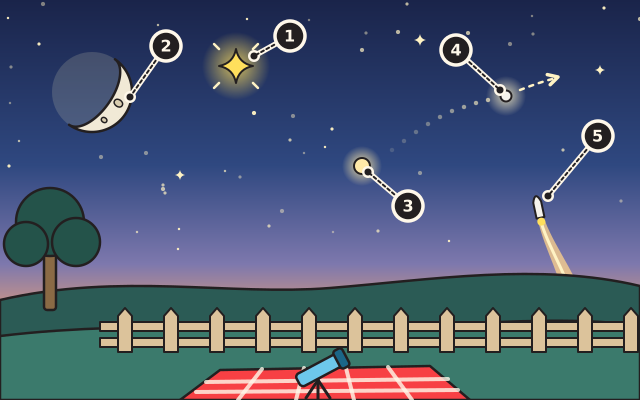
Look forBusque

  1. A star that twinklesUna estrella que titila
  2. The MoonLa Luna
  3. A planet, shining steadyUn planeta de luz estable
  4. The space station, gliding acrossLa estación espacial, cruzando el cielo
  5. A rocket climbing far awayUn cohete que sube a lo lejos

Stop 1Parada 1

The backyard skyEl cielo desde el patio

Step outside on a clear evening and look up. Stars twinkle: they are so far away that they are only points of light, and ripples in our air bend that light. Planets are much closer, here in our solar system, so they shine with a steadier light.Salga en una noche despejada y mire hacia arriba. Las estrellas titilan: están tan lejos que son solo puntos de luz, y las ondas del aire desvían esa luz. Los planetas están mucho más cerca, aquí en nuestro sistema solar, así que brillan con una luz más estable.

A very bright dot gliding steadily across the sky, with no blinking lights, may be the space station, still lit by the Sun high above you. Just after sunset you might even spot a rocket climbing.Un punto muy brillante que cruza el cielo con calma, sin luces que parpadeen, puede ser la estación espacial, iluminada todavía por el Sol allá arriba. Justo después de la puesta del sol, hasta podría ver un cohete subiendo.
Try this at homePruébelo en casaKeep a Moon diary for a monthLleve un diario de la Luna durante un mes

Learn more: NASA Science, What's Up: June skywatching tips from NASAMás información: NASA Science, What's Up: June skywatching tips from NASA

Next: The launchSiguiente: El despegue

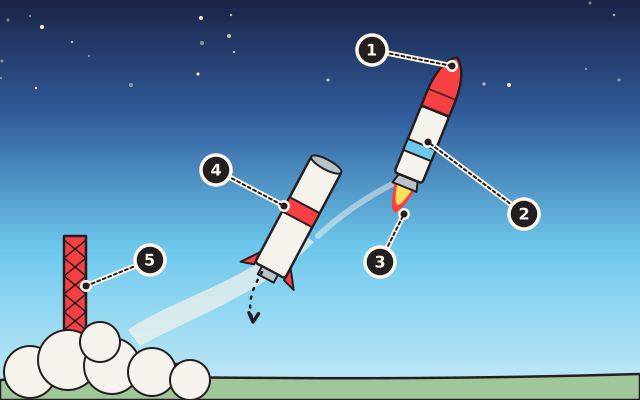
Look forBusque

  1. The payload on topLa carga útil, arriba
  2. The second stage, firingLa segunda etapa, encendida
  3. The flame that makes the thrustLa llama que produce el empuje
  4. The empty first stage, falling awayLa primera etapa vacía, desprendiéndose
  5. The launch padLa plataforma de lanzamiento

Stop 2Parada 2

The launchEl despegue

A rocket's engines make thrust, a push that has to be bigger than the rocket's weight. At liftoff, most of that weight is propellant, the stuff it burns. As the propellant burns away, the rocket ends up hauling nearly empty tanks.Los motores de un cohete producen empuje, una fuerza que tiene que ser mayor que el peso del cohete. Al despegar, casi todo ese peso es propelente, lo que se quema. Mientras el propelente se consume, el cohete termina cargando tanques casi vacíos.

So most rockets drop part of themselves on the way up. This is called staging. The big first stage burns until its propellant is gone, then falls away, and a smaller second stage fires and carries the payload into orbit.Por eso la mayoría de los cohetes sueltan una parte de sí mismos al subir. Esto se llama separación de etapas. La primera etapa, la grande, se quema hasta agotar su propelente y se desprende, y una segunda etapa más pequeña se enciende y lleva la carga útil hasta la órbita.

Try this at homePruébelo en casaWater bottle rocketCohete de botella con agua

Learn more: NASA Glenn Research Center, Booster stagingMás información: NASA Glenn Research Center, Booster staging

Next: Low Earth orbitSiguiente: La órbita baja

Look forBusque

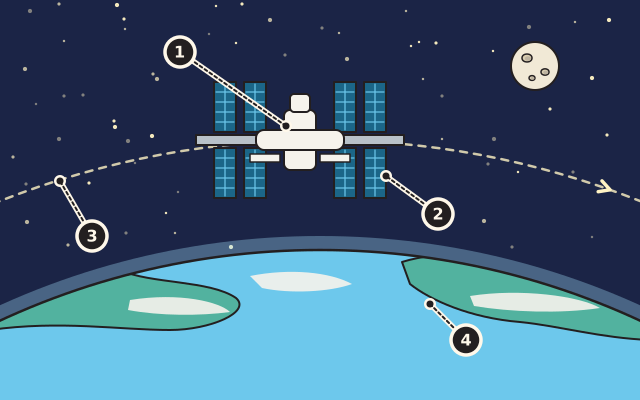
  1. The space stationLa estación espacial
  2. Its solar panelsSus paneles solares
  3. Its path around EarthSu trayectoria alrededor de la Tierra
  4. Earth belowLa Tierra, abajo

Stop 3Parada 3

Low Earth orbitLa órbita baja

The space station flies in low Earth orbit, about four hundred kilometers up. It circles the whole planet about every ninety minutes.La estación espacial vuela en la órbita baja de la Tierra, a unos cuatrocientos kilómetros de altura. Le da la vuelta a todo el planeta más o menos cada noventa minutos.

From up there the view is spectacular. Crews aboard have taken more than three and a half million photographs of Earth: volcanoes erupting, cities, rivers, lakes and weather. Those pictures help scientists study the health and future of our planet.Desde allá arriba la vista es espectacular. Las tripulaciones han tomado más de tres millones y medio de fotografías de la Tierra: volcanes en erupción, ciudades, ríos, lagos y el tiempo. Esas imágenes ayudan a los científicos a estudiar la salud y el futuro de nuestro planeta.

Try this at homePruébelo en casaNewton's cannonballLa bala de cañón de Newton

Learn more: NASA, Observing our planet from low Earth orbitMás información: NASA, Observing our planet from low Earth orbit

Next: The MoonSiguiente: La Luna

Look forBusque

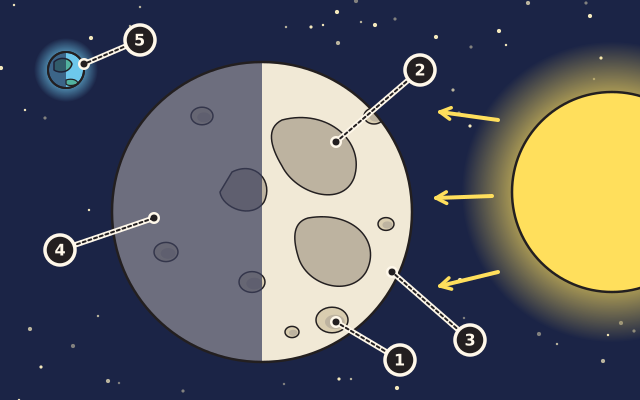
  1. A craterUn cráter
  2. A dark sea of old lavaUn mar oscuro de lava antigua
  3. The side the Sun lightsEl lado que ilumina el Sol
  4. The night sideEl lado de noche
  5. Earth, far awayLa Tierra, a lo lejos

Stop 4Parada 4

The MoonLa Luna

The Moon is Earth's only natural satellite, an average of about three hundred eighty-four thousand kilometers away. About thirty Earths could fit in the gap between us.La Luna es el único satélite natural de la Tierra y está, en promedio, a unos trescientos ochenta y cuatro mil kilómetros. En ese espacio cabrían unas treinta Tierras.

It spins at the same rate that it circles us, so we always see the same side. Its craters were made by asteroids, meteorites and comets, and its dark patches are old basins filled with lava. As it travels, sunlight falls on different parts of it, which is why we see its phases.Gira al mismo ritmo con que nos da la vuelta, así que siempre vemos el mismo lado. Sus cráteres los hicieron asteroides, meteoritos y cometas, y sus manchas oscuras son cuencas antiguas llenas de lava. Mientras viaja, la luz del Sol cae sobre distintas partes de ella, y por eso vemos sus fases.

Try this at homePruébelo en casaThe phases of the MoonLas fases de la Luna

Learn more: NASA Science, Moon factsMás información: NASA Science, Moon facts

Next: The SunSiguiente: El Sol

Look forBusque

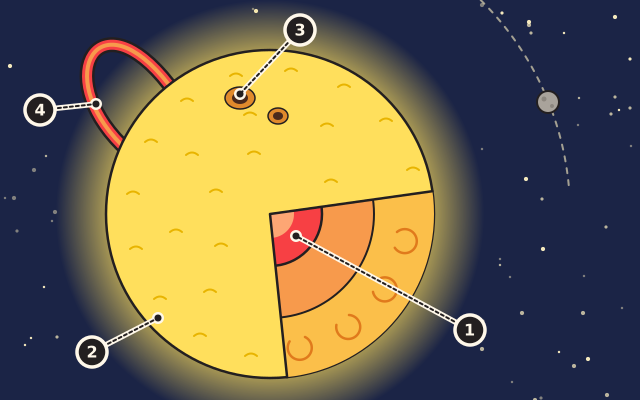
  1. The coreEl núcleo
  2. The surface we seeLa superficie que vemos
  3. A sunspotUna mancha solar
  4. A prominence looping off the edgeUna protuberancia que se arquea en el borde

Stop 5Parada 5

The SunEl Sol

The Sun is a star, the only one in our solar system, about one hundred fifty million kilometers from Earth. It is a hot, glowing ball of hydrogen and helium, and its gravity holds the whole solar system together.El Sol es una estrella, la única de nuestro sistema solar, a unos ciento cincuenta millones de kilómetros de la Tierra. Es una bola caliente y brillante de hidrógeno y helio, y su gravedad mantiene unido a todo el sistema solar.

Deep in its core, hydrogen fuses into helium, and that powers its heat and light. Sunspots are patches a little cooler than the rest of the surface. Never look straight at the Sun without proper eye protection.En su núcleo, el hidrógeno se fusiona y forma helio, y eso le da su calor y su luz. Las manchas solares son zonas un poco más frías que el resto de la superficie. Nunca mire directo al Sol sin la protección adecuada para los ojos.

Try this at homePruébelo en casaBuild a solar ovenConstruya un horno solar

Learn more: NASA Science, Sun factsMás información: NASA Science, Sun facts

Next: The rocky planetsSiguiente: Los planetas rocosos

Look forBusque

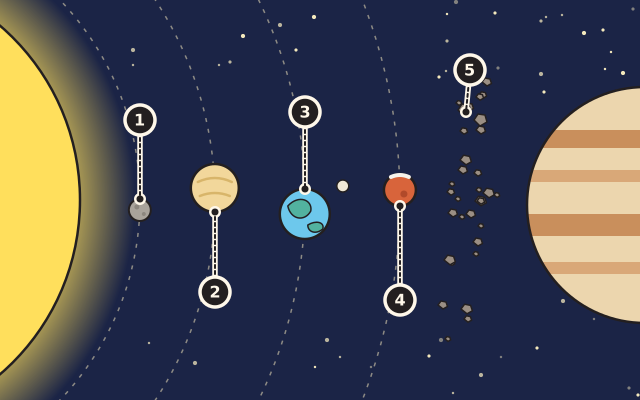
  1. MercuryMercurio
  2. VenusVenus
  3. EarthLa Tierra
  4. MarsMarte
  5. The asteroid beltEl cinturón de asteroides

Stop 6Parada 6

The rocky planetsLos planetas rocosos

When the solar system was young, only rocky material could stand the heat close to the Sun. That is why the first four planets, Mercury, Venus, Earth and Mars, are rocky. They are all small, with solid surfaces.Cuando el sistema solar era joven, solo el material rocoso aguantaba el calor cerca del Sol. Por eso los primeros cuatro planetas, Mercurio, Venus, la Tierra y Marte, son rocosos. Todos son pequeños y tienen una superficie sólida.

The asteroid belt is made of bits and pieces from the early solar system that never quite came together into a planet.El cinturón de asteroides está hecho de pedazos del sistema solar temprano que nunca llegaron a juntarse en un planeta.

Learn more: NASA Science, Solar system factsMás información: NASA Science, Solar system facts

Next: The giant planetsSiguiente: Los planetas gigantes

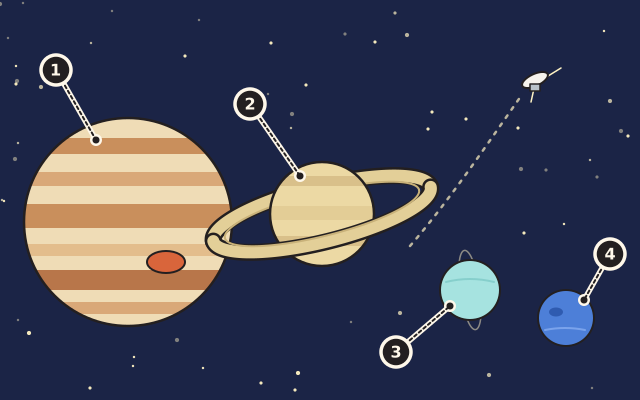
Look forBusque

  1. JupiterJúpiter
  2. Saturn and its ringsSaturno y sus anillos
  3. UranusUrano
  4. NeptuneNeptuno

Stop 7Parada 7

The giant planetsLos planetas gigantes

Past the asteroid belt come the giants. They have no hard surface to stand on. Instead, they have swirling gases above a core.Después del cinturón de asteroides vienen los gigantes. No tienen una superficie dura donde pararse. En cambio, tienen gases que se arremolinan sobre un núcleo.

Jupiter and Saturn are gas giants. Jupiter is the largest planet in our solar system, and Saturn is the second largest. Uranus and Neptune are ice giants, and Neptune is the eighth planet, the most distant from the Sun.Júpiter y Saturno son gigantes gaseosos. Júpiter es el planeta más grande de nuestro sistema solar y Saturno, el segundo. Urano y Neptuno son gigantes de hielo, y Neptuno es el octavo planeta, el más lejano del Sol.

Learn more: NASA Science, About the planetsMás información: NASA Science, About the planets

Next: The far edgeSiguiente: El borde lejano

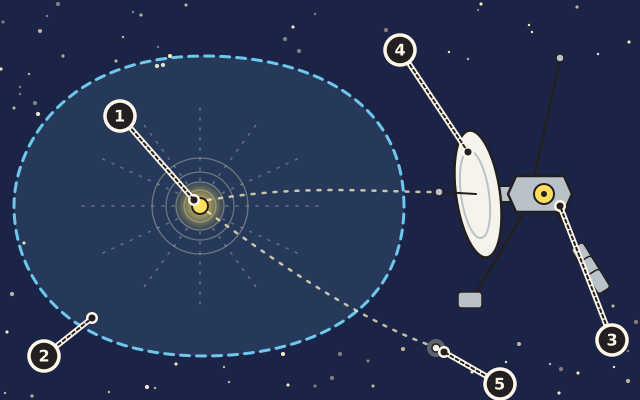
The bubble the Sun makes around itself with the Sun small inside, one Voyager spacecraft up close beyond its edge with its big dish turned toward home, and the other Voyager far off.

Look forBusque

  1. The Sun, far behindEl Sol, muy atrás
  2. The edge of the Sun's bubbleEl borde de la burbuja del Sol
  3. A Voyager spacecraftUna nave Voyager
  4. Its big dish, turned toward homeSu gran antena, apuntando a casa
  5. The other Voyager, far offLa otra Voyager, a lo lejos

Stop 8Parada 8

The far edgeEl borde lejano

Two Voyager spacecraft left Earth in 1977. One of them flew past all four giant planets on its way out. Today they are the only spacecraft ever to work outside the heliosphere, the bubble of particles and magnetic fields the Sun makes around itself.Dos naves Voyager salieron de la Tierra en 1977. Una de ellas pasó junto a los cuatro planetas gigantes en su camino hacia afuera. Hoy son las únicas naves que han funcionado fuera de la heliosfera, la burbuja de partículas y campos magnéticos que el Sol forma a su alrededor.

The farther one is about one light day from Earth, the distance light travels in twenty-four hours. Nothing people have built has gone farther.La más lejana está a cerca de un día luz de la Tierra, la distancia que recorre la luz en veinticuatro horas. Nada que hayan construido las personas ha llegado más lejos.

Learn more: NASA Science, Where are the Voyagers now?Más información: NASA Science, Where are the Voyagers now?

Where the facts come fromDe dónde vienen los datos

To learn more about every stop. The drawings are byrd@home's own, simplified to show how the parts work.Para saber más de cada parada. Los dibujos son de byrd@home, simplificados para mostrar cómo funcionan las partes.

Use it, share it, adapt itÚsela, compártala, adáptela

The credit to copyEl crédito para copiar

Free BYRD, CC BY. “Out to space: from the backyard to the far edge” from the Byrd Academy STEM Curriculum by Byrd EDU, byrdathome.org.Free BYRD, CC BY. “Hacia el espacio: del patio al borde lejano”, del Currículo STEM de Byrd Academy, de Byrd EDU, byrdathome.org.

This is free to use, share and adapt, even commercially, under the Creative Commons Attribution 4.0 International license (CC BY 4.0), with this credit. What Free BYRD means.Esto es libre de usar, compartir y adaptar, incluso con fines comerciales, bajo la licencia Creative Commons Atribución 4.0 Internacional (CC BY 4.0), con este crédito. Qué significa Free BYRD.

Keep goingSiga adelante

What to do nextQué hacer después

Make it harderHágalo más difícil

Make a scale model on the sidewalk: if Earth is the size of a pea, about thirty peas fit between it and the Moon. Then work out why the space station circles Earth in about ninety minutes while the Moon takes weeks.Haga un modelo a escala en la banqueta: si la Tierra es del tamaño de un chícharo, caben unos treinta chícharos entre ella y la Luna. Luego piense por qué la estación espacial le da la vuelta a la Tierra en unos noventa minutos mientras la Luna tarda semanas.

For a younger onePara alguien más pequeño

Go outside together at dusk. Find the Moon, then hunt for a star that twinkles and a light that does not. Wave if a bright dot glides by: it might be the space station!Salgan juntos al anochecer. Busquen la Luna, luego una estrella que titile y una luz que no. Saluden si pasa un punto brillante que se desliza: ¡puede ser la estación espacial!

Try this nextPruebe esto después

SIM-0012

Why we have seasonsPor qué hay estaciones

Pick a place and a day, and see how the tilted Earth sets the noon sun’s height, the length of the day and the sunlight each square of ground gets.Elija un lugar y un día, y vea cómo la Tierra inclinada fija la altura del sol del mediodía, la duración del día y la luz que recibe cada cuadro de suelo.

  • Ways in:Formas de empezar:
  • SimulateSimular

Best for ages 5 and upIdeal desde los 5 años

DesignDiseño

Free BYRD, CC BYSimulationSimulación

SIM-0024

Newton's cannonballLa bala de cañón de Newton

Fire a cannonball sideways from a mountain at the edge of space. Too slow and it falls back; fast enough and it falls all the way around the Earth.Dispare una bala de cañón de lado desde una montaña en el borde del espacio. Muy lenta, cae de vuelta; lo bastante rápida, cae alrededor de toda la Tierra.

  • Ways in:Formas de empezar:
  • SimulateSimular

Best for ages 11 to 14Ideal de 11 a 14 años

DesignDiseño

Free BYRD, CC BYSimulationSimulación

SIM-0025

The phases of the MoonLas fases de la Luna

Move through a month and watch the Moon go around the Earth in the Sun's light, beside the Moon as it looks from home each night.Avance por un mes y vea a la Luna girar alrededor de la Tierra bajo la luz del Sol, junto a la Luna como se ve desde casa cada noche.

  • Ways in:Formas de empezar:
  • SimulateSimular

Best for ages 5 and upIdeal desde los 5 años

DesignDiseño

Free BYRD, CC BYSimulationSimulación

SIM-0026

Water bottle rocketCohete de botella con agua

Pump up a bottle rocket, choose how much water and which fins, and see how high it flies and why the water pushes it up.Infle un cohete de botella, elija cuánta agua y qué aletas, y vea qué tan alto vuela y por qué el agua lo empuja hacia arriba.

  • Ways in:Formas de empezar:
  • SimulateSimular

Best for ages 6 and upIdeal desde los 6 años

ManufacturingManufacturaDesignDiseño

Free BYRD, CC BYSimulationSimulación

Explore everythingExplorar todo