

SimulationsSimulacionesSIM-0013
Explore, 5 minutesExplorar, 5 minutos
A plant growth journalUn diario del crecimiento de las plantas
Measure two plants day by day, chart their heights side by side, and see how fast each one grew between measurements.Mida dos plantas día a día, grafique sus alturas lado a lado y vea qué tan rápido creció cada una entre mediciones.
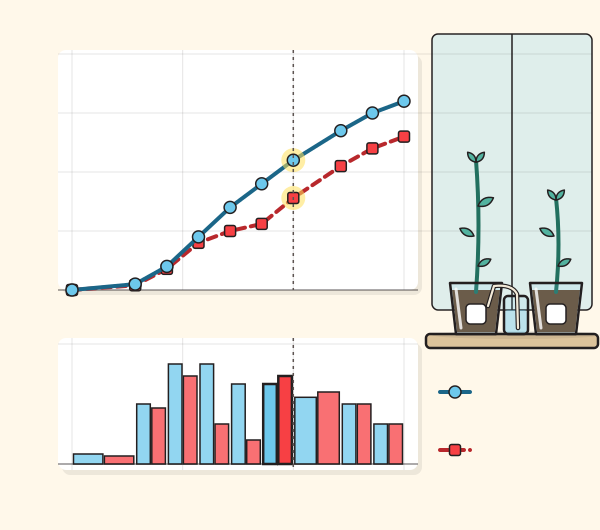
The drawing shows where it starts. It runs here once its script has loaded.El dibujo muestra dónde empieza. Funciona aquí una vez que carga su código.
Your challengeSu reto
- In the wick example, move the day to the stretch when Cup A grew fastest.En el ejemplo de la mecha, mueva el día al tramo en que el vaso A creció más rápido. Not done yet.Todavía no.
- In the too much water example, find a stretch when the soaked cup grew less than a millimeter a day.En el ejemplo de demasiada agua, encuentre un tramo en que el vaso empapado creció menos de un milímetro por día. Not done yet.Todavía no.
- Add two measurements of your own to one cup, a few days apart, so the chart can show how fast it grew.Agregue dos mediciones suyas a un vaso, con unos días de diferencia, para que la gráfica pueda mostrar qué tan rápido creció. Not done yet.Todavía no.
Every challenge done. Now try it for real at home.Todos los retos logrados. Ahora pruébelo de verdad en casa.
- Cup A,Vaso A,
- Cup B,Vaso B,
Circles and the solid line are Cup A; squares and the dashed line are Cup B. Each plant stands at its height on the chart’s own scale. The bars below show how fast each cup grew between two measurements. The lines stop at the last measurement: the chart never guesses what comes next. Your numbers are kept only in this browser on this device, and never sent anywhere; Start over keeps them, and only Clear my measurements erases them.Los círculos y la línea continua son el vaso A; los cuadrados y la línea punteada son el vaso B. Cada planta está a su altura en la escala de la gráfica. Las barras de abajo muestran qué tan rápido creció cada vaso entre dos mediciones. Las líneas terminan en la última medición: la gráfica nunca adivina lo que sigue. Sus números se guardan solo en este navegador, en este dispositivo, y nunca se envían a ningún lugar; Empezar de nuevo los conserva, y solo Borrar mis mediciones los borra.
What is happeningQué está pasando
A plant needs light, water, air and warmth, and room for its roots. It makes its own food from light, air and water; it does not eat dirt. The soil holds the water and a little of the minerals the plant needs.Una planta necesita luz, agua, aire y calor, y espacio para sus raíces. Hace su propio alimento con luz, aire y agua; no come tierra. La tierra guarda el agua y un poco de los minerales que la planta necesita.
A growth journal turns a plant into numbers you can compare. Measure from the soil to the top on the days you choose, and the chart plots each cup. The growth per day between two measurements is the change in height divided by the days between them.Un diario de crecimiento convierte una planta en números que se pueden comparar. Mida de la tierra a la punta los días que elija, y la gráfica marca cada vaso. El crecimiento por día entre dos mediciones es el cambio de altura dividido entre los días que pasaron.
More water is not always better. Roots need air too, and soil that stays soaked can slow a plant down. A wick waterer, a cotton string from a jar of water into the soil, keeps the soil moist without soaking it.Más agua no siempre es mejor. Las raíces también necesitan aire, y la tierra que se queda empapada puede frenar a una planta. Un regador de mecha, un cordón de algodón que va de un frasco de agua a la tierra, mantiene la tierra húmeda sin empaparla.
The chart shows only what was measured. Its lines stop at the last measurement, because nobody knows a plant’s next height until it is measured.La gráfica muestra solo lo que se midió. Sus líneas terminan en la última medición, porque nadie sabe la próxima altura de una planta hasta medirla.
Things to tryCosas para probar
- Plant two cups the same way, water one with a wick waterer and one by hand, and enter both heights every few days.Siembre dos vasos de la misma manera, riegue uno con un regador de mecha y otro a mano, y anote las dos alturas cada pocos días.
- Slide the day through the too much water example and watch the soaked cup fall behind.Recorra los días del ejemplo de demasiada agua y vea cómo el vaso empapado se queda atrás.
- Measure the same plant twice in a row. Do you get the same number? Small differences are part of measuring.Mida la misma planta dos veces seguidas. ¿Obtiene el mismo número? Las pequeñas diferencias son parte de medir.
- Change only one thing between the two cups, so you know what made the difference.Cambie solo una cosa entre los dos vasos, para saber qué causó la diferencia.
This is a journal, not a model of how plants grow. The two examples are made-up numbers, not a measurement, to show what a journal can look like, and the plants are drawn only at the heights measured. Your own plants will grow at their own pace, and the numbers you enter stay only in this browser on this device.Esto es un diario, no un modelo de cómo crecen las plantas. Los dos ejemplos son números inventados, no una medición, para mostrar cómo puede verse un diario, y las plantas se dibujan solo a las alturas medidas. Sus plantas crecerán a su propio ritmo, y los números que anote se quedan solo en este navegador, en este dispositivo.
Use it, share it, adapt itÚsela, compártala, adáptela
The credit to copyEl crédito para copiar
Free BYRD, CC BY. “A plant growth journal” from the Byrd Academy STEM Curriculum by Byrd EDU, byrdathome.org.Free BYRD, CC BY. “Un diario del crecimiento de las plantas”, del Currículo STEM de Byrd Academy, de Byrd EDU, byrdathome.org.
This is free to use, share and adapt, even commercially, under the Creative Commons Attribution 4.0 International license (CC BY 4.0), with this credit. What Free BYRD means.Esto es libre de usar, compartir y adaptar, incluso con fines comerciales, bajo la licencia Creative Commons Atribución 4.0 Internacional (CC BY 4.0), con este crédito. Qué significa Free BYRD.