

SimulationsSimulacionesSIM-0009
Explore, 5 minutesExplorar, 5 minutos
How a 3D printer slices a partCómo una impresora 3D corta una pieza en capas
Slice a little house, a cup, a cone or a pyramid into layers, watch the printer build it from the bed up, and see where a part needs support.Corte en capas una casita, un vaso, un cono o una pirámide, vea a la impresora construirla desde la cama hacia arriba y descubra dónde una pieza necesita soporte.
The drawing shows where it starts. It runs here once its script has loaded.El dibujo muestra dónde empieza. Funciona aquí una vez que carga su código.
Your challengeSu reto
- Find a layer where the house’s wide roof reaches out past its walls.Encuentre una capa donde el techo ancho de la casita sale más allá de sus paredes. Not done yet.Todavía no.
- Change the house’s design so it prints with no supports at all.Cambie el diseño de la casita para que se imprima sin ningún soporte. Not done yet.Todavía no.
- Slice the cone so its steps are less than a tenth of a millimeter deep, and see what that costs in time.Corte el cono en capas para que sus escalones midan menos de una décima de milímetro de fondo, y vea lo que cuesta en tiempo. Not done yet.Todavía no.
Every challenge done. Now try it for real at home.Todos los retos logrados. Ahora pruébelo de verdad en casa.
Printed so far, of the whole print timeImpreso hasta ahora, del tiempo total
Layers in allCapas en total
Print time, from the modelTiempo de impresión, según el modelo
Height, in whole layersAltura, en capas completas
Steps on the sloping sideEscalones en el lado inclinado
SupportsSoportes
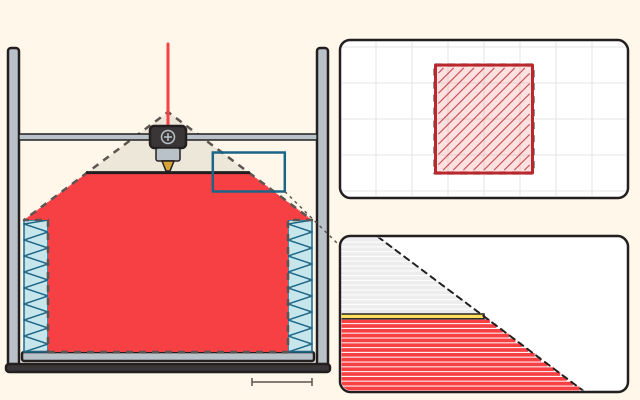
On the left, the part from the side, cut down the middle: the red layers are printed, the bold line is the layer printing now, and the pale ones are still to come; the dashed line is the part as designed. On the right, that layer from above, the layer under it dashed; below it, the blue box on the left seen up close, the true side dashed over the steps. Drag the carriage to move up and down.A la izquierda, la pieza de lado, cortada por la mitad: las capas rojas ya están impresas, la línea gruesa es la capa que se imprime ahora y las claras faltan; la línea punteada es la pieza tal como se diseñó. A la derecha, esa capa desde arriba, con la capa de abajo punteada; debajo, el recuadro azul de la izquierda visto de cerca, con el lado real punteado sobre los escalones. Arrastre el carro para subir y bajar.
What is happeningQué está pasando
A 3D printer builds a part by slicing it into thin layers and printing them one on top of another. As the little house’s roof comes up to its peak, each layer is shorter than the last.Una impresora 3D construye una pieza cortándola en capas delgadas e imprimiéndolas una encima de otra. A medida que el techo de la casita sube hacia la punta, cada capa es más corta que la anterior.
Because it prints in whole layers, a slope comes out as tiny steps, and a part’s height comes out in whole layers too. Thinner layers make smaller steps and a smoother side, but there are more of them, so they take longer to print.Como imprime en capas completas, una pendiente sale como escalones pequeñitos, y la altura de una pieza también sale en capas completas. Las capas más delgadas hacen escalones más chicos y un lado más liso, pero son más, así que tardan más en imprimirse.
Each layer has to rest on the one below. Where a layer sticks out over air, like the eaves of a wide roof, the printer adds supports underneath to hold it up, and they are snapped off afterward.Cada capa tiene que apoyarse en la de abajo. Donde una capa sobresale sobre el aire, como los aleros de un techo ancho, la impresora agrega soportes debajo para sostenerla, y después se quitan.
A designer can change a part so every layer rests on the one below and it needs no supports at all. Designing for the way a part will be made saves material, time and cleanup.Quien diseña puede cambiar una pieza para que cada capa se apoye en la de abajo y no necesite ningún soporte. Diseñar pensando en cómo se fabricará la pieza ahorra material, tiempo y limpieza.
Things to tryCosas para probar
- Drag the carriage, or step the layers, from the bed to the peak of the house.Arrastre el carro, o recorra las capas, desde la cama hasta la punta de la casita.
- Change the layer height and compare the steps up close and the print time.Cambie la altura de capa y compare los escalones de cerca y el tiempo de impresión.
- Make the roof no wider than the walls and see what happens to the supports.Haga el techo no más ancho que las paredes y vea qué pasa con los soportes.
- Print the cone and the pyramid: which one has the deeper steps?Imprima el cono y la pirámide: ¿cuál tiene los escalones más hondos?
The print time comes from a simple model of the outline, the fill and the moves between layers. A real slicer also prints solid floors and tops, slows down for small layers, counts every travel move and builds its supports as a lattice, so its time and its supports are different.El tiempo de impresión viene de un modelo sencillo del contorno, el relleno y los movimientos entre capas. Un programa real también imprime pisos y tapas sólidas, va más lento en las capas pequeñas, cuenta cada traslado y arma sus soportes como un enrejado, así que su tiempo y sus soportes son distintos.
Use it, share it, adapt itÚsela, compártala, adáptela
The credit to copyEl crédito para copiar
Free BYRD, CC BY. “How a 3D printer slices a part” from the Byrd Academy STEM Curriculum by Byrd EDU, byrdathome.org.Free BYRD, CC BY. “Cómo una impresora 3D corta una pieza en capas”, del Currículo STEM de Byrd Academy, de Byrd EDU, byrdathome.org.
This is free to use, share and adapt, even commercially, under the Creative Commons Attribution 4.0 International license (CC BY 4.0), with this credit. What Free BYRD means.Esto es libre de usar, compartir y adaptar, incluso con fines comerciales, bajo la licencia Creative Commons Atribución 4.0 Internacional (CC BY 4.0), con este crédito. Qué significa Free BYRD.