
Virtual toursRecorridos virtualesTOUR-0005

TOUR-0005

Virtual tour, 10 minutes, 8 stopsRecorrido virtual, 10 minutos, 8 paradas

The deep sea: from sunlight to the trenchesEl mar profundo: de la luz del sol a las fosas

Dive from the sunlit surface through the twilight and midnight zones to hot vents and the deepest trench, and meet the sound maps, robot floats, submersibles and robots that explore it.Sumérjase desde la superficie iluminada por las zonas del crepúsculo y de medianoche hasta las fuentes calientes y la fosa más profunda, y conozca los mapas de sonido, los flotadores robot, los sumergibles y los robots que la exploran.

AgesEdades
Every age. Best for ages 5 and up.Todas las edades. Ideal desde los 5 años.
TopicTema
Earth, sky and spaceTierra, cielo y espacio
HowCómo
Tap the ring, or use Go deeper or the arrow keys.Toque el anillo, o use Más adentro o las flechas del teclado.

The MESH'D components this tour shows:Los componentes MESH'D que muestra:ElectronicsElectrónica

The stopsLas paradas

Look forBusque

  1. The sunlit zoneLa zona iluminada
  2. The twilight zoneLa zona del crepúsculo
  3. The midnight zoneLa zona de medianoche
  4. The abyssEl abismo
  5. A trench, in the hadal zoneUna fosa, en la zona hadal

Stop 1Parada 1

The ocean's layersLas capas del océano

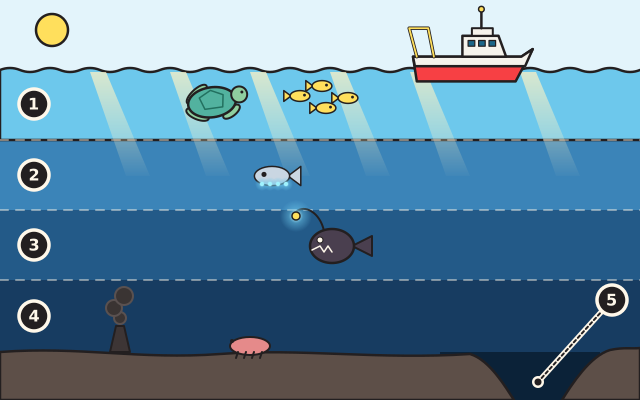
Sunlight can reach about one thousand meters down, but there is rarely much light below two hundred meters. Scientists divide the ocean into zones by depth and light.La luz del sol puede llegar a unos mil metros de profundidad, pero casi nunca hay mucha luz por debajo de los doscientos metros. Los científicos dividen el océano en zonas según la profundidad y la luz.

The sunlit zone is the top two hundred meters, home to many sea turtles and ocean mammals. The twilight zone reaches down to one thousand meters. Below that, sunlight never reaches: the midnight zone goes to four thousand meters, the abyss to six thousand, and the hadal zone is everything deeper.La zona iluminada son los primeros doscientos metros, hogar de muchas tortugas marinas y mamíferos del mar. La zona del crepúsculo llega hasta los mil metros. Más abajo nunca llega la luz del sol: la zona de medianoche llega a los cuatro mil metros, el abismo a los seis mil, y la zona hadal es todo lo que está más hondo.
Learn more: NOAA Ocean Service, How far does light travel in the ocean?Más información: NOAA Ocean Service, How far does light travel in the ocean?

Next: Mapping with soundSiguiente: Mapas con sonido

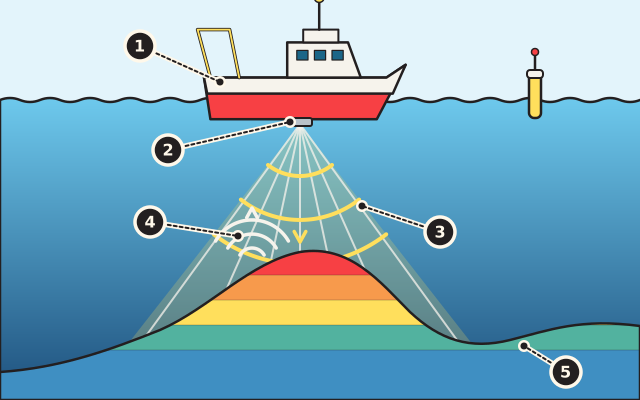
Look forBusque

  1. The shipEl barco
  2. The sound array on its hullLos sensores de sonido en el casco
  3. A fan of sound beamsUn abanico de haces de sonido
  4. An echo coming backUn eco que regresa
  5. The colors of the seafloor mapLos colores del mapa del fondo

Stop 2Parada 2

Mapping with soundMapas con sonido

Exploring a new part of the ocean often starts with sound. A ship sends out pulses of sound in a fan of beams from an array on its hull. Each pulse bounces off the seafloor, and its echo comes back up.Explorar una parte nueva del océano muchas veces empieza con sonido. Un barco envía pulsos de sonido en un abanico de haces desde un conjunto de sensores en su casco. Cada pulso rebota en el fondo del mar y su eco regresa.

The time the sound takes to go down and back gives the depth. Computers turn the echoes into colorful maps: red and orange where the seafloor is shallow, yellow and green where it is deeper. Then scientists plan where robots will dive.El tiempo que tarda el sonido en bajar y volver da la profundidad. Las computadoras convierten los ecos en mapas de colores: rojo y anaranjado donde el fondo es poco profundo, amarillo y verde donde es más hondo. Luego los científicos planean dónde se sumergirán los robots.

Try this at homePruébelo en casaSound and its wavesEl sonido y sus ondas

Learn more: NOAA Ocean Exploration, Multibeam sonarMás información: NOAA Ocean Exploration, Multibeam sonar

Next: Robot floatsSiguiente: Flotadores robot

Look forBusque

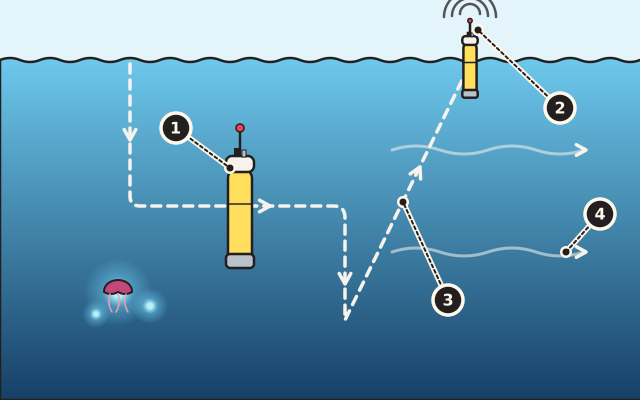
  1. A float, drifting deepUn flotador, a la deriva en lo hondo
  2. A float at the surface, sending its dataUn flotador en la superficie, enviando sus datos
  3. Its path down and back upSu camino de bajada y de subida
  4. The current that carries itLa corriente que lo lleva

Stop 3Parada 3

Robot floatsFlotadores robot

Robot floats drift through the world's ocean, carried by the currents. Each one moves up and down between the surface and the middle depths, measuring the water's temperature and saltiness in the top two thousand meters.Los flotadores robot van a la deriva por el océano del mundo, llevados por las corrientes. Cada uno sube y baja entre la superficie y las profundidades medias, y mide la temperatura y la salinidad del agua en los primeros dos mil metros.

Their data is shared freely with everyone, in real time. Forecasters use it to improve weather and hurricane forecasts.Sus datos se comparten libremente con todos, en tiempo real. Los meteorólogos los usan para mejorar los pronósticos del tiempo y de los huracanes.

Try this at homePruébelo en casaSink or float¿Se hunde o flota?

Learn more: NOAA Atlantic Oceanographic and Meteorological Laboratory, Argo programMás información: NOAA Atlantic Oceanographic and Meteorological Laboratory, Argo program

Next: Living lightSiguiente: Luz viva

Look forBusque

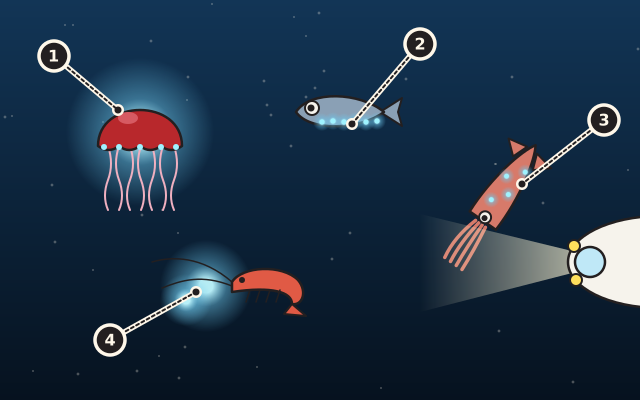
  1. A glowing jellyfishUna medusa que brilla
  2. A fish with rows of lightsUn pez con filas de luces
  3. A squid with glowing spotsUn calamar con manchas que brillan
  4. A shrimp puffing out a glowing cloudUn camarón que suelta una nube brillante

Stop 4Parada 4

Living lightLuz viva

Deep down it is almost completely dark, yet many animals make their own light. This is bioluminescence: light a living thing makes with a chemical reaction. It is rare on land but very common in the ocean. Between two hundred and one thousand meters deep, eight of every ten animals can make light.En lo hondo está casi completamente oscuro, y aun así muchos animales producen su propia luz. Esto es la bioluminiscencia: luz que hace un ser vivo mediante una reacción química. Es rara en tierra pero muy común en el océano. Entre los doscientos y los mil metros de profundidad, ocho de cada diez animales pueden producir luz.

The glow is usually blue, the color of light that travels best through water. It may help animals find food, find mates or defend themselves, but scientists still have many questions.El brillo suele ser azul, el color de luz que mejor viaja por el agua. Puede ayudar a los animales a encontrar comida, encontrar pareja o defenderse, pero los científicos todavía tienen muchas preguntas.

Learn more: NOAA Ocean Exploration, What is bioluminescence?Más información: NOAA Ocean Exploration, What is bioluminescence?

Next: The squeezeSiguiente: La presión

Look forBusque

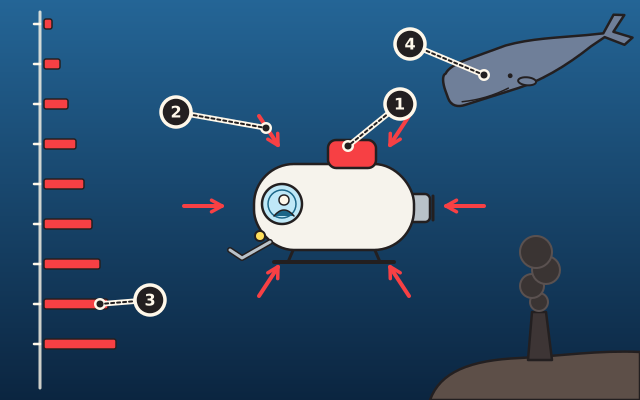
  1. A crewed submersibleUn sumergible con tripulación
  2. The water pressing in from every sideEl agua que presiona por todos lados
  3. Pressure growing with depthLa presión que crece con la profundidad
  4. A sperm whale divingUn cachalote que se sumerge

Stop 5Parada 5

The squeezeLa presión

At the surface, air presses on you, but you do not feel it because your body pushes back just as hard. Underwater, the pressure grows by one more atmosphere about every ten meters you go down. Just ten meters down, the push on you has already doubled.En la superficie, el aire lo presiona a usted, pero no lo siente porque su cuerpo empuja hacia afuera con la misma fuerza. Bajo el agua, la presión aumenta una atmósfera más por cada diez metros, más o menos, que baja. A solo diez metros, el empuje ya es el doble.

Scientists dive in submersibles built to take that squeeze. Whales handle it with flexible ribs and lungs that can collapse safely, so sperm whales can hunt giant squid more than two kilometers down.Los científicos bajan en sumergibles hechos para aguantar esa presión. Las ballenas la soportan con costillas flexibles y pulmones que se pueden comprimir sin peligro, así que los cachalotes pueden cazar calamares gigantes a más de dos kilómetros de profundidad.

Try this at homePruébelo en casaAir pressure in a bottleLa presión del aire en una botella

Learn more: NOAA Ocean Service, How does pressure change with ocean depth?Más información: NOAA Ocean Service, How does pressure change with ocean depth?

Next: Hot ventsSiguiente: Fuentes hidrotermales

Look forBusque

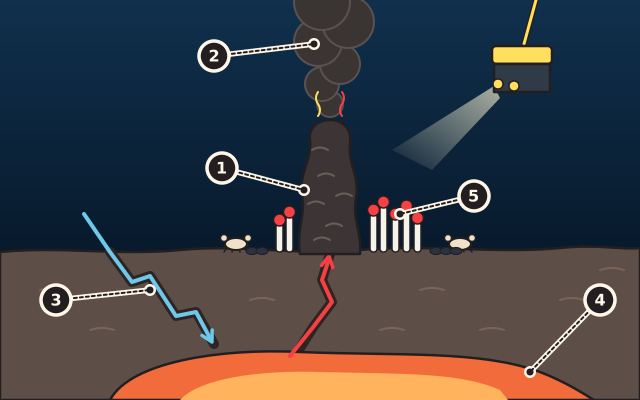
  1. A chimney of mineralsUna chimenea de minerales
  2. The black smoke: hot water full of mineral bitsEl humo negro: agua caliente llena de partículas de minerales
  3. Cold seawater seeping downAgua fría que se filtra hacia abajo
  4. The hot magma belowEl magma caliente, abajo
  5. Animals living by the ventAnimales que viven junto a la fuente

Stop 6Parada 6

Hot ventsFuentes hidrotermales

Where seawater meets magma, the seafloor has hot springs called hydrothermal vents. Cold seawater seeps down through cracks, the magma heats it, and it rises back out at over seven hundred degrees Fahrenheit. It does not boil, because the pressure down there is so great.Donde el agua de mar se encuentra con el magma, el fondo marino tiene manantiales calientes llamados fuentes hidrotermales. El agua fría se filtra por las grietas, el magma la calienta y vuelve a salir a más de setecientos grados Fahrenheit. No hierve, porque allá abajo la presión es enorme.

Minerals in the hot water harden into chimneys; black smokers are built of iron sulfide. When scientists first found vents in 1977, near the Galapagos Islands, they were surrounded by animals no one had ever seen.Los minerales del agua caliente se endurecen y forman chimeneas; las fumarolas negras están hechas de sulfuro de hierro. Cuando los científicos encontraron estas fuentes por primera vez en 1977, cerca de las islas Galápagos, estaban rodeadas de animales que nadie había visto jamás.

Try this at homePruébelo en casaHeat on the move: spoons and cupsEl calor en movimiento: cucharas y vasos

Learn more: NOAA Ocean Service, What is a hydrothermal vent?Más información: NOAA Ocean Service, What is a hydrothermal vent?

Next: A robot on a cableSiguiente: Un robot con cable

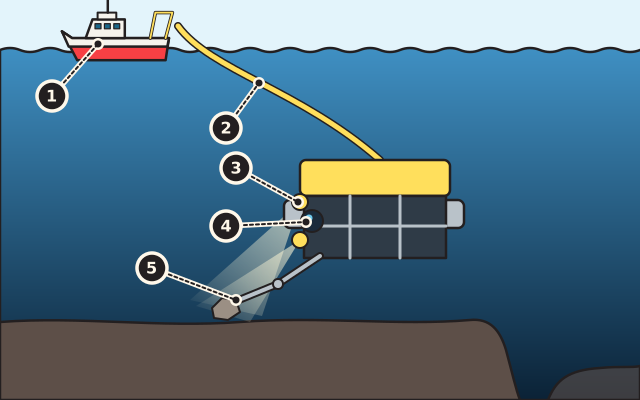
Look forBusque

  1. The ship, where a pilot steersEl barco, donde alguien lo maneja
  2. The tether cableEl cable umbilical
  3. The lightsLas luces
  4. The cameraLa cámara
  5. The robot arm with a sampleEl brazo robot con una muestra

Stop 7Parada 7

A robot on a cableUn robot con cable

A remotely operated vehicle, or ROV, is an underwater robot with no one inside. A person on the ship steers it with a joystick, a lot like a video game, and a cable called a tether carries signals back and forth.Un vehículo operado a distancia es un robot submarino sin nadie adentro. Una persona en el barco lo maneja con una palanca de mando, muy parecido a un videojuego, y un cable umbilical lleva señales de ida y vuelta.

Its lights and cameras send pictures and video up to the ship, and its arm can collect samples. It can go where it is too deep for people to dive safely and stay down much longer, while its pilots stay safe and dry on deck.Sus luces y cámaras envían fotos y video al barco, y su brazo puede recoger muestras. Puede ir a donde es demasiado hondo para que las personas buceen con seguridad y quedarse mucho más tiempo, mientras quienes lo manejan siguen seguros y secos en cubierta.

Try this at homePruébelo en casaCode the robotPrograme al robot

Learn more: NOAA Ocean Exploration, What is an ROV?Más información: NOAA Ocean Exploration, What is an ROV?

Next: The deepest trenchSiguiente: La fosa más profunda

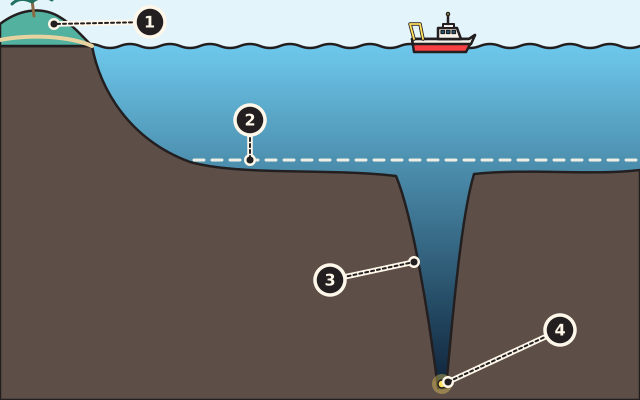
A slice of the ocean from an island to a deep, narrow trench, with a dashed line at the ocean's average depth and the trench plunging far below it to its deepest spot.

Look forBusque

  1. An islandUna isla
  2. The ocean's average depthLa profundidad promedio del océano
  3. The trenchLa fosa
  4. The Challenger Deep, the deepest spotEl abismo Challenger, el punto más hondo

Stop 8Parada 8

The deepest trenchLa fosa más profunda

On average the ocean is about three thousand seven hundred meters deep. Its deepest spot is the Challenger Deep, at the southern end of the Mariana Trench in the western Pacific Ocean, which runs southwest of the island of Guam.En promedio, el océano tiene unos tres mil setecientos metros de profundidad. Su punto más hondo es el abismo Challenger, en el extremo sur de la fosa de las Marianas, en el oeste del océano Pacífico, que corre al suroeste de la isla de Guam.

The Challenger Deep is about eleven kilometers deep. It is named for a ship called Challenger, whose crew first measured the trench's depth in 1875.El abismo Challenger tiene unos once kilómetros de profundidad. Lleva el nombre de un barco llamado Challenger, cuya tripulación midió por primera vez la profundidad de la fosa en 1875.

Learn more: NOAA Ocean Service, How deep is the ocean?Más información: NOAA Ocean Service, How deep is the ocean?

Use it, share it, adapt itÚsela, compártala, adáptela

The credit to copyEl crédito para copiar

Free BYRD, CC BY. “The deep sea: from sunlight to the trenches” from the Byrd Academy STEM Curriculum by Byrd EDU, byrdathome.org.Free BYRD, CC BY. “El mar profundo: de la luz del sol a las fosas”, del Currículo STEM de Byrd Academy, de Byrd EDU, byrdathome.org.

This is free to use, share and adapt, even commercially, under the Creative Commons Attribution 4.0 International license (CC BY 4.0), with this credit. What Free BYRD means.Esto es libre de usar, compartir y adaptar, incluso con fines comerciales, bajo la licencia Creative Commons Atribución 4.0 Internacional (CC BY 4.0), con este crédito. Qué significa Free BYRD.

Keep goingSiga adelante

What to do nextQué hacer después

Make it harderHágalo más difícil

Use the rule from the squeeze stop: about one more atmosphere for every ten meters. How many atmospheres press on a robot float at its deepest, two thousand meters down? Then try the same for the Challenger Deep.Use la regla de la parada de la presión: una atmósfera más por cada diez metros, más o menos. ¿Cuántas atmósferas presionan a un flotador robot en su punto más hondo, a dos mil metros? Luego haga lo mismo con el abismo Challenger.

For a younger onePara alguien más pequeño

In a dark room, glow like a deep sea animal: blink a flashlight under a blanket to find a partner, then blink it fast to scare off a pretend predator.En un cuarto oscuro, brillen como animales del mar profundo: hagan parpadear una linterna bajo una cobija para encontrar a un compañero y luego háganla parpadear rápido para asustar a un depredador de mentira.

Try this nextPruebe esto después

SIM-0014

Sink or float¿Se hunde o flota?

Drop a cork, an apple, an egg and more into fresh water, salt water or cooking oil, and see why each one sinks or floats: its density against the liquid’s, and the push of the liquid it moves aside.Ponga un corcho, una manzana, un huevo y más en agua sin sal, agua con sal o aceite de cocina, y vea por qué cada uno se hunde o flota: su densidad contra la del líquido, y el empuje del líquido que aparta.

  • Ways in:Formas de empezar:
  • SimulateSimular

Best for ages 5 and upIdeal desde los 5 años

ManufacturingManufactura

Free BYRD, CC BYSimulationSimulación

SIM-0001

Air pressure in a bottleLa presión del aire en una botella

Pull air out of a bottle through its straw and watch what the air outside does to a balloon on top of the bottle, or inside it.Saque aire de una botella por su popote y vea lo que el aire de afuera le hace a un globo sobre la botella, o dentro de ella.

  • Ways in:Formas de empezar:
  • SimulateSimular

Best for ages 4 to 12Ideal de 4 a 12 años

ManufacturingManufacturaDesignDiseño

Free BYRD, CC BYSimulationSimulación

SIM-0008

Sound and its wavesEl sonido y sus ondas

Change a string’s length and tightness, or a straw flute’s length, and watch how fast it vibrates and how long its sound waves are in the air. Half the length, one octave higher, and a wave half as long.Cambie el largo y la tensión de una cuerda, o el largo de una flauta de popote, y vea qué tan rápido vibra y qué tan largas son sus ondas de sonido en el aire. La mitad del largo, una octava más alta, y una onda de la mitad.

  • Ways in:Formas de empezar:
  • SimulateSimular

Best for ages 4 to 12Ideal de 4 a 12 años

ElectronicsElectrónica

Free BYRD, CC BYSimulationSimulación

STEMGrades 6 to 8Grados 6 a 8 How healthy is our own patch of the world?¿Qué tan sano está nuestro propio rincón del mundo? STEM-JH-09

Environmental MonitorsMonitores ambientales

Ask a question about your surroundings, build a sensor monitor to answer it and use percent change to report what really changed.Haga una pregunta sobre su entorno, construya un monitor con sensores para responderla y use el cambio porcentual para informar qué cambió de verdad.

  • Ways in:Formas de empezar:
  • ReadLeer
  • DoHacer

Grades 6 to 8Grados 6 a 8

ManufacturingManufacturaElectronicsElectrónicaSoftwareSoftware

Free BYRD, CC BYCurriculum unitUnidad del currículo

Explore everythingExplorar todo