

ExploreExplorarBH-0004
Build a cup phoneConstruya un teléfono de vasos
Two cups and a string carry your voice across the room: see how sound travels as a vibration.Dos vasos y una cuerda llevan su voz de un lado a otro del cuarto: vea cómo el sonido viaja como una vibración.
- Ways in:Formas de empezar:
- Read, 2 minutesLeer, 2 minutos
- Do, 20 minutesHacer, 20 minutos
- Simulate, 5 minutesSimular, 5 minutos
- AgesEdades
- Every age. Best for ages 4 to 10.Todas las edades. Ideal de 4 a 10 años.
- CostCosto
- Things already at homeCosas que ya hay en casa
- EpisodeEpisodio
- Episode 4Episodio 4
The MESH'D components this item uses:Los componentes MESH'D que usa:ManufacturingManufacturaElectronicsElectrónica
WatchVea
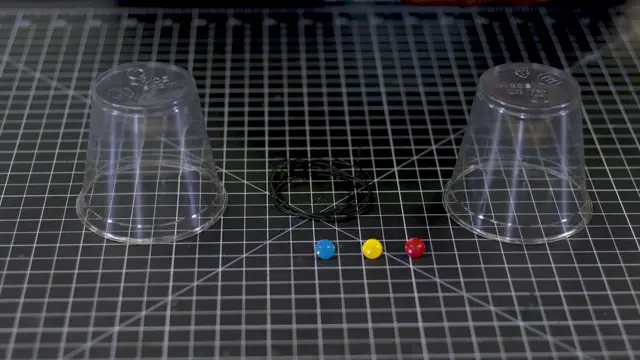
Do, about 20 minutesHacer, unos 20 minutos
Build it at homeConstrúyalo en casa
StepsPasos
- Poke a small hole in the bottom of each cup with the push pin or the pencil.Haga un agujero pequeño en el fondo de cada vaso con la chincheta o el lápiz.
- Thread the string through the hole of one cup, from the outside in.Pase la cuerda por el agujero de un vaso, de afuera hacia adentro.
- Tie a knot in the end inside the cup, so the string cannot pull back through. Tie more than one knot if the hole is big.Haga un nudo en la punta dentro del vaso, para que la cuerda no se salga. Haga más de un nudo si el agujero es grande.
- Repeat with the other cup on the other end of the string.Repita con el otro vaso en la otra punta de la cuerda.
- Pull the string tight, speak into one cup, and have someone listen at the other.Estire bien la cuerda, hable dentro de un vaso y pida a alguien que escuche en el otro.
What you needLo que necesita
- Two cupsDos vasos
- StringCuerda
- A push pin or a sharp pencil, to make the holesUna chincheta o un lápiz con punta, para hacer los agujeros
Things already at home.Cosas que ya hay en casa.
Check with a grown-up before you use push pins. Ask a grown-up before you post your invention or results online.Consulte con una persona adulta antes de usar chinchetas. Pregunte a una persona adulta antes de publicar su invento o sus resultados en internet.
Read, 2 minutesLeer, 2 minutos
The big ideaLa gran idea
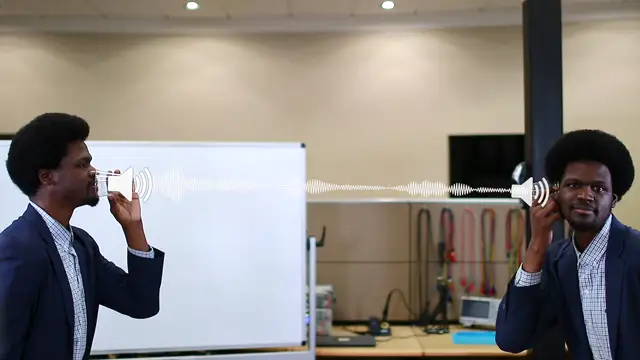
When you speak into one cup, your voice makes the bottom of the cup vibrate. The vibration travels along the tight string to the other cup, makes its bottom vibrate too, and that vibration becomes sound again in the listener's ear. The episode calls it a trip back in time, for retro day: the idea that led, step by step, to the phones we carry today.Cuando habla dentro de un vaso, su voz hace vibrar el fondo del vaso. La vibración viaja por la cuerda tensa hasta el otro vaso, hace vibrar también su fondo, y esa vibración vuelve a ser sonido en el oído de quien escucha. El episodio lo llama un viaje al pasado, por el día retro: la idea que llevó, paso a paso, a los teléfonos que usamos hoy.
Simulate, 5 minutesSimular, 5 minutos
Sound on a stringEl sonido en una cuerda
Speak into one cup and follow your voice along the string to the other, then see what a slack string, a longer one, a pinch and a different string do to it.Hable en un vaso y siga su voz por la cuerda hasta el otro, y luego vea qué le hacen una cuerda floja, una más larga, un pellizco y otra clase de cuerda.
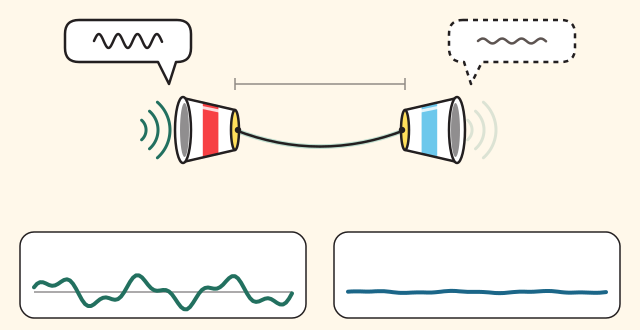
The drawing shows where it starts. It runs here once its script has loaded.El dibujo muestra dónde empieza. Funciona aquí una vez que carga su código.
Your challengeSu reto
- Pull the string tight and speak, so that more than half of your voice reaches the other cup.Tense la cuerda y hable, para que más de la mitad de su voz llegue al otro vaso. Not done yet.Todavía no.
- Stop your voice on a tight string with just one finger.Detenga su voz en una cuerda tensa con un solo dedo. Not done yet.Todavía no.
- Send more than half of your voice all the way down a hallway.Mande más de la mitad de su voz hasta el final de un pasillo. Not done yet.Todavía no.
Every challenge done. Now try it for real at home.Todos los retos logrados. Ahora pruébelo de verdad en casa.
Your voice that reaches the other cupLa parte de su voz que llega al otro vaso
The string isLa cuerda mide
The green band around the string is the vibration: the wider it is at a place, the more of it is left there. The waves below are what you say and what arrives.La banda verde alrededor de la cuerda es la vibración: entre más ancha en un lugar, más queda de ella ahí. Las ondas de abajo son lo que usted dice y lo que llega.
What is happeningQué está pasando
Your voice makes the bottom of the cup shake back and forth very fast. That shaking is a vibration.Su voz hace que el fondo del vaso se sacuda de un lado a otro muy rápido. Esa sacudida es una vibración.
With every shake, the cup's bottom tugs the string, so the vibration runs along the string to the other cup. It shakes that cup's bottom, and the air there carries the sound into the listener's ear.Con cada sacudida, el fondo del vaso jala la cuerda, así que la vibración corre por la cuerda hasta el otro vaso. Sacude el fondo de ese vaso, y el aire ahí lleva el sonido al oído de quien escucha.
A tight string passes the tugs along. A slack string only swings, and a finger pinching the string soaks up the vibration, so the sound stops there.Una cuerda tensa pasa los jalones. Una cuerda floja solo se mece, y un dedo que pellizca la cuerda absorbe la vibración, así que el sonido se detiene ahí.
Every meter of string loses a little of the vibration, and what the string is made of matters: soft, fuzzy yarn soaks up the most, and stiff fishing line the least.Cada metro de cuerda pierde un poco de la vibración, y el material de la cuerda importa: el estambre, suave y peludo, absorbe más, y el hilo de pescar, rígido, absorbe menos.
Things to tryCosas para probar
- Speak with the string slack, then pull it tight and speak again.Hable con la cuerda floja, luego ténsela bien y vuelva a hablar.
- Pinch the string and speak.Pellizque la cuerda y hable.
- Keep the string tight and try all three materials across a room.Mantenga la cuerda tensa y pruebe los tres materiales de un lado del cuarto al otro.
- Make the string longer and watch the green band get thinner on the way.Alargue la cuerda y vea cómo la banda verde se adelgaza en el camino.
This is a model with simple rules: how much a tight string passes on, and how much each material loses for every meter, are chosen to show the ideas in the right order, never measured. A real string also wiggles sideways, and your own cups and knots matter, so your cup phone will sound a little different. The motion is slowed down a lot: a real tug crosses a room in a few thousandths of a second.Este es un modelo con reglas sencillas: cuánto pasa una cuerda tensa, y cuánto pierde cada material en cada metro, se eligieron para mostrar las ideas en el orden correcto, nunca se midieron. Una cuerda real también se mueve de lado, y sus vasos y sus nudos importan, así que su teléfono de vasos sonará un poco distinto. El movimiento va mucho más lento: un jalón real cruza un cuarto en unas pocas milésimas de segundo.
Open the simulation on its own pageAbrir la simulación en su propia páginaSound and its wavesEl sonido y sus ondas
Your engineering challengeSu reto de ingeniería
Take household items you can find and turn them into a listening device, or something you can use to communicate.Tome objetos de la casa que encuentre y conviértalos en un aparato para escuchar, o en algo que sirva para comunicarse.
Make it an experimentConviértalo en un experimento
Science is about changing one thing and watching what happens. Write down your guess, your hypothesis, before you start.La ciencia se trata de cambiar una cosa y observar qué pasa. Escriba su suposición, su hipótesis, antes de empezar.
- Try different kinds of cups.Pruebe con distintos tipos de vasos.
- Try a longer string, a thicker or thinner one, or one made of a different material.Pruebe con una cuerda más larga, más gruesa o más delgada, o de otro material.
Use it, share it, adapt itÚsela, compártala, adáptela
The credit to copyEl crédito para copiar
Free BYRD, CC BY. “Build a cup phone” from the Byrd Academy STEM Curriculum by Byrd EDU, byrdathome.org.Free BYRD, CC BY. “Construya un teléfono de vasos”, del Currículo STEM de Byrd Academy, de Byrd EDU, byrdathome.org.
This is free to use, share and adapt, even commercially, under the Creative Commons Attribution 4.0 International license (CC BY 4.0), with this credit. What Free BYRD means.Esto es libre de usar, compartir y adaptar, incluso con fines comerciales, bajo la licencia Creative Commons Atribución 4.0 Internacional (CC BY 4.0), con este crédito. Qué significa Free BYRD.
Keep goingSiga adelante
What to do nextQué hacer después
Make it harderHágalo más difícil
Tie a second string to the middle of the first and add a third cup: can all three people hear each other?Amarre una segunda cuerda a la mitad de la primera y agregue un tercer vaso: ¿pueden oírse las tres personas?
For a younger onePara alguien más pequeño
Hold the string tight for them and take turns: one whispers a word, the other says it back.Sostenga la cuerda tensa por ellos y tomen turnos: uno susurra una palabra y el otro la repite.
Try this nextPruebe esto después
Sound on a stringEl sonido en una cuerda
Speak into one cup and follow your voice along the string to the other, then see what a slack string, a longer one, a pinch and a different string do to it.Hable en un vaso y siga su voz por la cuerda hasta el otro, y luego vea qué le hacen una cuerda floja, una más larga, un pellizco y otra clase de cuerda.
- Ways in:Formas de empezar:
- SimulateSimular
Best for ages 4 to 11Ideal de 4 a 11 años
ManufacturingManufacturaElectronicsElectrónica
Free BYRD, CC BYSimulationSimulación
 SIM-0008
 Sound and its wavesEl sonido y sus ondas
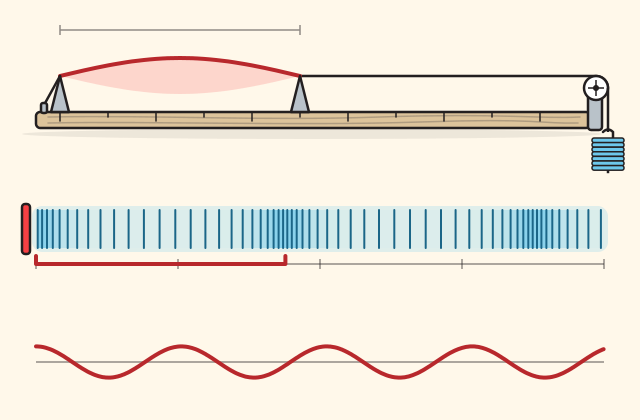
Change a string’s length and tightness, or a straw flute’s length, and watch how fast it vibrates and how long its sound waves are in the air. Half the length, one octave higher, and a wave half as long.Cambie el largo y la tensión de una cuerda, o el largo de una flauta de popote, y vea qué tan rápido vibra y qué tan largas son sus ondas de sonido en el aire. La mitad del largo, una octava más alta, y una onda de la mitad.
- Ways in:Formas de empezar:
- SimulateSimular
Best for ages 4 to 12Ideal de 4 a 12 años
ElectronicsElectrónica
Free BYRD, CC BYSimulationSimulación
 BH-0001
 Make a vacuumHaga un vacío
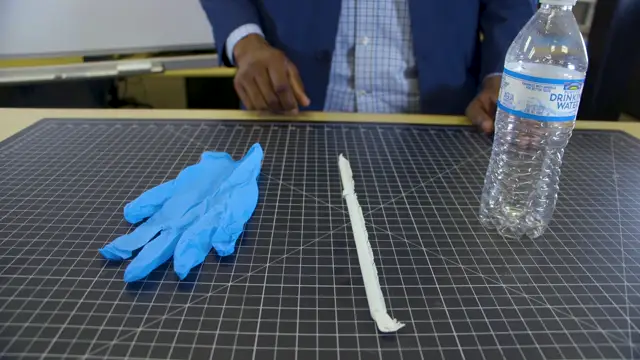
Pull the air out of a water bottle through a straw and watch a balloon shrink, then grow.Saque el aire de una botella de agua con un popote y vea cómo un globo se encoge y luego crece.
- Ways in:Formas de empezar:
- ReadLeer
- WatchVer
- DoHacer
- SimulateSimular
Best for ages 4 to 12Ideal de 4 a 12 años
ManufacturingManufacturaDesignDiseño
Free BYRD, CC BYLessonLección
 BH-0007
 Engineer a leprechaun trapDiseñe una trampa para duendes
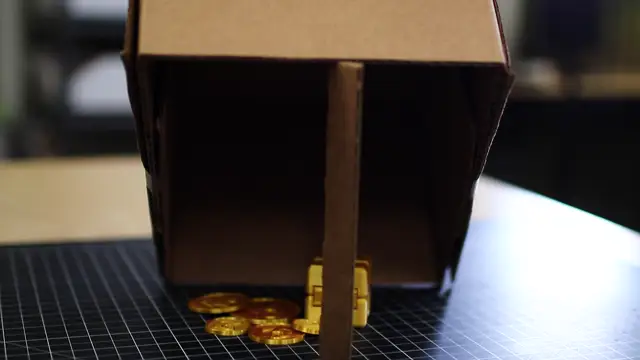
For St. Patrick's Day, take a trap from problem to prototype with the seven steps of the engineering design process.Para el Día de San Patricio, lleve una trampa del problema al prototipo con los siete pasos del proceso de diseño de ingeniería.
- Ways in:Formas de empezar:
- ReadLeer
- DoHacer
- SimulateSimular
Best for ages 6 and upIdeal desde los 6 años
ManufacturingManufacturaDesignDiseño
Free BYRD, CC BYLessonLección