

ExploreExplorarBH-0017
Clock a walk and find your speed on a graphCronometre una caminata y encuentre su velocidad en una gráfica
Time a walk past measured marks with a phone stopwatch, graph distance against time, and read your walking speed from the slope of the line.Cronometre una caminata frente a marcas medidas con el cronómetro de un teléfono, grafique distancia contra tiempo y lea su velocidad en la pendiente de la recta.
- Ways in:Formas de empezar:
- Read, 2 minutesLeer, 2 minutos
- Do, 30 minutesHacer, 30 minutos
- Simulate, 10 minutesSimular, 10 minutos
- AgesEdades
- Every age. Best for ages 10 and up.Todas las edades. Ideal desde los 10 años.
- CostCosto
- Things already at homeCosas que ya hay en casa
- From the curriculumDel currículo
- STEM-JH-05
The MESH'D components this item uses:Los componentes MESH'D que usa:SoftwareSoftware
Do, about 30 minutesHacer, unos 30 minutos
Build it at homeConstrúyalo en casa
StepsPasos
- Mark a start line, then a mark every two meters, out to ten meters.Marque una línea de salida, y luego una marca cada dos metros, hasta diez metros.
- The walker starts a few steps behind the start line, so they are already walking steadily when they cross it.Quien camina empieza unos pasos antes de la línea de salida, para ir ya a ritmo constante al cruzarla.
- The timekeeper starts the stopwatch as the walker crosses the start line and presses lap at each mark.Quien toma el tiempo arranca el cronómetro cuando la persona cruza la línea de salida y presiona vuelta en cada marca.
- Make a table: each distance next to its time.Haga una tabla: cada distancia junto a su tiempo.
- On graph paper, put time along the bottom and distance up the side, and plot each pair as a dot.En el papel cuadriculado, ponga el tiempo abajo y la distancia a un lado, y marque cada pareja con un punto.
- Lay the ruler so it runs from zero through the middle of the dots, and draw the line by hand.Ponga la regla de modo que vaya del cero por en medio de los puntos, y trace la recta a mano.
- Find the slope: pick a point on the line and divide its distance by its time. That is your speed in meters per second.Encuentre la pendiente: escoja un punto de la recta y divida su distancia entre su tiempo. Esa es su velocidad en metros por segundo.
What you needLo que necesita
- A tape measureUna cinta métrica
- Masking tape or chalk to mark the distancesCinta de papel o tiza para marcar las distancias
- A phone stopwatch with a lap buttonEl cronómetro de un teléfono con botón de vueltas
- Graph paper, a pencil and a rulerPapel cuadriculado, un lápiz y una regla
Things already at home.Cosas que ya hay en casa.
A grown-up picks a flat, clear place to walk, such as a hallway, a yard or a park path, never a street or a parking lot. Walk, do not run, and let the timekeeper hold the phone so the walker keeps eyes ahead.Una persona adulta escoge un lugar plano y despejado para caminar, como un pasillo, un patio o un sendero de un parque, nunca una calle ni un estacionamiento. Caminen, no corran, y que quien toma el tiempo tenga el teléfono para que quien camina mire hacia adelante.
Read, 2 minutesLeer, 2 minutos
The big ideaLa gran idea
Speed is how far you go in a certain amount of time. If you graph distance up the side against time along the bottom, a steady walk makes a straight line, and the steepness of that line, its slope, is your speed: how many meters you cover each second. A faster walk makes a steeper line, and because the line is the equation, you can use it to predict how long a longer walk will take. Speed and acceleration are not the same: acceleration is speed changing, and it bends the line into a curve.La velocidad es qué tan lejos llega en cierta cantidad de tiempo. Si grafica la distancia hacia arriba y el tiempo a lo largo de abajo, una caminata constante forma una línea recta, y la inclinación de esa recta, su pendiente, es su velocidad: cuántos metros recorre cada segundo. Una caminata más rápida hace una recta más inclinada, y como la recta es la ecuación, puede usarla para predecir cuánto tardará una caminata más larga. La velocidad y la aceleración no son lo mismo: la aceleración es la velocidad que cambia, y dobla la recta en una curva.
Simulate, 10 minutesSimular, 10 minutos
Time a pendulumMida el tiempo de un péndulo
Hang a ball on a string, let it go, and time ten swings the way a family does with a phone stopwatch. Find out what changes the swing and what does not.Cuelgue una pelota de una cuerda, suéltela y mida diez vaivenes como lo hace una familia con el cronómetro de un teléfono. Descubra qué cambia el vaivén y qué no.
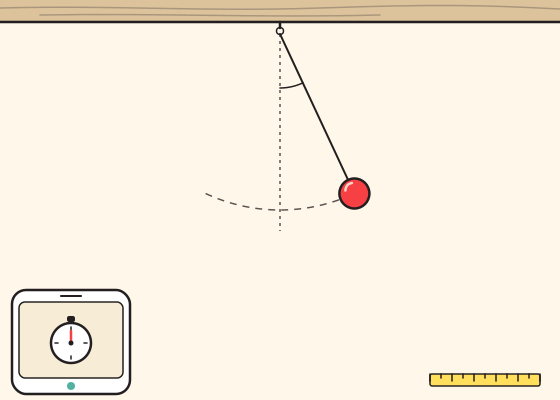
The drawing shows where it starts. It runs here once its script has loaded.El dibujo muestra dónde empieza. Funciona aquí una vez que carga su código.
Your challengeSu reto
- Let the ball go and time ten swings.Suelte la pelota y mida diez vaivenes. Not done yet.Todavía no.
- Time a light ball and a heavy ball on the same string, pulled out the same way.Mida una pelota ligera y una pesada en la misma cuerda, separadas igual. Not done yet.Todavía no.
- Pull it out sixty degrees or more and time ten swings. Does one swing match the formula for small swings?Sepárela sesenta grados o más y mida diez vaivenes. ¿Un vaivén coincide con la fórmula para vaivenes pequeños? Not done yet.Todavía no.
- Make ten swings take twenty seconds, give or take a tenth: the swing of a clock that ticks each second.Haga que diez vaivenes tarden veinte segundos, con una décima más o menos: el vaivén de un reloj que hace tic cada segundo. Not done yet.Todavía no.
Every challenge done. Now try it for real at home.Todos los retos logrados. Ahora pruébelo de verdad en casa.
How wide it swings nowQué tan amplio es el vaivén ahora
One swing, there and back:Un vaivén, de ida y vuelta:
The formula for small swings:La fórmula para vaivenes pequeños:
The ball:La pelota:
Stopwatch:Cronómetro:
One swing is there and back: the ball leaves your hand, swings across, and comes back to where it started. The stopwatch starts when you let go, counts each return, and stops at ten. The dashed ball is where it started; the tape is fifty centimeters long.Un vaivén es de ida y vuelta: la pelota sale de su mano, cruza y regresa a donde empezó. El cronómetro arranca al soltarla, cuenta cada regreso y se detiene en diez. La pelota punteada es donde empezó; la cinta mide cincuenta centímetros.
What is happeningQué está pasando
A pendulum is a weight on a string. Pull it to one side and let go: gravity pulls it back down, it swings past the bottom, slows as it climbs the other side, and comes back. One swing, there and back, is its period.Un péndulo es un peso colgado de una cuerda. Sepárelo hacia un lado y suéltelo: la gravedad lo jala hacia abajo, pasa por el punto más bajo, se frena al subir del otro lado y regresa. Un vaivén, de ida y vuelta, es su periodo.
The length of the string sets the period: a longer string swings slower, and a string four times as long takes twice as long. The weight hardly matters. Gravity pulls a heavy ball harder, but a heavy ball is harder to get moving by just as much, so a heavy ball and a light one swing together.El largo de la cuerda decide el periodo: una cuerda más larga se mece más despacio, y una cuerda cuatro veces más larga tarda el doble. El peso casi no importa. La gravedad jala más fuerte a una pelota pesada, pero a una pelota pesada también cuesta más ponerla en movimiento, en la misma medida, así que una pesada y una ligera se mecen juntas.
How far you pull it out matters only a little. Small swings all take about the same time, which is why pendulums once kept clocks; a wide swing takes a little longer. The air slowly steals the swing, and a light ball loses its swing sooner than a heavy one.Qué tanto la separe importa solo un poco. Los vaivenes pequeños tardan casi lo mismo, y por eso los péndulos marcaban el tiempo en los relojes; un vaivén amplio tarda un poco más. El aire le roba el vaivén poco a poco, y una pelota ligera lo pierde antes que una pesada.
To time it well, time ten swings and divide by ten. Your thumb is a little late on the stopwatch at the start and at the end, and over ten swings that slip is shared ten ways.Para medirlo bien, mida diez vaivenes y divida entre diez. Su dedo llega un poco tarde al cronómetro al empezar y al terminar, y en diez vaivenes ese error se reparte en diez partes.
Things to tryCosas para probar
- Make the string four times as long. Does one swing take twice as long?Haga la cuerda cuatro veces más larga. ¿Un vaivén tarda el doble?
- Turn the air off and watch how wide it swings. Does the swing ever shrink?Quite el aire y observe qué tan amplio es el vaivén. ¿Se hace más pequeño alguna vez?
- With the air on, pull the wooden ball and then the steel ball out wide. Which one loses its swing first?Con el aire puesto, separe mucho la pelota de madera y luego la de acero. ¿Cuál pierde primero su vaivén?
- Make your own with a string, a lump of clay and a phone stopwatch, and time it beside the screen.Haga el suyo con una cuerda, una bolita de plastilina y el cronómetro de un teléfono, y mídalo junto a la pantalla.
A model: the string does not stretch or weigh anything and the knot does not rub, though in a real pendulum the knot and the string often take the swing away faster than the air does. The balls are all four centimeters across, and the clay’s weight is the model’s choice. A thumb on a real stopwatch is late by about a fifth of a second; this stopwatch is not, so your own times will wander a little more.Un modelo: la cuerda no se estira ni pesa nada y el nudo no roza, aunque en un péndulo real el nudo y la cuerda a menudo le quitan el vaivén más rápido que el aire. Todas las pelotas miden cuatro centímetros, y el peso de la plastilina es una elección del modelo. Un dedo en un cronómetro real llega tarde por como una quinta parte de segundo; este cronómetro no, así que sus tiempos variarán un poco más.
Open the simulation on its own pageAbrir la simulación en su propia página
Your engineering challengeSu reto de ingeniería
Use your line to predict how long you will take to walk a longer distance, write the prediction down, then walk it and see how close you came.Use su recta para predecir cuánto tardará en caminar una distancia más larga, anote su predicción, luego camínela y vea qué tan cerca quedó.
Make it an experimentConviértalo en un experimento
Science is about changing one thing and watching what happens. Write down your guess, your hypothesis, before you start.La ciencia se trata de cambiar una cosa y observar qué pasa. Escriba su suposición, su hipótesis, antes de empezar.
- Walk the same marks fast, then slowly, and draw both lines on the same graph.Camine las mismas marcas rápido y luego lentamente, y dibuje las dos rectas en la misma gráfica.
- Clock a grown-up and a kid on the same course and compare the slopes.Cronometre a una persona adulta y a una niña o un niño en el mismo recorrido y compare las pendientes.
- Start from standing still at the start line and look closely at the first marks: does the line bend at the start?Empiece desde estar parado en la línea de salida y fíjese bien en las primeras marcas: ¿se dobla la recta al principio?
Use it, share it, adapt itÚsela, compártala, adáptela
The credit to copyEl crédito para copiar
Free BYRD, CC BY. “Clock a walk and find your speed on a graph” from the Byrd Academy STEM Curriculum by Byrd EDU, byrdathome.org.Free BYRD, CC BY. “Cronometre una caminata y encuentre su velocidad en una gráfica”, del Currículo STEM de Byrd Academy, de Byrd EDU, byrdathome.org.
This is free to use, share and adapt, even commercially, under the Creative Commons Attribution 4.0 International license (CC BY 4.0), with this credit. What Free BYRD means.Esto es libre de usar, compartir y adaptar, incluso con fines comerciales, bajo la licencia Creative Commons Atribución 4.0 Internacional (CC BY 4.0), con este crédito. Qué significa Free BYRD.