

ExploreExplorarBH-0049
Time a pendulum with a phone stopwatchMida el tiempo de un péndulo con el cronómetro de un teléfono
Hang a soft weight on a string, time ten swings with a phone stopwatch, and find out which change slows a pendulum down: a longer string, a heavier weight or a bigger pull.Cuelgue un peso suave de una cuerda, mida diez vaivenes con el cronómetro de un teléfono y descubra qué cambio hace más lento un péndulo: una cuerda más larga, un peso mayor o un jalón más grande.
- Ways in:Formas de empezar:
- Read, 3 minutesLeer, 3 minutos
- Do, 30 minutesHacer, 30 minutos
- Simulate, 10 minutesSimular, 10 minutos
- AgesEdades
- Every age. Best for ages 9 and up.Todas las edades. Ideal desde los 9 años.
- CostCosto
- Things already at homeCosas que ya hay en casa
The MESH'D components this item uses:Los componentes MESH'D que usa:ManufacturingManufacturaSoftwareSoftware
Do, about 30 minutesHacer, unos 30 minutos
Build it at homeConstrúyalo en casa
StepsPasos
- Pour the rice into the toe of the sock and tie one end of the string tightly around the sock just above the rice. That is your weight.Eche el arroz en la punta del calcetín y ate bien un extremo de la cuerda alrededor del calcetín, justo arriba del arroz. Ese es su peso.
- A grown-up ties or tapes the other end to the broom handle or the top of the doorway, so the weight hangs freely above the floor.Una persona adulta ata o pega con cinta el otro extremo al palo de escoba o a la parte de arriba del marco, para que el peso cuelgue libre sobre el piso.
- Measure the string from where it hangs to the middle of the weight, and write it down.Mida la cuerda desde donde cuelga hasta la mitad del peso y anótelo.
- Pull the weight to one side, about a hand's width, and let go without pushing.Jale el peso hacia un lado, como el ancho de una mano, y suéltelo sin empujar.
- Start the stopwatch as you let go and count ten full swings, there and back. Stop it on the tenth return.Arranque el cronómetro al soltar y cuente diez vaivenes completos, de ida y vuelta. Deténgalo en el décimo regreso.
- Divide the time by ten to find one swing. Do it three times so you can trust your number.Divida el tiempo entre diez para saber cuánto dura un vaivén. Hágalo tres veces para poder confiar en su número.
- Change one thing, the length, the weight or the start, and time ten swings again. Write each result in a table.Cambie una sola cosa, el largo, el peso o el inicio, y vuelva a medir diez vaivenes. Anote cada resultado en una tabla.
- A grown-up takes the pendulum down when you finish, and you wind up the string.Al terminar, una persona adulta quita el péndulo y usted enrolla la cuerda.
What you needLo que necesita
- String about as long as you are tallUna cuerda más o menos tan larga como su estatura
- A clean sock and a few spoonfuls of dry riceUn calcetín limpio y unas cucharadas de arroz crudo
- A broom handle laid across the backs of two chairs, or a doorway to hang fromUn palo de escoba apoyado sobre los respaldos de dos sillas, o el marco de una puerta para colgarlo
- Tape and a measuring tape or rulerCinta adhesiva y una cinta métrica o una regla
- A phone stopwatch, or any stopwatchEl cronómetro de un teléfono, o cualquier cronómetro
- Paper and a pencilPapel y un lápiz
Things already at home.Cosas que ya hay en casa.
A grown-up hangs the pendulum and takes it down after. Long strings and cords can strangle, so keep the string away from necks, never tie it in a loop anyone could put their head through, and let little ones watch rather than hold it. Use a soft weight, such as rice in a sock, keep faces out of its path, and clear the floor so no one trips.Una persona adulta cuelga el péndulo y lo quita al final. Las cuerdas y los cordones largos pueden estrangular, así que mantenga la cuerda lejos del cuello, nunca la ate en un lazo por el que alguien pueda meter la cabeza y deje que los más pequeños miren en vez de sostenerla. Use un peso suave, como arroz dentro de un calcetín, mantenga las caras fuera de su camino y despeje el piso para que nadie se tropiece.
Read, 3 minutesLeer, 3 minutos
The big ideaLa gran idea
A pendulum is a weight hanging from a string. Pull it aside and let go: gravity pulls it down, it swings past the bottom, slows as it climbs the other side, and comes back. The time for one full swing, there and back, is its period. The period depends almost only on the length of the string: a longer string swings more slowly. The weight does not change it, and a small swing and a slightly bigger one take nearly the same time. That steady beat made the pendulum the first accurate clock: the first pendulum clock, built more than three hundred fifty years ago, kept time to within a minute a day, better than any clock before it.Un péndulo es un peso que cuelga de una cuerda. Sepárelo hacia un lado y suéltelo: la gravedad lo jala hacia abajo, pasa por el punto más bajo, se frena al subir del otro lado y regresa. El tiempo de un vaivén completo, de ida y vuelta, es su periodo. El periodo depende casi solo del largo de la cuerda: una cuerda más larga se mece más despacio. El peso no lo cambia, y un vaivén pequeño y uno un poco más grande tardan casi lo mismo. Ese ritmo constante hizo del péndulo el primer reloj exacto: el primer reloj de péndulo, construido hace más de trescientos cincuenta años, se desviaba menos de un minuto al día, mejor que cualquier reloj anterior.
Simulate, 10 minutesSimular, 10 minutos
Time a pendulumMida el tiempo de un péndulo
Hang a ball on a string, let it go, and time ten swings the way a family does with a phone stopwatch. Find out what changes the swing and what does not.Cuelgue una pelota de una cuerda, suéltela y mida diez vaivenes como lo hace una familia con el cronómetro de un teléfono. Descubra qué cambia el vaivén y qué no.
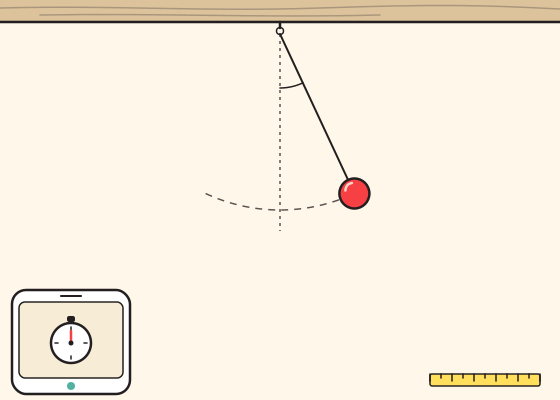
The drawing shows where it starts. It runs here once its script has loaded.El dibujo muestra dónde empieza. Funciona aquí una vez que carga su código.
Your challengeSu reto
- Let the ball go and time ten swings.Suelte la pelota y mida diez vaivenes. Not done yet.Todavía no.
- Time a light ball and a heavy ball on the same string, pulled out the same way.Mida una pelota ligera y una pesada en la misma cuerda, separadas igual. Not done yet.Todavía no.
- Pull it out sixty degrees or more and time ten swings. Does one swing match the formula for small swings?Sepárela sesenta grados o más y mida diez vaivenes. ¿Un vaivén coincide con la fórmula para vaivenes pequeños? Not done yet.Todavía no.
- Make ten swings take twenty seconds, give or take a tenth: the swing of a clock that ticks each second.Haga que diez vaivenes tarden veinte segundos, con una décima más o menos: el vaivén de un reloj que hace tic cada segundo. Not done yet.Todavía no.
Every challenge done. Now try it for real at home.Todos los retos logrados. Ahora pruébelo de verdad en casa.
How wide it swings nowQué tan amplio es el vaivén ahora
One swing, there and back:Un vaivén, de ida y vuelta:
The formula for small swings:La fórmula para vaivenes pequeños:
The ball:La pelota:
Stopwatch:Cronómetro:
One swing is there and back: the ball leaves your hand, swings across, and comes back to where it started. The stopwatch starts when you let go, counts each return, and stops at ten. The dashed ball is where it started; the tape is fifty centimeters long.Un vaivén es de ida y vuelta: la pelota sale de su mano, cruza y regresa a donde empezó. El cronómetro arranca al soltarla, cuenta cada regreso y se detiene en diez. La pelota punteada es donde empezó; la cinta mide cincuenta centímetros.
What is happeningQué está pasando
A pendulum is a weight on a string. Pull it to one side and let go: gravity pulls it back down, it swings past the bottom, slows as it climbs the other side, and comes back. One swing, there and back, is its period.Un péndulo es un peso colgado de una cuerda. Sepárelo hacia un lado y suéltelo: la gravedad lo jala hacia abajo, pasa por el punto más bajo, se frena al subir del otro lado y regresa. Un vaivén, de ida y vuelta, es su periodo.
The length of the string sets the period: a longer string swings slower, and a string four times as long takes twice as long. The weight hardly matters. Gravity pulls a heavy ball harder, but a heavy ball is harder to get moving by just as much, so a heavy ball and a light one swing together.El largo de la cuerda decide el periodo: una cuerda más larga se mece más despacio, y una cuerda cuatro veces más larga tarda el doble. El peso casi no importa. La gravedad jala más fuerte a una pelota pesada, pero a una pelota pesada también cuesta más ponerla en movimiento, en la misma medida, así que una pesada y una ligera se mecen juntas.
How far you pull it out matters only a little. Small swings all take about the same time, which is why pendulums once kept clocks; a wide swing takes a little longer. The air slowly steals the swing, and a light ball loses its swing sooner than a heavy one.Qué tanto la separe importa solo un poco. Los vaivenes pequeños tardan casi lo mismo, y por eso los péndulos marcaban el tiempo en los relojes; un vaivén amplio tarda un poco más. El aire le roba el vaivén poco a poco, y una pelota ligera lo pierde antes que una pesada.
To time it well, time ten swings and divide by ten. Your thumb is a little late on the stopwatch at the start and at the end, and over ten swings that slip is shared ten ways.Para medirlo bien, mida diez vaivenes y divida entre diez. Su dedo llega un poco tarde al cronómetro al empezar y al terminar, y en diez vaivenes ese error se reparte en diez partes.
Things to tryCosas para probar
- Make the string four times as long. Does one swing take twice as long?Haga la cuerda cuatro veces más larga. ¿Un vaivén tarda el doble?
- Turn the air off and watch how wide it swings. Does the swing ever shrink?Quite el aire y observe qué tan amplio es el vaivén. ¿Se hace más pequeño alguna vez?
- With the air on, pull the wooden ball and then the steel ball out wide. Which one loses its swing first?Con el aire puesto, separe mucho la pelota de madera y luego la de acero. ¿Cuál pierde primero su vaivén?
- Make your own with a string, a lump of clay and a phone stopwatch, and time it beside the screen.Haga el suyo con una cuerda, una bolita de plastilina y el cronómetro de un teléfono, y mídalo junto a la pantalla.
A model: the string does not stretch or weigh anything and the knot does not rub, though in a real pendulum the knot and the string often take the swing away faster than the air does. The balls are all four centimeters across, and the clay’s weight is the model’s choice. A thumb on a real stopwatch is late by about a fifth of a second; this stopwatch is not, so your own times will wander a little more.Un modelo: la cuerda no se estira ni pesa nada y el nudo no roza, aunque en un péndulo real el nudo y la cuerda a menudo le quitan el vaivén más rápido que el aire. Todas las pelotas miden cuatro centímetros, y el peso de la plastilina es una elección del modelo. Un dedo en un cronómetro real llega tarde por como una quinta parte de segundo; este cronómetro no, así que sus tiempos variarán un poco más.
Open the simulation on its own pageAbrir la simulación en su propia página
Your engineering challengeSu reto de ingeniería
Build a seconds pendulum: one that takes exactly one second to swing from one side to the other. Change only the length until ten one-way swings take ten seconds. How long is your string?Construya un péndulo de segundos: uno que tarde justo un segundo en ir de un lado al otro. Cambie solo el largo hasta que diez idas de un lado al otro tarden diez segundos. ¿Qué tan larga es su cuerda?
Make it an experimentConviértalo en un experimento
Science is about changing one thing and watching what happens. Write down your guess, your hypothesis, before you start.La ciencia se trata de cambiar una cosa y observar qué pasa. Escriba su suposición, su hipótesis, antes de empezar.
- Change only the length: time ten swings with the string long, then half as long, then a quarter as long.Cambie solo el largo: mida diez vaivenes con la cuerda larga, luego a la mitad y luego a la cuarta parte.
- Change only the weight: put more rice in the sock, tie it at the same length, and time ten swings again.Cambie solo el peso: ponga más arroz en el calcetín, átelo al mismo largo y vuelva a medir diez vaivenes.
- Change only the start: let go from a small pull, about a hand's width, then from a pull twice as wide, and time ten swings each.Cambie solo el inicio: suéltelo desde un jalón pequeño, como el ancho de una mano, y luego desde uno del doble de ancho, y mida diez vaivenes en cada caso.
Use it, share it, adapt itÚsela, compártala, adáptela
The credit to copyEl crédito para copiar
Free BYRD, CC BY. “Time a pendulum with a phone stopwatch” from the Byrd Academy STEM Curriculum by Byrd EDU, byrdathome.org.Free BYRD, CC BY. “Mida el tiempo de un péndulo con el cronómetro de un teléfono”, del Currículo STEM de Byrd Academy, de Byrd EDU, byrdathome.org.
This is free to use, share and adapt, even commercially, under the Creative Commons Attribution 4.0 International license (CC BY 4.0), with this credit. What Free BYRD means.Esto es libre de usar, compartir y adaptar, incluso con fines comerciales, bajo la licencia Creative Commons Atribución 4.0 Internacional (CC BY 4.0), con este crédito. Qué significa Free BYRD.