

SimulationsSimulacionesSIM-0001
Simulate, 5 minutesSimular, 5 minutos
Air pressure in a bottleLa presión del aire en una botella
Pull air out of a bottle through its straw and watch what the air outside does to a balloon on top of the bottle, or inside it.Saque aire de una botella por su popote y vea lo que el aire de afuera le hace a un globo sobre la botella, o dentro de ella.
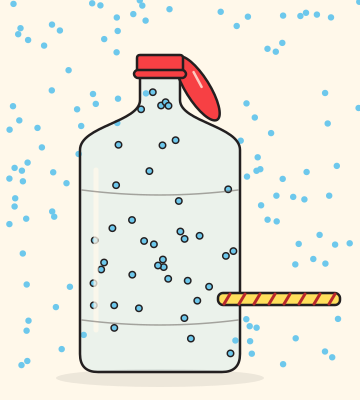
The drawing shows where it starts. It runs here once its script has loaded.El dibujo muestra dónde empieza. Funciona aquí una vez que carga su código.
Your challengeSu reto
- Pull enough air out that the balloon on top sinks into the bottle.Saque suficiente aire para que el globo de arriba se meta en la botella. Not done yet.Todavía no.
- Put the balloon inside, then pull until the outside pushes harder by five kilopascals.Ponga el globo adentro y saque aire hasta que afuera empuje cinco kilopascales más fuerte. Not done yet.Todavía no.
- Pull more air out than a mouth can.Saque más aire del que puede sacar una boca. Not done yet.Todavía no.
Every challenge done. Now try it for real at home.Todos los retos logrados. Ahora pruébelo de verdad en casa.
Air pressure outsidePresión del aire afuera
Air pressure inside the bottlePresión del aire dentro de la botella
The outside pushes harder byAfuera empuja más fuerte por
The blue arrow is the push of the air in the room, the dark one the push of the air in the bottle, each as long as its pressure.La flecha azul es el empuje del aire del cuarto, la oscura el empuje del aire de la botella, cada una tan larga como su presión.
What is happeningQué está pasando
Air is made of tiny particles that never stop moving. Every time they bump into something, they push on it. All of those pushes together are air pressure.El aire está hecho de partículas diminutas que nunca dejan de moverse. Cada vez que chocan con algo, lo empujan. Todos esos empujones juntos son la presión del aire.
When you pull air out through the straw, fewer particles are left inside the bottle to push. The air outside still pushes just as hard, so it wins: it pushes a balloon on top down into the bottle, and it fills a balloon inside the bottle, whose opening lets the outside air in.Al sacar aire por el popote, quedan menos partículas dentro de la botella para empujar. El aire de afuera sigue empujando igual de fuerte, así que gana: empuja hacia adentro un globo puesto encima de la botella, y llena un globo puesto dentro de la botella, cuya abertura deja entrar el aire de afuera.
Pull out every particle and you would have a vacuum, a space with no matter in it. A mouth can only pull a little of the air out; a pump can pull out much more.Si sacara todas las partículas tendría un vacío, un espacio sin materia. Con la boca solo se puede sacar un poco del aire; una bomba puede sacar mucho más.
Things to tryCosas para probar
- Pull out a little air, then a lot, and watch how far the balloon moves.Saque un poco de aire, luego mucho, y vea cuánto se mueve el globo.
- Move the balloon from the top to the inside, and pull again.Cambie el globo de arriba hacia adentro y vuelva a sacar aire.
- Watch the two pressures: the balloon always moves toward the side that pushes less.Observe las dos presiones: el globo siempre se mueve hacia el lado que empuja menos.
The numbers come from a simple model: Boyle’s law for the air and a stretchy skin for the balloon. A real balloon stiffens as it stretches and a plastic bottle squeezes in a little, so your own bottle may move a little differently.Los números vienen de un modelo sencillo: la ley de Boyle para el aire y una piel elástica para el globo. Un globo real se pone más duro al estirarse y una botella de plástico se aprieta un poco, así que su botella puede moverse un poco distinto.
Use it, share it, adapt itÚsela, compártala, adáptela
The credit to copyEl crédito para copiar
Free BYRD, CC BY. “Air pressure in a bottle” from the Byrd Academy STEM Curriculum by Byrd EDU, byrdathome.org.Free BYRD, CC BY. “La presión del aire en una botella”, del Currículo STEM de Byrd Academy, de Byrd EDU, byrdathome.org.
This is free to use, share and adapt, even commercially, under the Creative Commons Attribution 4.0 International license (CC BY 4.0), with this credit. What Free BYRD means.Esto es libre de usar, compartir y adaptar, incluso con fines comerciales, bajo la licencia Creative Commons Atribución 4.0 Internacional (CC BY 4.0), con este crédito. Qué significa Free BYRD.