

SimulationsSimulacionesSIM-0019
Simulate, 5 minutesSimular, 5 minutos
Magnets, fields and compassesImanes, campos y brújulas
See a bar magnet's field, walk a compass around it, push and pull two magnets, and find out which things at home a magnet picks up.Vea el campo de un imán de barra, mueva una brújula a su alrededor, empuje y atraiga dos imanes, y descubra qué cosas de la casa levanta un imán.
The drawing shows where it starts. It runs here once its script has loaded.El dibujo muestra dónde empieza. Funciona aquí una vez que carga su código.
Your challengeSu reto
- Take the compass all the way around the magnet.Lleve la brújula alrededor de todo el imán. Not done yet.Todavía no.
- Find a spot where the Earth turns the needle more than the magnet does.Encuentre un lugar donde la Tierra gire la aguja más que el imán. Not done yet.Todavía no.
- Turn one magnet around, bring them close and let go, so they push apart.Voltee un imán, acérquelos y suéltelos, para que se empujen. Not done yet.Todavía no.
- Test all seven things and find which ones a magnet picks up.Pruebe las siete cosas y descubra cuáles levanta un imán. Not done yet.Todavía no.
Every challenge done. Now try it for real at home.Todos los retos logrados. Ahora pruébelo de verdad en casa.
The magnet's field at the compassEl campo del imán en la brújula
The Earth's fieldEl campo de la Tierra
Between them, aEntre ellos, un
Tested:Probadas: . Picked up:Levantadas:
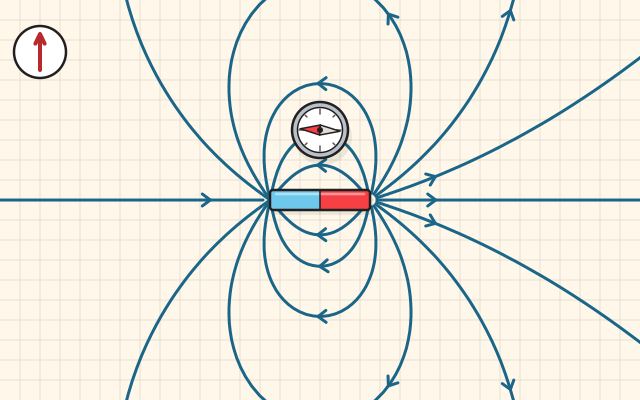
The blue lines are the magnet's own field, running out of its north end and around into its south end. The compass needle's red end points along them; it also feels the Earth's field, pointing north. Each grid square is two centimeters.Las líneas azules son el campo del imán, que sale de su polo norte y da la vuelta hasta su polo sur. La punta roja de la aguja apunta a lo largo de ellas; también siente el campo de la Tierra, que apunta al norte. Cada cuadro mide dos centímetros.
The red arrows are the push or pull on each magnet: always equal, and opposite. A magnet slides only when the push or pull beats the table's grip.Las flechas rojas son el empuje o el jalón sobre cada imán: siempre iguales y opuestos. Un imán solo se desliza cuando el empuje o el jalón vence lo que la mesa lo sujeta.
A green check means the magnet picked it up; a gray cross means it did not.Una marca verde quiere decir que el imán lo levantó; una cruz gris, que no.
What is happeningQué está pasando
Every magnet has two ends called poles, north and south. Around it is a magnetic field, which we draw as lines that leave the north pole and curve around into the south pole. Where the lines crowd together, near the poles, the field is strongest.Todo imán tiene dos extremos llamados polos, norte y sur. A su alrededor hay un campo magnético, que dibujamos como líneas que salen del polo norte y dan la vuelta hasta el polo sur. Donde las líneas se juntan, cerca de los polos, el campo es más fuerte.
A compass needle is a tiny magnet, so its north end turns to point along the field line where it sits. Go once around a bar magnet and the needle turns around twice. Far from the magnet, the Earth's own magnetism wins, and the needle points north: the whole Earth is a giant, weak magnet.La aguja de una brújula es un imán diminuto, así que su punta norte gira para apuntar a lo largo de la línea de campo donde está. Si da una vuelta alrededor de un imán de barra, la aguja da dos vueltas. Lejos del imán gana el magnetismo de la propia Tierra, y la aguja apunta al norte: toda la Tierra es un imán gigante y débil.
Opposite poles pull together and like poles push apart, and the push or pull grows quickly as the magnets get closer. Two magnets on a table slide only when that force beats the table's grip on them.Los polos opuestos se atraen y los polos iguales se empujan, y el empuje o el jalón crece rápido al acercarse los imanes. Dos imanes sobre una mesa solo se deslizan cuando esa fuerza vence lo que la mesa los sujeta.
A magnet picks up things with iron in them, like steel. Iron is full of tiny magnets that line up with the magnet's field and get pulled. Aluminum and copper are metals too, but a magnet does not pull them, and plastic and wood have no iron at all.Un imán levanta cosas que tienen hierro, como el acero. El hierro está lleno de imanes diminutos que se alinean con el campo del imán y son jalados. El aluminio y el cobre también son metales, pero el imán no los jala, y el plástico y la madera no tienen nada de hierro.
Things to tryCosas para probar
- Walk the compass slowly around the magnet and count how many times the needle turns around.Mueva la brújula despacio alrededor del imán y cuente cuántas vueltas da la aguja.
- Move the compass far past one end, then leave out the Earth's magnetism. What changes?Aleje mucho la brújula de un extremo y luego deje de contar el magnetismo de la Tierra. ¿Qué cambia?
- Find how close two magnets must be before they snap together when you let go.Descubra qué tan cerca deben estar dos imanes para que se junten de golpe al soltarlos.
- Guess before each test: will the magnet pick it up? Then try it at home with a fridge magnet.Adivine antes de cada prueba: ¿lo levantará el imán? Luego pruébelo en casa con un imán del refrigerador.
This is a model of one ceramic bar magnet, with its two poles drawn as points at its ends. Real poles spread across the ends, so up close the model cannot say how hard two touching magnets hold on. The compass feels only the level part of the Earth's field, and north here is magnetic north, a few degrees from true north. Some kinds of stainless steel are not pulled by a magnet at all.Esto es un modelo de un imán de barra de cerámica, con sus dos polos dibujados como puntos en sus extremos. Los polos reales se reparten en los extremos, así que de muy cerca el modelo no puede decir qué tan fuerte se sostienen dos imanes que se tocan. La brújula siente solo la parte horizontal del campo de la Tierra, y aquí el norte es el norte magnético, a unos pocos grados del norte verdadero. Algunos tipos de acero inoxidable no son jalados por un imán.
Use it, share it, adapt itÚsela, compártala, adáptela
The credit to copyEl crédito para copiar
Free BYRD, CC BY. “Magnets, fields and compasses” from the Byrd Academy STEM Curriculum by Byrd EDU, byrdathome.org.Free BYRD, CC BY. “Imanes, campos y brújulas”, del Currículo STEM de Byrd Academy, de Byrd EDU, byrdathome.org.
This is free to use, share and adapt, even commercially, under the Creative Commons Attribution 4.0 International license (CC BY 4.0), with this credit. What Free BYRD means.Esto es libre de usar, compartir y adaptar, incluso con fines comerciales, bajo la licencia Creative Commons Atribución 4.0 Internacional (CC BY 4.0), con este crédito. Qué significa Free BYRD.