

SimulationsSimulacionesSIM-0026
Simulate, 6 minutesSimular, 6 minutos
Water bottle rocketCohete de botella con agua
Pump up a bottle rocket, choose how much water and which fins, and see how high it flies and why the water pushes it up.Infle un cohete de botella, elija cuánta agua y qué aletas, y vea qué tan alto vuela y por qué el agua lo empuja hacia arriba.
The drawing shows where it starts. It runs here once its script has loaded.El dibujo muestra dónde empieza. Funciona aquí una vez que carga su código.
Your challengeSu reto
- Fly it with no water at all. How high does air alone push it?Hágalo volar sin nada de agua. ¿Qué tan alto lo empuja solo el aire? Not done yet.Todavía no.
- Fill it so full that the air runs out of push before the water is out.Llénelo tanto que al aire se le acabe el empuje antes de que salga el agua. Not done yet.Todavía no.
- Find the water fill that flies highest for the pressure and fins you chose.Encuentre la cantidad de agua que vuela más alto con la presión y las aletas que eligió. Not done yet.Todavía no.
- Fly higher than fifty meters.Vuele a más de cincuenta metros de altura. Not done yet.Todavía no.
Every challenge done. Now try it for real at home.Todos los retos logrados. Ahora pruébelo de verdad en casa.
Highest pointPunto más alto
Time in the airTiempo en el aire
Top speedRapidez máxima
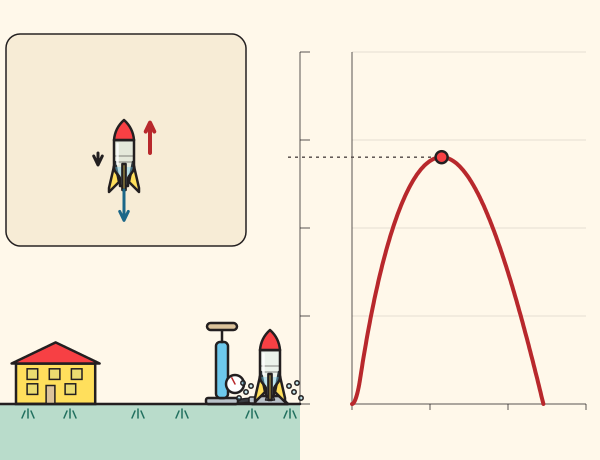
The house is seven meters tall, on the same scale as the flight; the rocket, pad and pump are drawn bigger than life. In the card of forces, the red arrow is the water pushing the rocket up and the blue arrow the rocket pushing the water down and out, equal and opposite; the dark arrows are its weight and the air's drag. Each arrow grows with its push, squeezed so they all fit. On the right, height against time; the dashed line is your last flight.La casa mide siete metros de alto, a la misma escala que el vuelo; el cohete, la base y la bomba están dibujados más grandes que en la realidad. En el cuadro de fuerzas, la flecha roja es el agua que empuja el cohete hacia arriba y la azul el cohete que empuja el agua hacia abajo y afuera, iguales y opuestas; las flechas oscuras son su peso y el arrastre del aire. Cada flecha crece con su empuje, apretadas para que quepan. A la derecha, la altura contra el tiempo; la línea punteada es su último vuelo.
What is happeningQué está pasando
The pump squeezes air into the bottle above the water. When the rocket is let go, the squeezed air shoves the water out through the bottle's mouth, very fast.La bomba aprieta aire dentro de la botella, encima del agua. Cuando se suelta el cohete, el aire apretado empuja el agua hacia afuera por la boca de la botella, muy rápido.
Pushing the water down pushes the rocket up, just as hard: every push comes with an equal push back the other way. That is Newton's third law, and it is how every rocket flies. At liftoff the push is many times the rocket's weight, but it lasts only a fraction of a second.Al empujar el agua hacia abajo, el cohete es empujado hacia arriba con la misma fuerza: cada empuje viene con un empuje igual de regreso en sentido contrario. Esa es la tercera ley de Newton, y así vuela todo cohete. Al despegar, el empuje es muchas veces el peso del cohete, pero dura solo una fracción de segundo.
After the push, the rocket coasts. Its weight and the air's drag slow it until it stops at its highest point, then it falls back. Water is what the rocket throws out the back: with none there is little push, and with too much the rocket is heavy and the air runs out of push first. Fins keep it flying point first, so the air drags on it least.Después del empuje, el cohete sigue subiendo solo. Su peso y el arrastre del aire lo frenan hasta que se detiene en su punto más alto, y luego cae. El agua es lo que el cohete lanza hacia atrás: sin agua hay poco empuje, y con demasiada el cohete pesa mucho y al aire se le acaba el empuje primero. Las aletas lo mantienen volando con la punta adelante, así que el aire lo frena lo menos posible.
Things to tryCosas para probar
- Keep the pressure the same and change only the water, five percent at a time. Where is the best fill?Deje la misma presión y cambie solo el agua, de cinco en cinco por ciento. ¿Dónde está la mejor cantidad?
- Fly with no fins, then with small fins, then with big fins, and compare the dashed line with the new one.Vuele sin aletas, luego con aletas chicas y luego con aletas grandes, y compare la línea punteada con la nueva.
- Read the graph: where is the rocket moving fastest, and where does it stop for an instant?Lea la gráfica: ¿dónde se mueve más rápido el cohete, y dónde se detiene por un instante?
- Building a real one? A grown-up runs every pressurized launch, outdoors in an open field. Everyone wears eye protection, stays well back, and no one ever stands over the rocket.¿Va a construir uno de verdad? Un adulto dirige cada lanzamiento con presión, afuera en un campo abierto. Todos usan protección para los ojos, se quedan bien lejos, y nadie se para nunca encima del cohete.
The flight comes from a simple model: the water's push from the air pressure, the air cooling as it expands, the rocket's weight and the air's drag, straight up and down. It leaves out wind, tilting, wobbling and the push lost in a real nozzle, so a real rocket flies lower. Safety first: a grown-up runs any real pressurized launch, outdoors, with eye protection on, and no one ever stands over the rocket.El vuelo sale de un modelo sencillo: el empuje del agua por la presión del aire, el aire que se enfría al expandirse, el peso del cohete y el arrastre del aire, solo hacia arriba y hacia abajo. No toma en cuenta el viento, la inclinación, el bamboleo ni el empuje que se pierde en una boquilla real, así que un cohete real vuela más bajo. Primero la seguridad: un adulto dirige cualquier lanzamiento real con presión, afuera, con protección para los ojos, y nadie se para nunca encima del cohete.
Use it, share it, adapt itÚsela, compártala, adáptela
The credit to copyEl crédito para copiar
Free BYRD, CC BY. “Water bottle rocket” from the Byrd Academy STEM Curriculum by Byrd EDU, byrdathome.org.Free BYRD, CC BY. “Cohete de botella con agua”, del Currículo STEM de Byrd Academy, de Byrd EDU, byrdathome.org.
This is free to use, share and adapt, even commercially, under the Creative Commons Attribution 4.0 International license (CC BY 4.0), with this credit. What Free BYRD means.Esto es libre de usar, compartir y adaptar, incluso con fines comerciales, bajo la licencia Creative Commons Atribución 4.0 Internacional (CC BY 4.0), con este crédito. Qué significa Free BYRD.