

ExploreExplorarBH-0057
Launch a balloon rocket on a stringLance un cohete de globo por una cuerda
Thread a straw on a string, tape a blown-up balloon to it, let go, and find out what makes the rocket fly farther along the line.Pase un popote por una cuerda, pegue un globo inflado al popote, suéltelo y descubra qué hace que el cohete llegue más lejos por la cuerda.
- Ways in:Formas de empezar:
- Read, 3 minutesLeer, 3 minutos
- Do, 30 minutesHacer, 30 minutos
- Simulate, 6 minutesSimular, 6 minutos
- AgesEdades
- Every age. Best for ages 6 and up.Todas las edades. Ideal desde los 6 años.
- CostCosto
- Under a few dollarsMenos de unos pocos dólares
The MESH'D components this item uses:Los componentes MESH'D que usa:ManufacturingManufacturaHolistic DesignDiseño integral
Do, about 30 minutesHacer, unos 30 minutos
Build it at homeConstrúyalo en casa
StepsPasos
- Tie one end of the string to a chair back or a doorknob.Amarre un extremo de la cuerda al respaldo de una silla o a la perilla de una puerta.
- Thread the straw onto the string, then pull the string tight and tie the other end across the room at the same height.Pase el popote por la cuerda, luego estire bien la cuerda y amarre el otro extremo al otro lado del cuarto, a la misma altura.
- A grown-up blows up the balloon and pinches the end shut with the clothespin, without tying it.Una persona adulta infla el globo y cierra la boca con la pinza, sin amarrarlo.
- Tape the balloon to the straw, with the open end pointing back toward the start of the string.Pegue el globo al popote, con la boca apuntando hacia el inicio de la cuerda.
- Slide the rocket back to the start. Count down and take off the clip.Regrese el cohete al inicio. Cuente hacia atrás y quite la pinza.
- Measure how far it went. Launch it three times the same way and write down each distance.Mida qué tan lejos llegó. Láncelo tres veces de la misma manera y anote cada distancia.
- Change one thing, launch three more times, and compare.Cambie una sola cosa, lance tres veces más y compare.
- Take the string down when you finish, and pick up every balloon and every broken piece.Al terminar, quite la cuerda y recoja cada globo y cada pedazo roto.
What you needLo que necesita
- Balloons, long or roundGlobos, largos o redondos
- A drinking strawUn popote
- String or fishing line about as long as a roomUna cuerda o hilo de pescar más o menos del largo de un cuarto
- TapeCinta adhesiva
- A clothespin or a binder clipUna pinza de ropa o una pinza sujetapapeles
- A tape measure, or count your stepsUna cinta métrica, o cuente sus pasos
Under a few dollars.Menos de unos pocos dólares.
A grown-up blows up every balloon. Balloons and broken balloon pieces can choke children, so keep them away from children under three and pick up every piece right away. Many balloons are made of latex, so if anyone is allergic to latex, use balloons that are not. Run the string where no one will walk into it, keep it away from necks, keep faces away from the end of the line, and take the string down when you finish.Una persona adulta infla cada globo. Los globos y los pedazos de globo pueden asfixiar a los niños, así que manténgalos lejos de los menores de tres años y recoja cada pedazo de inmediato. Muchos globos son de látex, así que si alguien es alérgico al látex, use globos que no lo sean. Ponga la cuerda donde nadie choque con ella, lejos del cuello, mantenga las caras lejos del final de la cuerda y quítela al terminar.
Read, 3 minutesLeer, 3 minutos
The big ideaLa gran idea
A rocket flies by pushing something out of its back end. When you let go of the balloon, its stretched rubber squeezes the air inside and shoves it out through the open end. Every push comes with an equal push back the other way, so as the balloon pushes the air backward, the air pushes the balloon forward. The straw and string keep it on a straight track. A real rocket works the same way, pushing hot gas out of its engine. It carries its own fuel and the oxygen to burn it, so it needs no air around it to push against, and it works in space.Un cohete vuela empujando algo hacia afuera por su parte de atrás. Cuando usted suelta el globo, su hule estirado aprieta el aire de adentro y lo empuja hacia afuera por la boca. Todo empujón viene con un empujón igual en sentido contrario, así que mientras el globo empuja el aire hacia atrás, el aire empuja el globo hacia adelante. El popote y la cuerda lo mantienen en un camino recto. Un cohete de verdad funciona igual, empujando gas caliente hacia afuera de su motor. Lleva su propio combustible y el oxígeno para quemarlo, así que no necesita aire a su alrededor para empujar, y funciona en el espacio.
Simulate, 6 minutesSimular, 6 minutos
Water bottle rocketCohete de botella con agua
Pump up a bottle rocket, choose how much water and which fins, and see how high it flies and why the water pushes it up.Infle un cohete de botella, elija cuánta agua y qué aletas, y vea qué tan alto vuela y por qué el agua lo empuja hacia arriba.
The drawing shows where it starts. It runs here once its script has loaded.El dibujo muestra dónde empieza. Funciona aquí una vez que carga su código.
Your challengeSu reto
- Fly it with no water at all. How high does air alone push it?Hágalo volar sin nada de agua. ¿Qué tan alto lo empuja solo el aire? Not done yet.Todavía no.
- Fill it so full that the air runs out of push before the water is out.Llénelo tanto que al aire se le acabe el empuje antes de que salga el agua. Not done yet.Todavía no.
- Find the water fill that flies highest for the pressure and fins you chose.Encuentre la cantidad de agua que vuela más alto con la presión y las aletas que eligió. Not done yet.Todavía no.
- Fly higher than fifty meters.Vuele a más de cincuenta metros de altura. Not done yet.Todavía no.
Every challenge done. Now try it for real at home.Todos los retos logrados. Ahora pruébelo de verdad en casa.
Highest pointPunto más alto
Time in the airTiempo en el aire
Top speedRapidez máxima
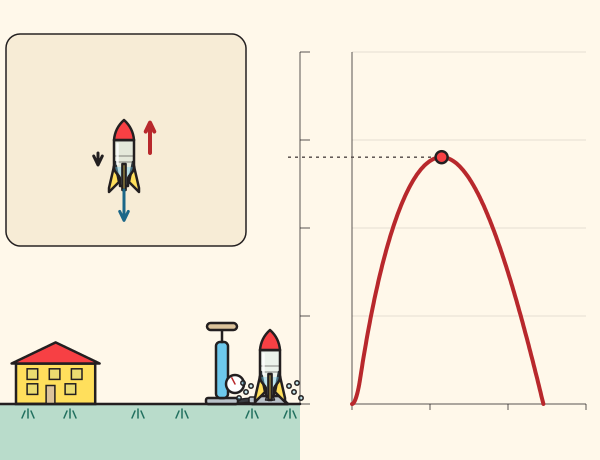
The house is seven meters tall, on the same scale as the flight; the rocket, pad and pump are drawn bigger than life. In the card of forces, the red arrow is the water pushing the rocket up and the blue arrow the rocket pushing the water down and out, equal and opposite; the dark arrows are its weight and the air's drag. Each arrow grows with its push, squeezed so they all fit. On the right, height against time; the dashed line is your last flight.La casa mide siete metros de alto, a la misma escala que el vuelo; el cohete, la base y la bomba están dibujados más grandes que en la realidad. En el cuadro de fuerzas, la flecha roja es el agua que empuja el cohete hacia arriba y la azul el cohete que empuja el agua hacia abajo y afuera, iguales y opuestas; las flechas oscuras son su peso y el arrastre del aire. Cada flecha crece con su empuje, apretadas para que quepan. A la derecha, la altura contra el tiempo; la línea punteada es su último vuelo.
What is happeningQué está pasando
The pump squeezes air into the bottle above the water. When the rocket is let go, the squeezed air shoves the water out through the bottle's mouth, very fast.La bomba aprieta aire dentro de la botella, encima del agua. Cuando se suelta el cohete, el aire apretado empuja el agua hacia afuera por la boca de la botella, muy rápido.
Pushing the water down pushes the rocket up, just as hard: every push comes with an equal push back the other way. That is Newton's third law, and it is how every rocket flies. At liftoff the push is many times the rocket's weight, but it lasts only a fraction of a second.Al empujar el agua hacia abajo, el cohete es empujado hacia arriba con la misma fuerza: cada empuje viene con un empuje igual de regreso en sentido contrario. Esa es la tercera ley de Newton, y así vuela todo cohete. Al despegar, el empuje es muchas veces el peso del cohete, pero dura solo una fracción de segundo.
After the push, the rocket coasts. Its weight and the air's drag slow it until it stops at its highest point, then it falls back. Water is what the rocket throws out the back: with none there is little push, and with too much the rocket is heavy and the air runs out of push first. Fins keep it flying point first, so the air drags on it least.Después del empuje, el cohete sigue subiendo solo. Su peso y el arrastre del aire lo frenan hasta que se detiene en su punto más alto, y luego cae. El agua es lo que el cohete lanza hacia atrás: sin agua hay poco empuje, y con demasiada el cohete pesa mucho y al aire se le acaba el empuje primero. Las aletas lo mantienen volando con la punta adelante, así que el aire lo frena lo menos posible.
Things to tryCosas para probar
- Keep the pressure the same and change only the water, five percent at a time. Where is the best fill?Deje la misma presión y cambie solo el agua, de cinco en cinco por ciento. ¿Dónde está la mejor cantidad?
- Fly with no fins, then with small fins, then with big fins, and compare the dashed line with the new one.Vuele sin aletas, luego con aletas chicas y luego con aletas grandes, y compare la línea punteada con la nueva.
- Read the graph: where is the rocket moving fastest, and where does it stop for an instant?Lea la gráfica: ¿dónde se mueve más rápido el cohete, y dónde se detiene por un instante?
- Building a real one? A grown-up runs every pressurized launch, outdoors in an open field. Everyone wears eye protection, stays well back, and no one ever stands over the rocket.¿Va a construir uno de verdad? Un adulto dirige cada lanzamiento con presión, afuera en un campo abierto. Todos usan protección para los ojos, se quedan bien lejos, y nadie se para nunca encima del cohete.
The flight comes from a simple model: the water's push from the air pressure, the air cooling as it expands, the rocket's weight and the air's drag, straight up and down. It leaves out wind, tilting, wobbling and the push lost in a real nozzle, so a real rocket flies lower. Safety first: a grown-up runs any real pressurized launch, outdoors, with eye protection on, and no one ever stands over the rocket.El vuelo sale de un modelo sencillo: el empuje del agua por la presión del aire, el aire que se enfría al expandirse, el peso del cohete y el arrastre del aire, solo hacia arriba y hacia abajo. No toma en cuenta el viento, la inclinación, el bamboleo ni el empuje que se pierde en una boquilla real, así que un cohete real vuela más bajo. Primero la seguridad: un adulto dirige cualquier lanzamiento real con presión, afuera, con protección para los ojos, y nadie se para nunca encima del cohete.
Open the simulation on its own pageAbrir la simulación en su propia página
Your engineering challengeSu reto de ingeniería
Make the rocket carry cargo. Tape a small paper cup under it and find the most paper clips it can carry the whole length of the string.Haga que el cohete lleve carga. Pegue un vasito de papel debajo y encuentre la mayor cantidad de clips que puede llevar por todo el largo de la cuerda.
Make it an experimentConviértalo en un experimento
Science is about changing one thing and watching what happens. Write down your guess, your hypothesis, before you start.La ciencia se trata de cambiar una cosa y observar qué pasa. Escriba su suposición, su hipótesis, antes de empezar.
- Change only how big the balloon is: blow it up small, medium and large, measuring around it with a string, and launch each one three times.Cambie solo el tamaño del globo: ínflelo chico, mediano y grande, midiendo su contorno con una cuerda, y lance cada uno tres veces.
- Change only the shape: a long balloon against a round one, blown up to about the same size.Cambie solo la forma: un globo largo contra uno redondo, inflados más o menos al mismo tamaño.
- Change only the slope: tie the far end of the string higher, then lower, and see how far the rocket climbs.Cambie solo la inclinación: amarre el otro extremo de la cuerda más alto y luego más bajo, y vea qué tan lejos sube el cohete.
Use it, share it, adapt itÚsela, compártala, adáptela
The credit to copyEl crédito para copiar
Free BYRD, CC BY. “Launch a balloon rocket on a string” from the Byrd Academy STEM Curriculum by Byrd EDU, byrdathome.org.Free BYRD, CC BY. “Lance un cohete de globo por una cuerda”, del Currículo STEM de Byrd Academy, de Byrd EDU, byrdathome.org.
This is free to use, share and adapt, even commercially, under the Creative Commons Attribution 4.0 International license (CC BY 4.0), with this credit. What Free BYRD means.Esto es libre de usar, compartir y adaptar, incluso con fines comerciales, bajo la licencia Creative Commons Atribución 4.0 Internacional (CC BY 4.0), con este crédito. Qué significa Free BYRD.
Keep goingSiga adelante
What to do nextQué hacer después
Make it harderHágalo más difícil
Measure speed. Time each trip with a phone stopwatch and divide the distance by the time. Then graph speed against the size of the balloon, and explain the shape of your graph using pushes and the weight the rocket has to carry.Mida la velocidad. Tome el tiempo de cada viaje con el cronómetro de un teléfono y divida la distancia entre el tiempo. Luego haga una gráfica de la velocidad contra el tamaño del globo y explique la forma de su gráfica con los empujones y el peso que tiene que llevar el cohete.
For a younger onePara alguien más pequeño
A younger child can count down and call out where the rocket stops. The grown-up blows up and handles every balloon. A child under three, or any child who still puts things in their mouth, watches from a safe spot with no balloon or balloon piece within reach.La niña o el niño más pequeño puede contar hacia atrás y decir dónde se detiene el cohete. La persona adulta infla y maneja cada globo. Un niño menor de tres años, o cualquier niño que todavía se mete cosas en la boca, mira desde un lugar seguro sin ningún globo ni pedazo de globo a su alcance.
Try this nextPruebe esto después
Water bottle rocketCohete de botella con agua
Pump up a bottle rocket, choose how much water and which fins, and see how high it flies and why the water pushes it up.Infle un cohete de botella, elija cuánta agua y qué aletas, y vea qué tan alto vuela y por qué el agua lo empuja hacia arriba.
- Ways in:Formas de empezar:
- SimulateSimular
Best for ages 6 and upIdeal desde los 6 años
ManufacturingManufacturaDesignDiseño
Free BYRD, CC BYSimulationSimulación
Out to space: from the backyard to the far edgeHacia el espacio: del patio al borde lejano
Start with the sky over your backyard, ride a rocket up to the space station, then travel past the Moon, the Sun and every planet to the two Voyager spacecraft at the Sun's far edge.Empiece con el cielo sobre su patio, suba en un cohete hasta la estación espacial y luego viaje más allá de la Luna, el Sol y todos los planetas hasta las dos naves Voyager en el borde lejano del Sol.
- Ways in:Formas de empezar:
- TourRecorrer
Best for ages 5 and upIdeal desde los 5 años
DesignDiseño
Free BYRD, CC BYVirtual tourRecorrido virtual
 BH-0001
 Make a vacuumHaga un vacío
Pull the air out of a water bottle through a straw and watch a balloon shrink, then grow.Saque el aire de una botella de agua con un popote y vea cómo un globo se encoge y luego crece.
- Ways in:Formas de empezar:
- ReadLeer
- WatchVer
- DoHacer
- SimulateSimular
Best for ages 4 to 12Ideal de 4 a 12 años
ManufacturingManufacturaDesignDiseño
Free BYRD, CC BYLessonLección
Race ramp racers with a fair testHaga carreras en rampa con una prueba justa
Build a cardboard racer, roll it down a ramp, and change one thing at a time, three runs each, to find out what really makes it go farther.Construya un carrito de cartón, láncelo por una rampa y cambie una sola cosa a la vez, tres veces cada una, para descubrir qué lo hace llegar más lejos.
- Ways in:Formas de empezar:
- ReadLeer
- DoHacer
- SimulateSimular
Best for ages 6 to 12Ideal de 6 a 12 años
ManufacturingManufacturaSoftwareSoftware
Free BYRD, CC BYHome activityActividad en casa