

SimulationsSimulacionesSIM-0021
Simulate, 10 minutesSimular, 10 minutos
Ice, water and steamHielo, agua y vapor
Add heat to ice straight from the freezer, or take it away, and watch it melt, boil and turn back: the particles up close, and the temperature on a heating curve with its flat steps.Agregue calor a un hielo recién salido del congelador, o quítelo, y vea cómo se derrite, hierve y vuelve atrás: las partículas de cerca, y la temperatura en una curva de calentamiento con sus escalones planos.
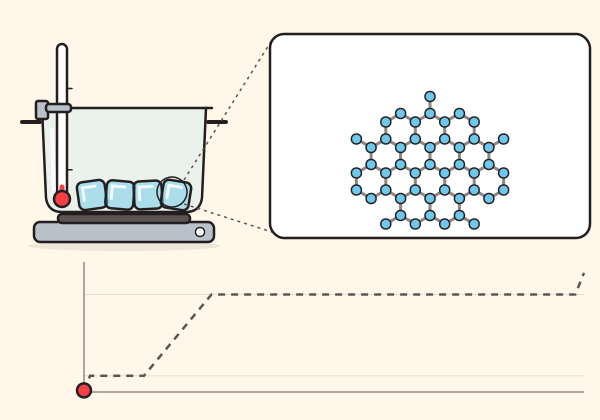
The drawing shows where it starts. It runs here once its script has loaded.El dibujo muestra dónde empieza. Funciona aquí una vez que carga su código.
Your challengeSu reto
- Melt all of the ice into water.Derrita todo el hielo hasta que sea agua. Not done yet.Todavía no.
- Boil a quarter of the water into steam and see the temperature hold still.Hierva una cuarta parte del agua hasta que sea vapor y vea que la temperatura no cambia. Not done yet.Todavía no.
- Then take heat away until it is all ice again.Luego quite calor hasta que todo vuelva a ser hielo. Not done yet.Todavía no.
- A mile high, bring the water to a boil. What temperature is it?A una milla de altura, haga hervir el agua. ¿A qué temperatura está? Not done yet.Todavía no.
Every challenge done. Now try it for real at home.Todos los retos logrados. Ahora pruébelo de verdad en casa.
TemperatureTemperatura
Ice melted into waterHielo derretido en agua
Water boiled into steamAgua hervida en vapor
Here water boils atAquí el agua hierve a
On the graph, the solid line is the path the water has taken, the dashed line the rest of the way, and the dot is where it is now. The flat steps are melting and boiling.En la gráfica, la línea continua es el camino que ha seguido el agua, la punteada el resto del camino, y el punto es donde está ahora. Los escalones planos son el derretimiento y la ebullición.
What is happeningQué está pasando
Water is made of tiny particles that never stop moving. In ice they are locked in an open pattern of rings and only shake in place. In liquid water they stay just as close, even a little closer, but slide past each other, so water pours and takes the shape of its container. In steam they fly free and far apart, and fill any space they are in.El agua está hecha de partículas diminutas que nunca dejan de moverse. En el hielo están fijas en un patrón abierto de anillos y solo tiemblan en su lugar. En el agua líquida siguen igual de cerca, hasta un poco más, pero se deslizan unas junto a otras, así que el agua se puede verter y toma la forma de su recipiente. En el vapor vuelan libres y muy separadas, y llenan cualquier espacio en el que estén.
Adding heat makes the particles move faster, and that is what a thermometer reads as a higher temperature. But while ice melts, the heat goes into breaking particles out of their pattern instead, so the temperature stays at zero degrees Celsius until all the ice is water. While water boils, the heat pulls particles out of the liquid altogether, so the temperature stays at one hundred degrees Celsius at sea level until all the water is steam. Those are the flat steps on the graph.Agregar calor hace que las partículas se muevan más rápido, y eso es lo que un termómetro marca como una temperatura más alta. Pero mientras el hielo se derrite, el calor se usa en soltar partículas de su patrón, así que la temperatura se queda en cero grados Celsius hasta que todo el hielo es agua. Mientras el agua hierve, el calor saca las partículas del líquido por completo, así que la temperatura se queda en cien grados Celsius al nivel del mar hasta que toda el agua es vapor. Esos son los escalones planos de la gráfica.
Boiling takes far more heat than anything else: about five times the heat it took to warm the water from freezing to boiling. Take heat away and everything runs backward: steam condenses into water and water freezes into ice, each at the same temperature where it boiled or melted.Hervir requiere mucho más calor que todo lo demás: cerca de cinco veces el calor que hizo falta para calentar el agua desde el punto de congelación hasta hervir. Si se quita calor, todo va al revés: el vapor se condensa en agua y el agua se congela en hielo, cada uno a la misma temperatura en la que hirvió o se derritió.
Up a mountain the air presses down less, so particles escape from the water more easily and it boils sooner, at about ninety-five degrees Celsius a mile up. That is why some recipes change at high altitude.En lo alto de una montaña el aire aprieta menos, así que las partículas escapan del agua con más facilidad y hierve antes, a cerca de noventa y cinco grados Celsius a una milla de altura. Por eso algunas recetas cambian en lugares altos.
Things to tryCosas para probar
- Add heat a little at a time and watch the dot climb the graph, then sit still on a flat step.Agregue calor poco a poco y vea cómo el punto sube por la gráfica y luego se queda quieto en un escalón plano.
- Stop halfway through melting, then halfway through boiling, and compare the particles up close.Deténgase a la mitad del derretimiento y luego a la mitad de la ebullición, y compare las partículas de cerca.
- Switch to a mile high and find where the water boils now.Cambie a una milla de altura y encuentre dónde hierve el agua ahora.
- Take heat away from the steam and watch it turn back into water, then ice.Quítele calor al vapor y vea cómo vuelve a ser agua, y luego hielo.
This is a model of one hundred grams of pure water, heated evenly and stirred. The particles are a picture, not a measurement: real steam’s particles are about twelve times farther apart than drawn, and a real drop of water holds far more particles than anyone could count. To heat steam past its boiling point it has to be held in, so the pot gets a lid.Esto es un modelo de cien gramos de agua pura, calentada de forma pareja y revuelta. Las partículas son un dibujo, no una medición: las partículas del vapor real están unas doce veces más separadas de lo que se dibuja, y una gota de agua de verdad tiene muchísimas más partículas de las que nadie podría contar. Para calentar el vapor por encima de su punto de ebullición hay que guardarlo, así que la olla lleva tapa.
Use it, share it, adapt itÚsela, compártala, adáptela
The credit to copyEl crédito para copiar
Free BYRD, CC BY. “Ice, water and steam” from the Byrd Academy STEM Curriculum by Byrd EDU, byrdathome.org.Free BYRD, CC BY. “Hielo, agua y vapor”, del Currículo STEM de Byrd Academy, de Byrd EDU, byrdathome.org.
This is free to use, share and adapt, even commercially, under the Creative Commons Attribution 4.0 International license (CC BY 4.0), with this credit. What Free BYRD means.Esto es libre de usar, compartir y adaptar, incluso con fines comerciales, bajo la licencia Creative Commons Atribución 4.0 Internacional (CC BY 4.0), con este crédito. Qué significa Free BYRD.