

ExploreExplorarBH-0053
Race ice cubes to find what melts ice fastestHaga carreras de cubos de hielo para descubrir qué los derrite más rápido
Set out matching ice cubes, change one thing for each, such as salt, sugar, a metal pan or a cup of water, and time which one turns to water first.Ponga cubos de hielo iguales, cambie una sola cosa para cada uno, como sal, azúcar, un molde de metal o un vaso con agua, y mida cuál se convierte primero en agua.
- Ways in:Formas de empezar:
- Read, 3 minutesLeer, 3 minutos
- Do, 40 minutesHacer, 40 minutos
- Simulate, 10 minutesSimular, 10 minutos
- AgesEdades
- Every age. Best for ages 5 and up.Todas las edades. Ideal desde los 5 años.
- CostCosto
- Things already at homeCosas que ya hay en casa
The MESH'D components this item uses:Los componentes MESH'D que usa:ManufacturingManufactura
Do, about 40 minutesHacer, unos 40 minutos
Build it at homeConstrúyalo en casa
StepsPasos
- Choose one thing to change and write down a guess: which cube will melt first?Escoja una sola cosa para cambiar y anote una predicción: ¿qué cubo se derretirá primero?
- Set the plates or pans side by side in the same spot, out of direct sun.Ponga los platos o moldes lado a lado en el mismo lugar, sin sol directo.
- Put one cube on each at the same moment, using the spoon, and start the timer.Ponga un cubo en cada uno al mismo tiempo, con la cuchara, y arranque el reloj.
- If you are testing toppings, sprinkle one level spoonful on each cube right away.Si está probando lo que va encima, espolvoree enseguida una cucharada rasa sobre cada cubo.
- Check every five minutes and write what each cube looks like. Touch only the edges of the plates.Revise cada cinco minutos y anote cómo se ve cada cubo. Toque solo las orillas de los platos.
- When no solid ice is left in a race spot, write down its time.Cuando ya no quede hielo sólido en un lugar de la carrera, anote su tiempo.
- Pour the water into the sink together and wipe up every drip.Tiren juntos el agua en el fregadero y sequen cada gota.
What you needLo que necesita
- Ice cubes that are all the same size, from the same trayCubos de hielo del mismo tamaño, de la misma charola
- A metal baking pan and some plastic platesUn molde de metal para hornear y unos platos de plástico
- Salt, sugar and a little sandSal, azúcar y un poco de arena
- A spoonUna cuchara
- A clock or a phone timerUn reloj o el temporizador de un teléfono
- Paper, a pencil and a towel for dripsPapel, un lápiz y una toalla para las gotas
Things already at home.Cosas que ya hay en casa.
Stay nearby for every race, and stay within arm's reach of little ones around the water. Salt stings eyes and cuts, so wash hands after sprinkling and keep them away from faces. Taste nothing, not even the sugar, since it has sat with sand and melt water. Ice held for a long time can hurt skin, so move cubes with a spoon. Wipe up every drip at once so no one slips.Quédese cerca en cada carrera, y al alcance de su brazo de los más pequeños cuando haya agua. La sal arde en los ojos y en las cortaduras, así que lávese las manos después de espolvorear y manténgalas lejos de la cara. No pruebe nada, ni siquiera el azúcar, porque estuvo junto a la arena y al agua derretida. Sostener hielo mucho tiempo puede lastimar la piel, así que mueva los cubos con una cuchara. Seque cada gota de inmediato para que nadie se resbale.
Read, 3 minutesLeer, 3 minutos
The big ideaLa gran idea
Ice melts when heat flows into it, and heat always flows from something warmer to something cooler. The better a material carries heat, the faster it can feed the ice. Metal carries heat hundreds of times better than plastic or wood, so a cube on a metal pan melts sooner than one on a plastic plate, even though both sit in the same warm room. Water carries heat about twenty-five times better than air, so a cube in a cup of water melts sooner than a cube in the open. Salt melts ice another way: it dissolves into the thin film of water on the ice and makes a mix that freezes at a lower temperature, so the ice keeps melting. That is why salt goes on icy roads.El hielo se derrite cuando le entra calor, y el calor siempre va de lo más caliente a lo más frío. Mientras mejor conduce el calor un material, más rápido puede alimentar al hielo. El metal conduce el calor cientos de veces mejor que el plástico o la madera, así que un cubo sobre un molde de metal se derrite antes que uno sobre un plato de plástico, aunque los dos estén en el mismo cuarto tibio. El agua conduce el calor unas veinticinco veces mejor que el aire, así que un cubo dentro de un vaso con agua se derrite antes que uno al aire libre. La sal derrite el hielo de otra manera: se disuelve en la capa delgada de agua que tiene el hielo y forma una mezcla que se congela a una temperatura más baja, así que el hielo sigue derritiéndose. Por eso se echa sal en los caminos con hielo.
Simulate, 10 minutesSimular, 10 minutos
Ice, water and steamHielo, agua y vapor
Add heat to ice straight from the freezer, or take it away, and watch it melt, boil and turn back: the particles up close, and the temperature on a heating curve with its flat steps.Agregue calor a un hielo recién salido del congelador, o quítelo, y vea cómo se derrite, hierve y vuelve atrás: las partículas de cerca, y la temperatura en una curva de calentamiento con sus escalones planos.
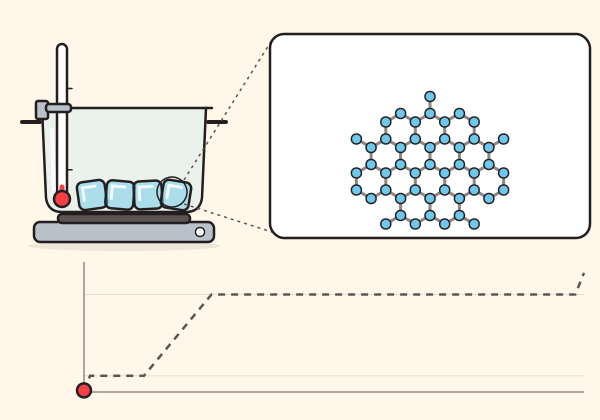
The drawing shows where it starts. It runs here once its script has loaded.El dibujo muestra dónde empieza. Funciona aquí una vez que carga su código.
Your challengeSu reto
- Melt all of the ice into water.Derrita todo el hielo hasta que sea agua. Not done yet.Todavía no.
- Boil a quarter of the water into steam and see the temperature hold still.Hierva una cuarta parte del agua hasta que sea vapor y vea que la temperatura no cambia. Not done yet.Todavía no.
- Then take heat away until it is all ice again.Luego quite calor hasta que todo vuelva a ser hielo. Not done yet.Todavía no.
- A mile high, bring the water to a boil. What temperature is it?A una milla de altura, haga hervir el agua. ¿A qué temperatura está? Not done yet.Todavía no.
Every challenge done. Now try it for real at home.Todos los retos logrados. Ahora pruébelo de verdad en casa.
TemperatureTemperatura
Ice melted into waterHielo derretido en agua
Water boiled into steamAgua hervida en vapor
Here water boils atAquí el agua hierve a
On the graph, the solid line is the path the water has taken, the dashed line the rest of the way, and the dot is where it is now. The flat steps are melting and boiling.En la gráfica, la línea continua es el camino que ha seguido el agua, la punteada el resto del camino, y el punto es donde está ahora. Los escalones planos son el derretimiento y la ebullición.
What is happeningQué está pasando
Water is made of tiny particles that never stop moving. In ice they are locked in an open pattern of rings and only shake in place. In liquid water they stay just as close, even a little closer, but slide past each other, so water pours and takes the shape of its container. In steam they fly free and far apart, and fill any space they are in.El agua está hecha de partículas diminutas que nunca dejan de moverse. En el hielo están fijas en un patrón abierto de anillos y solo tiemblan en su lugar. En el agua líquida siguen igual de cerca, hasta un poco más, pero se deslizan unas junto a otras, así que el agua se puede verter y toma la forma de su recipiente. En el vapor vuelan libres y muy separadas, y llenan cualquier espacio en el que estén.
Adding heat makes the particles move faster, and that is what a thermometer reads as a higher temperature. But while ice melts, the heat goes into breaking particles out of their pattern instead, so the temperature stays at zero degrees Celsius until all the ice is water. While water boils, the heat pulls particles out of the liquid altogether, so the temperature stays at one hundred degrees Celsius at sea level until all the water is steam. Those are the flat steps on the graph.Agregar calor hace que las partículas se muevan más rápido, y eso es lo que un termómetro marca como una temperatura más alta. Pero mientras el hielo se derrite, el calor se usa en soltar partículas de su patrón, así que la temperatura se queda en cero grados Celsius hasta que todo el hielo es agua. Mientras el agua hierve, el calor saca las partículas del líquido por completo, así que la temperatura se queda en cien grados Celsius al nivel del mar hasta que toda el agua es vapor. Esos son los escalones planos de la gráfica.
Boiling takes far more heat than anything else: about five times the heat it took to warm the water from freezing to boiling. Take heat away and everything runs backward: steam condenses into water and water freezes into ice, each at the same temperature where it boiled or melted.Hervir requiere mucho más calor que todo lo demás: cerca de cinco veces el calor que hizo falta para calentar el agua desde el punto de congelación hasta hervir. Si se quita calor, todo va al revés: el vapor se condensa en agua y el agua se congela en hielo, cada uno a la misma temperatura en la que hirvió o se derritió.
Up a mountain the air presses down less, so particles escape from the water more easily and it boils sooner, at about ninety-five degrees Celsius a mile up. That is why some recipes change at high altitude.En lo alto de una montaña el aire aprieta menos, así que las partículas escapan del agua con más facilidad y hierve antes, a cerca de noventa y cinco grados Celsius a una milla de altura. Por eso algunas recetas cambian en lugares altos.
Things to tryCosas para probar
- Add heat a little at a time and watch the dot climb the graph, then sit still on a flat step.Agregue calor poco a poco y vea cómo el punto sube por la gráfica y luego se queda quieto en un escalón plano.
- Stop halfway through melting, then halfway through boiling, and compare the particles up close.Deténgase a la mitad del derretimiento y luego a la mitad de la ebullición, y compare las partículas de cerca.
- Switch to a mile high and find where the water boils now.Cambie a una milla de altura y encuentre dónde hierve el agua ahora.
- Take heat away from the steam and watch it turn back into water, then ice.Quítele calor al vapor y vea cómo vuelve a ser agua, y luego hielo.
This is a model of one hundred grams of pure water, heated evenly and stirred. The particles are a picture, not a measurement: real steam’s particles are about twelve times farther apart than drawn, and a real drop of water holds far more particles than anyone could count. To heat steam past its boiling point it has to be held in, so the pot gets a lid.Esto es un modelo de cien gramos de agua pura, calentada de forma pareja y revuelta. Las partículas son un dibujo, no una medición: las partículas del vapor real están unas doce veces más separadas de lo que se dibuja, y una gota de agua de verdad tiene muchísimas más partículas de las que nadie podría contar. Para calentar el vapor por encima de su punto de ebullición hay que guardarlo, así que la olla lleva tapa.
Open the simulation on its own pageAbrir la simulación en su propia página
Your engineering challengeSu reto de ingeniería
Design the best ice keeper. Using only things from the house, build a holder that keeps one cube frozen as long as possible while a matching cube melts on a plate. What does your holder do to the flow of heat?Diseñe el mejor guardián del hielo. Con cosas de la casa, construya un recipiente que mantenga un cubo congelado el mayor tiempo posible mientras un cubo igual se derrite en un plato. ¿Qué le hace su recipiente al paso del calor?
Make it an experimentConviértalo en un experimento
Science is about changing one thing and watching what happens. Write down your guess, your hypothesis, before you start.La ciencia se trata de cambiar una cosa y observar qué pasa. Escriba su suposición, su hipótesis, antes de empezar.
- Change only what the cube sits on: a metal baking pan, a plastic plate, a wooden cutting board and a folded towel, all in the same spot.Cambie solo sobre qué está el cubo: un molde de metal para hornear, un plato de plástico, una tabla de madera y una toalla doblada, todos en el mismo lugar.
- Change only what goes on top: nothing, a spoonful of salt, a spoonful of sugar and a spoonful of sand, with every cube on the same kind of plate.Cambie solo lo que va encima: nada, una cucharada de sal, una de azúcar y una de arena, con todos los cubos sobre el mismo tipo de plato.
- Change only what surrounds the cube: open air, a cup of cold tap water and a cup of warm tap water.Cambie solo lo que rodea al cubo: aire libre, un vaso con agua fría de la llave y un vaso con agua tibia de la llave.
Use it, share it, adapt itÚsela, compártala, adáptela
The credit to copyEl crédito para copiar
Free BYRD, CC BY. “Race ice cubes to find what melts ice fastest” from the Byrd Academy STEM Curriculum by Byrd EDU, byrdathome.org.Free BYRD, CC BY. “Haga carreras de cubos de hielo para descubrir qué los derrite más rápido”, del Currículo STEM de Byrd Academy, de Byrd EDU, byrdathome.org.
This is free to use, share and adapt, even commercially, under the Creative Commons Attribution 4.0 International license (CC BY 4.0), with this credit. What Free BYRD means.Esto es libre de usar, compartir y adaptar, incluso con fines comerciales, bajo la licencia Creative Commons Atribución 4.0 Internacional (CC BY 4.0), con este crédito. Qué significa Free BYRD.