

CurriculumCurrículoSTEMGrades 3 to 5Grados 3 a 5STEM-ES-09
Sound MachinesMáquinas de sonido
See sound as vibration, find out how length changes pitch, and build a junk band that proves fractions have a sound.Vea el sonido como vibración, descubra cómo la longitud cambia el tono y forme una banda de cosas recicladas que demuestra que las fracciones tienen sonido.
- Ways in:Formas de empezar:
- Read, 1 minuteLeer, 1 minuto
- Do, 270 minutesHacer, 270 minutos
- Simulate, 5 minutesSimular, 5 minutos
- GradesGrados
- Grades 3 to 5, and any learner ready for itGrados 3 a 5, y cualquier persona lista para ello
- TimeTiempo
- 6 sessions of about 45 minutes6 sesiones de unos 45 minutos
- CostCosto
- Things already at homeCosas que ya hay en casa
The MESH'D components this unit uses:Los componentes MESH'D que usa esta unidad:ManufacturingManufactura
The driving questionLa pregunta central
What is sound made of?¿De qué está hecho el sonido?
Vibration you can see, pitch you can measure, and a junk band that proves fractions have a sound. Every instrument is built from things on their way to the recycling bin.Vibraciones que se pueden ver, un tono que se puede medir y una banda de cosas recicladas que demuestra que las fracciones tienen sonido. Cada instrumento se construye con cosas que iban al bote de reciclaje.
Learners will be able toAl terminar se podrá
- Show that sound is vibration with a demonstration you can see.Demostrar que el sonido es vibración con algo que se pueda ver.
- Relate length to pitch, where shorter means higher, on two different instruments.Relacionar la longitud con el tono, donde más corto significa más agudo, en dos instrumentos distintos.
- Hold a repeating rhythm pattern in a performance.Mantener un patrón de ritmo repetido durante una presentación.
Where the math isDónde están las matemáticas
Fractions in string and straw lengths, where half the length raises the pitch, and pattern structure in rhythm.Fracciones en la longitud de ligas y popotes, donde la mitad de la longitud sube el tono, y la estructura de los patrones en el ritmo.
Texas standards, strand levelEstándares de Texas, por componente
- Science: Force, Motion, and EnergyCiencias: Fuerza, movimiento y energía
- Math: Number and OperationsMatemáticas: Números y operaciones
Session by sessionSesión por sesión
What to doQué hacer
- Vibration hunt: rice bouncing on a drum, a buzz in your throat, a ruler twanging off the edge of a table.Cacería de vibraciones: arroz que brinca sobre un tambor, un zumbido en la garganta, una regla que vibra en la orilla de una mesa.
- Pitch lab: pluck rubber bands at different lengths and cut straw flutes to halves and quarters.Laboratorio de tono: toque ligas de distintas longitudes y corte flautas de popote a la mitad y a la cuarta parte.
- Build instruments from junk.Construya instrumentos con cosas recicladas.
- Tune-up: put the instruments in order from low to high and explain the order using length, with a claim, evidence and because.Afinación: ordene los instrumentos del más grave al más agudo y explique el orden con la longitud, usando una afirmación, su evidencia y su porqué.
- Band rehearsal: rhythm as a repeating pattern.Ensayo de la banda: el ritmo como un patrón que se repite.
- Perform as a junk band and explain the pitch.Presente la banda de cosas recicladas y explique el tono.
What you needLo que necesita
- Rubber bandsLigas
- Drinking strawsPopotes
- BoxesCajas
- CansLatas
- RiceArroz
- TapeCinta adhesiva
EquipmentEquipo
- ScissorsTijeras
- A rulerUna regla
Things already at home.Cosas que ya hay en casa.
Keep the volume comfortable for everyone's ears. Nothing goes in a mouth except each learner's own straw flute, and flutes are never shared.Mantenga un volumen cómodo para los oídos de todos. Nada se mete a la boca excepto la flauta de popote propia de cada estudiante, y las flautas nunca se comparten.
What learners make and showLo que se hace y se muestra
A junk band performance plus the pitch explanation: the instrument makes sound, the length and pitch rule is stated, and the rhythm pattern holds.Una presentación de la banda de cosas recicladas con la explicación del tono: el instrumento suena, se explica la regla de longitud y tono, y el patrón de ritmo se mantiene.
Mix-ups to expectConfusiones que esperar
- Sound comes from nothing. Every sound comes from something vibrating: watch the rice jump or feel your throat buzz.El sonido sale de la nada. Todo sonido viene de algo que vibra: observe cómo brinca el arroz o sienta el zumbido en su garganta.
- Bigger means higher. Usually bigger or longer means lower: a long rubber band or straw sounds lower than a short one.Más grande significa más agudo. Por lo general, más grande o más largo significa más grave: una liga o un popote largo suena más grave que uno corto.
- Music is not math. Halving a length raises the pitch, and a rhythm is a repeating pattern you can count.La música no es matemáticas. Partir una longitud a la mitad sube el tono, y un ritmo es un patrón que se repite y se puede contar.
At homeEn casa
Try it at the kitchen tablePruébelo en la mesa de la cocina
Make a straw flute: cover the bottom end of a straw with a finger and blow across the top edge, like blowing across a bottle. Then cut the straw to half its length and blow again: the shorter straw sounds higher.Haga una flauta de popote: tape con un dedo el extremo de abajo de un popote y sople por encima de la orilla de arriba, como cuando se sopla sobre una botella. Luego corte el popote a la mitad y vuelva a soplar: el popote más corto suena más agudo.
Simulate, 5 minutesSimular, 5 minutos
Sound on a stringEl sonido en una cuerda
Speak into one cup and follow your voice along the string to the other, then see what a slack string, a longer one, a pinch and a different string do to it.Hable en un vaso y siga su voz por la cuerda hasta el otro, y luego vea qué le hacen una cuerda floja, una más larga, un pellizco y otra clase de cuerda.
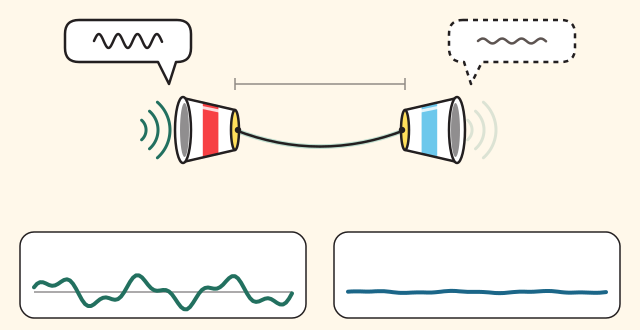
The drawing shows where it starts. It runs here once its script has loaded.El dibujo muestra dónde empieza. Funciona aquí una vez que carga su código.
Your challengeSu reto
- Pull the string tight and speak, so that more than half of your voice reaches the other cup.Tense la cuerda y hable, para que más de la mitad de su voz llegue al otro vaso. Not done yet.Todavía no.
- Stop your voice on a tight string with just one finger.Detenga su voz en una cuerda tensa con un solo dedo. Not done yet.Todavía no.
- Send more than half of your voice all the way down a hallway.Mande más de la mitad de su voz hasta el final de un pasillo. Not done yet.Todavía no.
Every challenge done. Now try it for real at home.Todos los retos logrados. Ahora pruébelo de verdad en casa.
Your voice that reaches the other cupLa parte de su voz que llega al otro vaso
The string isLa cuerda mide
The green band around the string is the vibration: the wider it is at a place, the more of it is left there. The waves below are what you say and what arrives.La banda verde alrededor de la cuerda es la vibración: entre más ancha en un lugar, más queda de ella ahí. Las ondas de abajo son lo que usted dice y lo que llega.
What is happeningQué está pasando
Your voice makes the bottom of the cup shake back and forth very fast. That shaking is a vibration.Su voz hace que el fondo del vaso se sacuda de un lado a otro muy rápido. Esa sacudida es una vibración.
With every shake, the cup's bottom tugs the string, so the vibration runs along the string to the other cup. It shakes that cup's bottom, and the air there carries the sound into the listener's ear.Con cada sacudida, el fondo del vaso jala la cuerda, así que la vibración corre por la cuerda hasta el otro vaso. Sacude el fondo de ese vaso, y el aire ahí lleva el sonido al oído de quien escucha.
A tight string passes the tugs along. A slack string only swings, and a finger pinching the string soaks up the vibration, so the sound stops there.Una cuerda tensa pasa los jalones. Una cuerda floja solo se mece, y un dedo que pellizca la cuerda absorbe la vibración, así que el sonido se detiene ahí.
Every meter of string loses a little of the vibration, and what the string is made of matters: soft, fuzzy yarn soaks up the most, and stiff fishing line the least.Cada metro de cuerda pierde un poco de la vibración, y el material de la cuerda importa: el estambre, suave y peludo, absorbe más, y el hilo de pescar, rígido, absorbe menos.
Things to tryCosas para probar
- Speak with the string slack, then pull it tight and speak again.Hable con la cuerda floja, luego ténsela bien y vuelva a hablar.
- Pinch the string and speak.Pellizque la cuerda y hable.
- Keep the string tight and try all three materials across a room.Mantenga la cuerda tensa y pruebe los tres materiales de un lado del cuarto al otro.
- Make the string longer and watch the green band get thinner on the way.Alargue la cuerda y vea cómo la banda verde se adelgaza en el camino.
This is a model with simple rules: how much a tight string passes on, and how much each material loses for every meter, are chosen to show the ideas in the right order, never measured. A real string also wiggles sideways, and your own cups and knots matter, so your cup phone will sound a little different. The motion is slowed down a lot: a real tug crosses a room in a few thousandths of a second.Este es un modelo con reglas sencillas: cuánto pasa una cuerda tensa, y cuánto pierde cada material en cada metro, se eligieron para mostrar las ideas en el orden correcto, nunca se midieron. Una cuerda real también se mueve de lado, y sus vasos y sus nudos importan, así que su teléfono de vasos sonará un poco distinto. El movimiento va mucho más lento: un jalón real cruza un cuarto en unas pocas milésimas de segundo.
Open the simulation on its own pageAbrir la simulación en su propia páginaSound and its wavesEl sonido y sus ondas
Use it, share it, adapt itÚsela, compártala, adáptela
The credit to copyEl crédito para copiar
Free BYRD, CC BY. “Sound Machines” from the Byrd Academy STEM Curriculum by Byrd EDU, byrdathome.org.Free BYRD, CC BY. “Máquinas de sonido”, del Currículo STEM de Byrd Academy, de Byrd EDU, byrdathome.org.
This is free to use, share and adapt, even commercially, under the Creative Commons Attribution 4.0 International license (CC BY 4.0), with this credit. What Free BYRD means.Esto es libre de usar, compartir y adaptar, incluso con fines comerciales, bajo la licencia Creative Commons Atribución 4.0 Internacional (CC BY 4.0), con este crédito. Qué significa Free BYRD.
Keep goingSiga adelante
What to do nextQué hacer después
Make it harderHágalo más difícil
Cut a set of straws into a scale using halves, quarters and other fractions of one length, then play a short repeating rhythm on it.Corte un juego de popotes para formar una escala usando mitades, cuartos y otras fracciones de una misma longitud, y luego toque en ella un ritmo corto que se repita.
For a younger onePara alguien más pequeño
Sprinkle rice on a drum or the top of a box and tap it to watch the rice jump. Then hold a ruler on a table edge, twang it, and slide it in so less hangs off: the sound gets higher.Eche arroz sobre un tambor o la tapa de una caja y golpéela suavemente para ver brincar el arroz. Luego sostenga una regla en la orilla de una mesa, hágala vibrar y métala más para que sobresalga menos: el sonido se vuelve más agudo.
Try this nextPruebe esto después
Make a straw flute and a rubber-band guitarHaga una flauta de popote y una guitarra de ligas
See sound as vibration, then cut a straw flute shorter and stretch rubber bands over a box to hear how length changes pitch.Vea el sonido como vibración, y luego corte una flauta de popote más corta y estire ligas sobre una caja para oír cómo el largo cambia el tono.
- Ways in:Formas de empezar:
- ReadLeer
- DoHacer
- SimulateSimular
Best for ages 5 to 12Ideal de 5 a 12 años
ManufacturingManufacturaElectronicsElectrónica
Free BYRD, CC BYHome activityActividad en casa
Sound on a stringEl sonido en una cuerda
Speak into one cup and follow your voice along the string to the other, then see what a slack string, a longer one, a pinch and a different string do to it.Hable en un vaso y siga su voz por la cuerda hasta el otro, y luego vea qué le hacen una cuerda floja, una más larga, un pellizco y otra clase de cuerda.
- Ways in:Formas de empezar:
- SimulateSimular
Best for ages 4 to 11Ideal de 4 a 11 años
ManufacturingManufacturaElectronicsElectrónica
Free BYRD, CC BYSimulationSimulación
 SIM-0008
 Sound and its wavesEl sonido y sus ondas
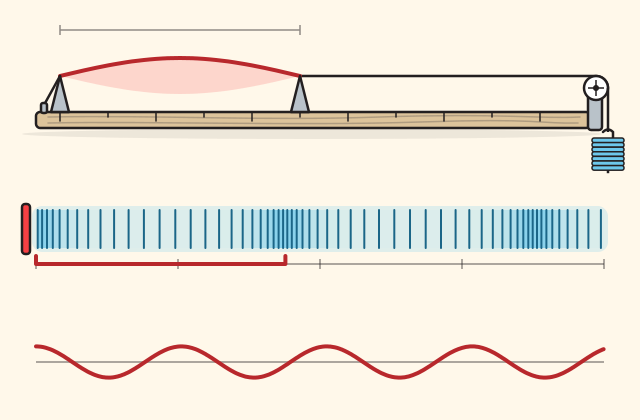
Change a string’s length and tightness, or a straw flute’s length, and watch how fast it vibrates and how long its sound waves are in the air. Half the length, one octave higher, and a wave half as long.Cambie el largo y la tensión de una cuerda, o el largo de una flauta de popote, y vea qué tan rápido vibra y qué tan largas son sus ondas de sonido en el aire. La mitad del largo, una octava más alta, y una onda de la mitad.
- Ways in:Formas de empezar:
- SimulateSimular
Best for ages 4 to 12Ideal de 4 a 12 años
ElectronicsElectrónica
Free BYRD, CC BYSimulationSimulación
Garden EngineeringIngeniería en el jardín
Measure a garden bed's perimeter and area, plant at counted distances, keep a growth journal, and invent a watering gadget.Mida el perímetro y el área de una cama de cultivo, siembre a distancias contadas, lleve un diario de crecimiento e invente un aparato para regar.
- Ways in:Formas de empezar:
- ReadLeer
- DoHacer
- SimulateSimular
Grades 3 to 5Grados 3 a 5
ManufacturingManufacturaDesignDiseño
Free BYRD, CC BYCurriculum unitUnidad del currículo