

ExploreExplorarBH-0013
Build a rain gauge and keep a weather logConstruya un pluviómetro y lleve un registro del clima
Turn a plastic bottle into a rain gauge, read it at the same time every day, and use the patterns in your log to forecast tomorrow.Convierta una botella de plástico en un pluviómetro, léalo a la misma hora cada día y use los patrones de su registro para pronosticar el día siguiente.
- Ways in:Formas de empezar:
- Read, 3 minutesLeer, 3 minutos
- Do, 20 minutesHacer, 20 minutos
- Simulate, 6 minutesSimular, 6 minutos
- AgesEdades
- Every age. Best for ages 5 and up.Todas las edades. Ideal desde los 5 años.
- CostCosto
- Things already at homeCosas que ya hay en casa
- From the curriculumDel currículo
- STEM-ES-07
The MESH'D components this item uses:Los componentes MESH'D que usa:ManufacturingManufacturaSoftwareSoftware
Do, about 20 minutesHacer, unos 20 minutos
Build it at homeConstrúyalo en casa
StepsPasos
- A grown-up cuts off the top of the bottle, just where it starts to narrow, and covers the cut edges with tape.Una persona adulta corta la parte de arriba de la botella, justo donde empieza a angostarse, y cubre los bordes cortados con cinta.
- Turn the top upside down and set it in the bottle like a funnel.Voltee la parte de arriba y póngala dentro de la botella como si fuera un embudo.
- Pour in a little water until the bumpy bottom is covered, and mark that level as zero. Then stick a strip of tape up the side and mark it with the ruler, in centimeters, up from zero.Eche un poco de agua hasta cubrir el fondo con bordes, y marque ese nivel como cero. Luego pegue una tira de cinta a lo largo de un lado y márquela con la regla, en centímetros, desde el cero hacia arriba.
- Stand the gauge in an open place, away from roofs and trees, and wedge it in a flowerpot or between bricks so it cannot tip.Ponga el pluviómetro en un lugar abierto, lejos de techos y árboles, y fíjelo dentro de una maceta o entre ladrillos para que no se caiga.
- Read it at the same time every day. Write the date, how deep the water is above zero, and a word about the sky.Léalo a la misma hora cada día. Anote la fecha, qué tan alta está el agua sobre el cero y una palabra sobre cómo está el cielo.
- After each reading, pour the water out down to the zero line.Después de cada lectura, tire el agua hasta la línea del cero.
- After a week, make a bar graph of your readings and look for a pattern.Después de una semana, haga una gráfica de barras con sus lecturas y busque un patrón.
What you needLo que necesita
- A clear plastic bottle with straight sidesUna botella de plástico transparente de lados rectos
- Scissors, for the grown-upTijeras, para la persona adulta
- Tape and a rulerCinta adhesiva y una regla
- A permanent markerUn marcador permanente
- A flowerpot or a few bricks to keep it standingUna maceta o unos ladrillos para que no se caiga
- Paper and a pencil for the logPapel y un lápiz para el registro
Things already at home.Cosas que ya hay en casa.
A grown-up cuts the bottle, and the cut edge can be sharp, so cover it with tape. Check the gauge with a grown-up nearby, and never go out to read it during thunder or lightning. Empty the water after each reading so none is left standing.Una persona adulta corta la botella, y el borde cortado puede estar filoso, así que cúbralo con cinta. Revise el pluviómetro con una persona adulta cerca, y nunca salga a leerlo cuando haya truenos o relámpagos. Tire el agua después de cada lectura para que no se quede estancada.
Read, 3 minutesLeer, 3 minutos
The big ideaLa gran idea
A forecast is a prediction made from patterns in what has been measured, not a guess. A rain gauge measures how deep the rain would stand if none of it soaked in or ran off. Reading it at the same time and in the same place every day keeps your data fair, so the days can be compared, and over many days patterns show up that you can use to predict. A forecast that turns out wrong is not bad science: forecasts are about chances, so even a good one is sometimes wrong.Un pronóstico es una predicción hecha a partir de los patrones de lo que se ha medido, no una adivinanza. Un pluviómetro mide qué tan alta quedaría el agua de lluvia si nada se absorbiera ni escurriera. Leerlo a la misma hora y en el mismo lugar cada día hace que sus datos sean justos, para poder comparar los días, y con muchos días aparecen patrones que puede usar para predecir. Un pronóstico que falla no es mala ciencia: los pronósticos hablan de probabilidades, así que hasta uno bueno a veces falla.
Explore, 6 minutesExplorar, 6 minutos
Why we have seasonsPor qué hay estaciones
Pick a place and a day, and see how the tilted Earth sets the noon sun’s height, the length of the day and the sunlight each square of ground gets.Elija un lugar y un día, y vea cómo la Tierra inclinada fija la altura del sol del mediodía, la duración del día y la luz que recibe cada cuadro de suelo.
The drawing shows where it starts. It runs here once its script has loaded.El dibujo muestra dónde empieza. Funciona aquí una vez que carga su código.
Your challengeSu reto
- In Texas, find the day of the year when the noon sun climbs highest.En Texas, encuentre el día del año en que el sol del mediodía sube más alto. Not done yet.Todavía no.
- Find a place and a day where the same beam spreads over twice as much ground as under an overhead sun.Encuentre un lugar y un día en que el mismo haz se reparte en el doble de suelo que con el sol justo arriba. Not done yet.Todavía no.
- Find a place and a day where the sun never rises.Encuentre un lugar y un día en que el sol nunca sale. Not done yet.Todavía no.
- Put the noon sun straight overhead.Ponga el sol del mediodía justo arriba. Not done yet.Todavía no.
Every challenge done. Now try it for real at home.Todos los retos logrados. Ahora pruébelo de verdad en casa.
Height of the sun at noon, of straight overheadAltura del sol al mediodía, comparada con justo arriba
Length of the day, sunrise to sunsetDuración del día, de la salida a la puesta del sol
Sunlight on a square of ground at noon, of the sun straight overheadLuz del sol sobre un cuadro de suelo al mediodía, comparada con el sol justo arriba
- The same beam lights a patch wider byEl mismo haz ilumina un área más ancha por
- Noon shadow of a stick one meter tallSombra al mediodía de un palo de un metro
- The season hereLa estación aquí
- Earth to sun todayDe la Tierra al sol hoy
- The noon sun is straight overhead atEl sol del mediodía está justo arriba en
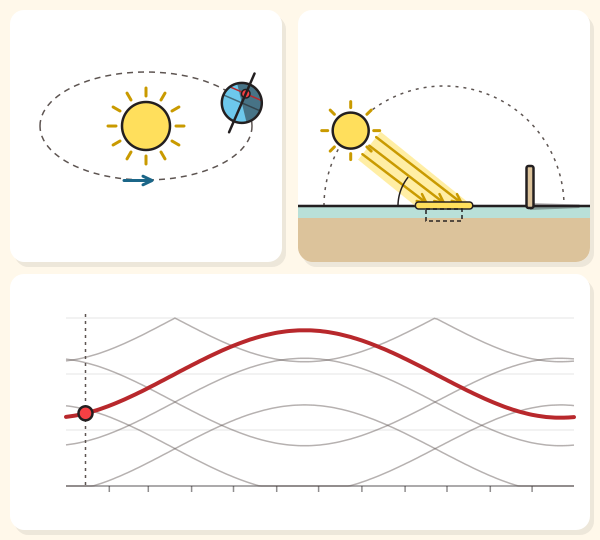
Top left, the Earth goes around the sun with its axis tilted about twenty-three point four degrees, always the same way; the red dot is this place. Top right, the noon sun seen from the side: its beam is always as wide, so the lower the sun, the wider the patch it lights; the dashed box is one square of ground, and the stick is one meter tall. Below, the height of the noon sun all year here, and, faint, at the other places.Arriba a la izquierda, la Tierra gira alrededor del sol con su eje inclinado unos veintitrés coma cuatro grados, siempre hacia el mismo lado; el punto rojo es este lugar. Arriba a la derecha, el sol del mediodía visto de lado: su haz siempre es igual de ancho, así que entre más bajo el sol, más ancha el área que ilumina; el cuadro punteado es un cuadro de suelo, y el palo mide un metro. Abajo, la altura del sol del mediodía todo el año aquí, y, tenues, en los otros lugares.
What is happeningQué está pasando
The Earth’s axis is tilted about twenty-three point four degrees, and it keeps pointing the same way all year. So for part of the year your half of the Earth leans toward the sun, and for part of the year it leans away.El eje de la Tierra está inclinado unos veintitrés coma cuatro grados, y sigue apuntando hacia el mismo lado todo el año. Así, durante una parte del año su mitad de la Tierra se inclina hacia el sol, y durante otra parte se inclina lejos de él.
Leaning toward the sun, the noon sun climbs high and the day is long. The solar oven’s rule shows why height matters: light that hits straight on brings the most energy, and the same beam at a slant spreads over a bigger patch, so each square of ground gets less. A low sun also casts long shadows, which you can measure with a stick.Cuando se inclina hacia el sol, el sol del mediodía sube alto y el día es largo. La regla del horno solar muestra por qué importa la altura: la luz que llega de frente trae más energía, y el mismo haz inclinado se reparte en un área más grande, así que cada cuadro de suelo recibe menos. Un sol bajo también hace sombras largas, que puede medir con un palo.
It is not the distance. The Earth is closest to the sun in early January, during the northern winter. The tilt makes summer and winter, which is why the seasons are opposite in the north and the south.No es la distancia. La Tierra está más cerca del sol a principios de enero, durante el invierno del norte. La inclinación causa el verano y el invierno, y por eso las estaciones son opuestas en el norte y en el sur.
Seasons are a pattern you can see in weather data: the noon sun’s height and the length of the day predict the warm and cold times of the year, even though each day’s weather still changes.Las estaciones son un patrón que se ve en los datos del clima: la altura del sol del mediodía y la duración del día predicen las épocas cálidas y frías del año, aunque el tiempo de cada día siga cambiando.
Things to tryCosas para probar
- Play the year in Texas and watch the noon sun climb and fall, and the stick’s shadow shrink and grow.Recorra el año en Texas y vea cómo sube y baja el sol del mediodía, y cómo se acorta y se alarga la sombra del palo.
- Choose far north in December, then far south in December. What changes, and why?Elija muy al norte en diciembre, y luego muy al sur en diciembre. ¿Qué cambia, y por qué?
- Set the latitude where you live and watch the distance to the sun. Is the Earth closer in your summer or your winter?Ponga la latitud donde vive y observe la distancia al sol. ¿La Tierra está más cerca en su verano o en su invierno?
- At noon outside, measure the shadow of a stick one meter tall and compare it with the one shown for today.Al mediodía, afuera, mida la sombra de un palo de un metro y compárela con la que se muestra para hoy.
This is a model. The sun’s place and the day’s length come from the standard formulas astronomers publish, but they leave out the air’s dimming of sunlight, clouds, hills and buildings on a real horizon, and leap years. Real sunlight is weaker than shown, most of all when the sun is low, and noon here means when the sun is highest, not twelve on the clock.Esto es un modelo. El lugar del sol y la duración del día vienen de las fórmulas comunes que publican los astrónomos, pero no toman en cuenta cómo el aire apaga la luz del sol, las nubes, los cerros y edificios de un horizonte real, ni los años bisiestos. La luz real del sol es más débil de lo que se muestra, sobre todo cuando el sol está bajo, y el mediodía aquí es cuando el sol está más alto, no las doce en el reloj.
Open the simulation on its own pageAbrir la simulación en su propia páginaThe water cycleEl ciclo del agua
Your engineering challengeSu reto de ingeniería
Play the forecast game: every evening, predict tomorrow's weather from your log, then check it the next day and keep score. Can you name one pattern in your own data that helps?Juegue a pronosticar: cada tarde, prediga el clima del día siguiente con su registro, revíselo al otro día y lleve la cuenta de sus aciertos. ¿Puede nombrar un patrón de sus propios datos que le ayude?
Make it an experimentConviértalo en un experimento
Science is about changing one thing and watching what happens. Write down your guess, your hypothesis, before you start.La ciencia se trata de cambiar una cosa y observar qué pasa. Escriba su suposición, su hipótesis, antes de empezar.
- Set two gauges in different places, one in the open and one near a wall or a tree, and compare what they catch.Ponga dos pluviómetros en lugares distintos, uno al aire libre y otro cerca de una pared o un árbol, y compare lo que juntan.
- Add a wind flag, a strip of paper taped to a straw. Log which way it points and see whether the wind changes before rain.Agregue una bandera de viento, una tira de papel pegada a un popote. Anote hacia dónde apunta y vea si el viento cambia antes de que llueva.
- Read a thermometer at the same time each day and graph it beside your rain.Lea un termómetro a la misma hora cada día y haga su gráfica junto a la de la lluvia.
Use it, share it, adapt itÚsela, compártala, adáptela
The credit to copyEl crédito para copiar
Free BYRD, CC BY. “Build a rain gauge and keep a weather log” from the Byrd Academy STEM Curriculum by Byrd EDU, byrdathome.org.Free BYRD, CC BY. “Construya un pluviómetro y lleve un registro del clima”, del Currículo STEM de Byrd Academy, de Byrd EDU, byrdathome.org.
This is free to use, share and adapt, even commercially, under the Creative Commons Attribution 4.0 International license (CC BY 4.0), with this credit. What Free BYRD means.Esto es libre de usar, compartir y adaptar, incluso con fines comerciales, bajo la licencia Creative Commons Atribución 4.0 Internacional (CC BY 4.0), con este crédito. Qué significa Free BYRD.
Keep goingSiga adelante
What to do nextQué hacer después
Make it harderHágalo más difícil
Keep ten days of clean readings in a row, then build a forecast against reality board: one column for what you predicted, one for what happened, and a tally of how often you were right. Give your family a live weather report from your own data.Lleve diez días seguidos de lecturas limpias, y luego arme un tablero de pronóstico contra realidad: una columna para lo que predijo, otra para lo que pasó y una cuenta de cuántas veces acertó. Dé a su familia un reporte del clima en vivo con sus propios datos.
For a younger onePara alguien más pequeño
Each morning, look at the gauge together and draw the sky: a sun, a cloud or raindrops. At the end of the week, count the pictures and ask which kind of day came most.Cada mañana, miren juntos el pluviómetro y dibujen el cielo: un sol, una nube o gotas de lluvia. Al final de la semana, cuenten los dibujos y pregunten qué tipo de día hubo más.
Try this nextPruebe esto después
Why we have seasonsPor qué hay estaciones
Pick a place and a day, and see how the tilted Earth sets the noon sun’s height, the length of the day and the sunlight each square of ground gets.Elija un lugar y un día, y vea cómo la Tierra inclinada fija la altura del sol del mediodía, la duración del día y la luz que recibe cada cuadro de suelo.
- Ways in:Formas de empezar:
- SimulateSimular
Best for ages 5 and upIdeal desde los 5 años
DesignDiseño
Free BYRD, CC BYSimulationSimulación
 SIM-0022
 The water cycleEl ciclo del agua
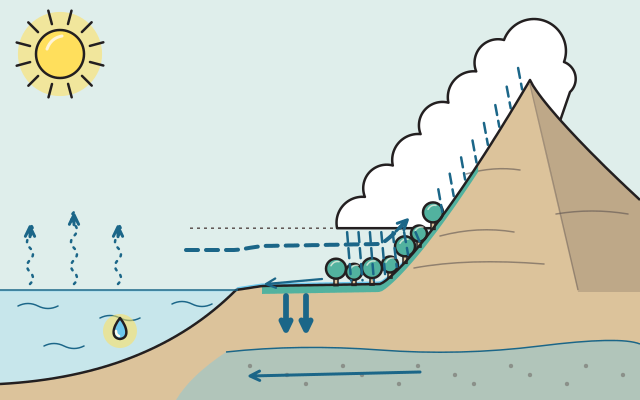
Turn up the sun and the warmth, then follow water from the sea into a cloud, down onto a mountain as rain or snow, and back to the sea.Suba el sol y el calor, y siga el agua del mar a una nube, de ahí a una montaña como lluvia o nieve, y de regreso al mar.
- Ways in:Formas de empezar:
- SimulateSimular
Best for ages 5 and upIdeal desde los 5 años
DesignDiseño
Free BYRD, CC BYSimulationSimulación
Fair test logRegistro de prueba justa
A sheet for testing one change at a time: your question, three tests, and what the results say.Una hoja para probar un cambio a la vez: su pregunta, tres pruebas y lo que dicen los resultados.
- Ways in:Formas de empezar:
- DoHacer
Best for ages 5 and upIdeal desde los 5 años
DesignDiseño
Free BYRD, CC BYPrintablePara imprimir
Weather keeper chartTabla del guardián del clima
A week of weather boxes and cut-out cards for a young weather keeper to look, decide and tape.Una semana de casillas del clima y tarjetas para recortar, para que un pequeño guardián del clima mire, decida y pegue.
- Ways in:Formas de empezar:
- DoHacer
Best for ages 2 and upIdeal desde los 2 años
DesignDiseño
Free BYRD, CC BYPrintablePara imprimir