

ExploreExplorarBH-0012
Find out where the salt went, then catch a gasDescubra adónde se fue la sal y luego atrape un gas
Stir salt, sugar and sand into water and find evidence of where they went, then catch the gas from baking soda and vinegar in a balloon.Mezcle sal, azúcar y arena en agua y busque pruebas de adónde se fueron, y luego atrape en un globo el gas del bicarbonato con vinagre.
- Ways in:Formas de empezar:
- Read, 3 minutesLeer, 3 minutos
- Do, 30 minutesHacer, 30 minutos
- Simulate, 10 minutesSimular, 10 minutos
- AgesEdades
- Every age. Best for ages 5 to 12.Todas las edades. Ideal de 5 a 12 años.
- CostCosto
- Under a few dollarsMenos de unos pocos dólares
- From the curriculumDel currículo
- STEM-ES-05
The MESH'D components this item uses:Los componentes MESH'D que usa:ManufacturingManufactura
Do, about 30 minutesHacer, unos 30 minutos
Build it at homeConstrúyalo en casa
StepsPasos
- If you have a kitchen scale, set a cup of water and a small dish holding a spoonful of salt on it together, and write down the weight.Si tiene báscula de cocina, ponga sobre ella el vaso con agua y un platito con una cucharada de sal, juntos, y anote el peso.
- Pour the salt into the water and stir until you cannot see it. Put the empty dish back on the scale with the cup and read the weight again.Eche la sal al agua y revuelva hasta que ya no la vea. Vuelva a poner el platito vacío en la báscula junto al vaso y lea otra vez el peso.
- Stir sugar into the second cup and sand into the third. Which ones seem to disappear, and which one can you still see?Revuelva azúcar en el segundo vaso y arena en el tercero. ¿Cuáles parecen desaparecer y cuál se sigue viendo?
- Put on goggles. Use the funnel to spoon a little baking soda into the balloon.Póngase las gafas protectoras. Con el embudo, eche un poco de bicarbonato dentro del globo.
- Pour vinegar into the bottle until it is about a finger deep. Stretch the balloon's mouth over the bottle's neck, letting the balloon hang to the side so no powder falls in yet.Eche vinagre en la botella hasta que tenga como un dedo de alto. Estire la boca del globo sobre el cuello de la botella, dejando el globo colgado de lado para que todavía no caiga el polvo.
- Lift the balloon so the baking soda drops into the vinegar. Watch the bubbles, and watch the balloon fill with the gas.Levante el globo para que el bicarbonato caiga en el vinagre. Observe las burbujas y vea cómo el globo se llena del gas.
- Make a claim card for each cup and one for the balloon.Haga una tarjeta de afirmación para cada vaso y otra para el globo.
What you needLo que necesita
- Three clear cups of waterTres vasos transparentes con agua
- Salt, sugar and a spoonful of sandSal, azúcar y una cucharada de arena
- A spoon and a small dish, and a kitchen scale if you have oneUna cuchara y un platito, y una báscula de cocina si tiene
- Baking soda and vinegarBicarbonato de sodio y vinagre
- An empty plastic bottle, a balloon and a funnel, or paper rolled into a coneUna botella de plástico vacía, un globo y un embudo, o un papel enrollado en forma de cono
- Goggles or safety glassesGafas protectoras o lentes de seguridad
Under a few dollars.Menos de unos pocos dólares.
A grown-up stays for every mix. Wear goggles or safety glasses for the reaction, because vinegar stings eyes. Taste nothing, ever, even though it all comes from the kitchen, and mix only what these steps say. Check for food allergies first. Keep balloons and broken balloon pieces away from young children, who can choke on them, and skip latex balloons if anyone is allergic.Una persona adulta acompaña cada mezcla. Use gafas protectoras o lentes de seguridad para la reacción, porque el vinagre arde en los ojos. No pruebe nada, nunca, aunque todo venga de la cocina, y mezcle solo lo que dicen estos pasos. Revise primero si hay alergias a algún alimento. Mantenga los globos y los pedazos de globo lejos de los niños pequeños, que pueden asfixiarse con ellos, y no use globos de látex si alguien es alérgico.
Read, 3 minutesLeer, 3 minutos
The big ideaLa gran idea
Stir salt or sugar into water and it seems to vanish, but it has dissolved: it has broken into pieces far too small to see and spread all through the water. Sand does not dissolve; it sinks, and you can still see it. You can find evidence that dissolved salt is still there: the cup, the water and the salt weigh the same after stirring as before, and if the water dries up, the salt comes back as crystals. Baking soda and vinegar do something different: they react and make a new substance, a gas called carbon dioxide. The bubbles are that gas, not boiling, and a balloon on the bottle catches it.Si mezcla sal o azúcar en agua, parece que desaparece, pero se disolvió: se separó en partes demasiado pequeñas para verse y se repartió por toda el agua. La arena no se disuelve; se va al fondo y se sigue viendo. Hay pruebas de que la sal disuelta sigue ahí: el vaso, el agua y la sal pesan lo mismo después de mezclar que antes, y si el agua se seca, la sal vuelve a aparecer como cristales. El bicarbonato y el vinagre hacen algo distinto: reaccionan y forman una sustancia nueva, un gas llamado dióxido de carbono. Las burbujas son ese gas, no un hervor, y un globo sobre la botella lo atrapa.
Simulate, 10 minutesSimular, 10 minutos
Sink or float¿Se hunde o flota?
Drop a cork, an apple, an egg and more into fresh water, salt water or cooking oil, and see why each one sinks or floats: its density against the liquid’s, and the push of the liquid it moves aside.Ponga un corcho, una manzana, un huevo y más en agua sin sal, agua con sal o aceite de cocina, y vea por qué cada uno se hunde o flota: su densidad contra la del líquido, y el empuje del líquido que aparta.
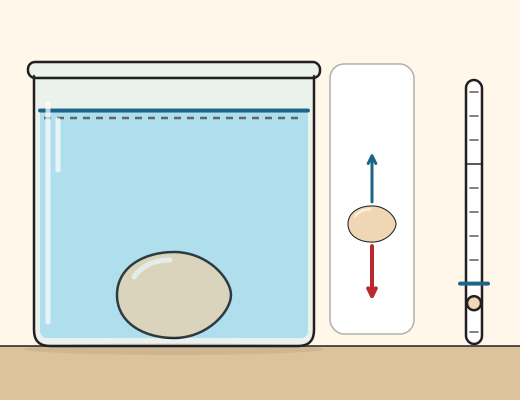
The drawing shows where it starts. It runs here once its script has loaded.El dibujo muestra dónde empieza. Funciona aquí una vez que carga su código.
Your challengeSu reto
- In fresh water, test three things and find one that floats and one that sinks.En agua sin sal, pruebe tres cosas y encuentre una que flote y una que se hunda. Not done yet.Todavía no.
- Stir salt into the water until the egg floats.Disuelva sal en el agua hasta que el huevo flote. Not done yet.Todavía no.
- Put the ice cube in cooking oil. Does it float?Ponga el cubo de hielo en aceite de cocina. ¿Flota? Not done yet.Todavía no.
- Float the grape with the least salt that does it.Haga flotar la uva con la menor cantidad de sal que lo logre. Not done yet.Todavía no.
Every challenge done. Now try it for real at home.Todos los retos logrados. Ahora pruébelo de verdad en casa.
Its weight, pulling downSu peso, que jala hacia abajo
The liquid’s push upEl empuje del líquido hacia arriba
Liquid it pushes asideLíquido que aparta
Its densitySu densidad
The liquid’s densityLa densidad del líquido
Under the surfaceBajo la superficie
The push up is the weight of the liquid the object pushes aside. On the density scale lighter is higher, so anything above the liquid’s blue line floats. The dashed line in the jar is where the liquid stood before.El empuje hacia arriba es el peso del líquido que el objeto aparta. En la escala de densidad lo más ligero queda más arriba, así que lo que esté sobre la línea azul del líquido flota. La línea punteada del frasco es donde estaba el líquido antes.
What is happeningQué está pasando
Density is how much stuff is packed into each bit of space. A milliliter of water has a mass of about one gram, a milliliter of cork about a quarter of a gram, and a milliliter of a coin’s metal about seven grams.La densidad es cuánta materia hay en cada pedacito de espacio. Un mililitro de agua tiene una masa de cerca de un gramo, un mililitro de corcho cerca de un cuarto de gramo, y un mililitro del metal de una moneda cerca de siete gramos.
Every liquid pushes up on whatever is in it, and the push is exactly the weight of the liquid the thing pushes out of its way. Something less dense than the liquid sinks in only until the liquid it pushes aside weighs as much as it does, so it floats. Something denser can never push aside enough: even all the way under, the liquid it moves weighs less than it does, so it sinks.Todo líquido empuja hacia arriba lo que tiene adentro, y ese empuje es justo el peso del líquido que el objeto quita de su camino. Algo menos denso que el líquido se hunde solo hasta que el líquido que aparta pesa lo mismo que él, así que flota. Algo más denso nunca logra apartar suficiente: aun completamente bajo la superficie, el líquido que mueve pesa menos que él, así que se hunde.
How deep a floater rides tells you its density: the share of it under the surface is its density divided by the liquid’s. Ice is about nine tenths as dense as water, so about nine tenths of an ice cube, or of an iceberg, stays under.Qué tan hondo flota algo dice su densidad: la parte que queda bajo la superficie es su densidad dividida entre la del líquido. El hielo tiene cerca de nueve décimos de la densidad del agua, así que cerca de nueve décimos de un cubo de hielo, o de un iceberg, quedan abajo.
Salt that dissolves in water adds mass but hardly any space, so salt water is denser than fresh water. That is why an egg that sinks in plain water floats once enough salt is stirred in, and it is evidence that the dissolved salt is still there.La sal que se disuelve en el agua le agrega masa pero casi nada de espacio, así que el agua con sal es más densa que el agua sin sal. Por eso un huevo que se hunde en agua sola flota cuando se disuelve suficiente sal, y eso es una prueba de que la sal disuelta sigue ahí.
Things to tryCosas para probar
- Test every object in fresh water, and guess before each one: sink or float?Pruebe cada objeto en agua sin sal, y antes de cada uno adivine: ¿se hunde o flota?
- Put the egg in salt water and add salt one teaspoon at a time. Count how many it takes.Ponga el huevo en agua con sal y agregue la sal de cucharadita en cucharadita. Cuente cuántas hacen falta.
- Compare one object in water and in oil: does it ride higher or lower, and why?Compare un mismo objeto en agua y en aceite: ¿flota más alto o más bajo, y por qué?
- Watch the dashed line in the jar: the liquid rises by exactly what the object pushes aside.Observe la línea punteada del frasco: el líquido sube justo lo que el objeto aparta.
This is a model. Each object gets one typical density, but real eggs, grapes and apples vary, and an egg gets lighter as it ages, so an old egg can float in plain water. Your own egg may need a little more or a little less salt than this one, and the drop into the jar is drawn, not worked out from the water’s drag.Esto es un modelo. Cada objeto tiene una densidad típica, pero los huevos, las uvas y las manzanas de verdad varían, y un huevo se hace más ligero con los días, así que un huevo viejo puede flotar en agua sola. Su huevo puede necesitar un poco más o un poco menos de sal que este, y la caída en el frasco está dibujada, no calculada a partir del roce del agua.
Open the simulation on its own pageAbrir la simulación en su propia páginaRed cabbage color testLa prueba de color de la col morada
Your engineering challengeSu reto de ingeniería
Say what happened in a claim, evidence and because sentence. For example, claim: the salt is still in the water. Evidence: the scale shows the same weight. Because: dissolving breaks it into pieces too small to see. Then make a claim card for the balloon.Diga lo que pasó con una frase de afirmación, prueba y porque. Por ejemplo, afirmación: la sal sigue en el agua. Prueba: la báscula marca el mismo peso. Porque: al disolverse, se separa en partes demasiado pequeñas para verse. Luego haga una tarjeta de afirmación para el globo.
Make it an experimentConviértalo en un experimento
Science is about changing one thing and watching what happens. Write down your guess, your hypothesis, before you start.La ciencia se trata de cambiar una cosa y observar qué pasa. Escriba su suposición, su hipótesis, antes de empezar.
- Try warm tap water and cold water with the same spoonful of sugar, and see which one dissolves it faster.Pruebe agua tibia de la llave y agua fría con la misma cucharada de azúcar, y vea en cuál se disuelve más rápido.
- Put a few drops of the salty water on a dark plate and leave them to dry for a day. Look for crystals.Ponga unas gotas del agua con sal en un plato oscuro y déjelas secar un día. Busque cristales.
- Use more baking soda or less, keeping the vinegar the same, and compare how big the balloon gets.Use más o menos bicarbonato, con la misma cantidad de vinagre, y compare qué tanto se infla el globo.
Use it, share it, adapt itÚsela, compártala, adáptela
The credit to copyEl crédito para copiar
Free BYRD, CC BY. “Find out where the salt went, then catch a gas” from the Byrd Academy STEM Curriculum by Byrd EDU, byrdathome.org.Free BYRD, CC BY. “Descubra adónde se fue la sal y luego atrape un gas”, del Currículo STEM de Byrd Academy, de Byrd EDU, byrdathome.org.
This is free to use, share and adapt, even commercially, under the Creative Commons Attribution 4.0 International license (CC BY 4.0), with this credit. What Free BYRD means.Esto es libre de usar, compartir y adaptar, incluso con fines comerciales, bajo la licencia Creative Commons Atribución 4.0 Internacional (CC BY 4.0), con este crédito. Qué significa Free BYRD.
Keep goingSiga adelante
What to do nextQué hacer después
Make it harderHágalo más difícil
Compare dissolving with reacting: stir baking soda into plain water, and vinegar into plain water, and see whether either one bubbles before the two meet. Write a claim card that says how you know a new substance formed.Compare disolver con reaccionar: revuelva bicarbonato en agua sola, y vinagre en agua sola, y vea si alguno burbujea antes de que los dos se junten. Escriba una tarjeta de afirmación que diga cómo sabe que se formó una sustancia nueva.
For a younger onePara alguien más pequeño
Let the younger one stir salt and sand into two cups and say which one hid and which one did not, then watch from beside the grown-up as the balloon fills. The grown-up handles the vinegar.Deje que la niña o el niño revuelva sal y arena en dos vasos y diga cuál se escondió y cuál no, y luego que vea junto a la persona adulta cómo se llena el globo. La persona adulta maneja el vinagre.
Try this nextPruebe esto después
Sink or float¿Se hunde o flota?
Drop a cork, an apple, an egg and more into fresh water, salt water or cooking oil, and see why each one sinks or floats: its density against the liquid’s, and the push of the liquid it moves aside.Ponga un corcho, una manzana, un huevo y más en agua sin sal, agua con sal o aceite de cocina, y vea por qué cada uno se hunde o flota: su densidad contra la del líquido, y el empuje del líquido que aparta.
- Ways in:Formas de empezar:
- SimulateSimular
Best for ages 5 and upIdeal desde los 5 años
ManufacturingManufactura
Free BYRD, CC BYSimulationSimulación
 SIM-0029
 Red cabbage color testLa prueba de color de la col morada
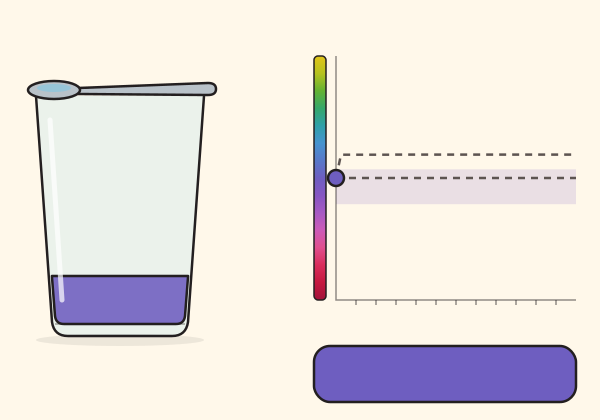
Red cabbage juice changes color with acids and bases. Test kitchen liquids in it, read their pH by color, then stir baking soda water into vinegar and watch the fizz pull the color back toward neutral purple.El jugo de col morada cambia de color con los ácidos y las bases. Pruebe líquidos de la cocina en él, lea su pH por el color, y luego agregue agua con bicarbonato al vinagre y vea cómo la efervescencia regresa el color hacia el morado neutro.
- Ways in:Formas de empezar:
- SimulateSimular
Best for ages 5 and upIdeal desde los 5 años
ManufacturingManufactura
Free BYRD, CC BYSimulationSimulación
A water treatment plant: from the lake to your tapUna planta de tratamiento de agua: del lago a su llave
Follow lake and river water through a treatment plant, where screens, sticky clumps, sand and a germ killer make it safe to drink, and workers test it all along the way.Siga el agua de lagos y ríos por una planta de tratamiento, donde rejillas, grumos pegajosos, arena y un desinfectante la vuelven segura para beber, y el personal la analiza en todo el camino.
- Ways in:Formas de empezar:
- TourRecorrer
Best for ages 5 and upIdeal desde los 5 años
ManufacturingManufactura
Free BYRD, CC BYVirtual tourRecorrido virtual
Kitchen indicator color chartTabla de colores del indicador de cocina
Make red cabbage juice with a grown-up, test kitchen liquids in it, and record the color each one turns, from acid red to base green.Prepare jugo de col morada con una persona adulta, pruebe en él líquidos de la cocina y anote el color que toma cada uno, del rojo ácido al verde básico.
- Ways in:Formas de empezar:
- DoHacer
Best for ages 5 and upIdeal desde los 5 años
ManufacturingManufactura
Free BYRD, CC BYPrintablePara imprimir