

ExploreExplorarBH-0038
Monitor your own patch of the world and report percent changeVigile su propio rincón del mundo y reporte el cambio en porcentaje
Ask one question about your surroundings, keep a hand-written monitor of temperature, light or soil moisture under a written protocol, then compute percent change and post the trend on the fridge.Haga una pregunta sobre su entorno, lleve a mano un monitor de temperatura, luz o humedad del suelo con un protocolo escrito, y luego calcule el cambio en porcentaje y publique la tendencia en el refrigerador.
- Ways in:Formas de empezar:
- Read, 3 minutesLeer, 3 minutos
- Do, 20 minutesHacer, 20 minutos
- Simulate, 8 minutesSimular, 8 minutos
- AgesEdades
- Every age. Best for ages 10 and up.Todas las edades. Ideal desde los 10 años.
- CostCosto
- Things already at homeCosas que ya hay en casa
- From the curriculumDel currículo
- STEM-JH-09
The MESH'D components this item uses:Los componentes MESH'D que usa:SoftwareSoftwareHolistic DesignDiseño integral
Do, about 20 minutesHacer, unos 20 minutos
Build it at homeConstrúyalo en casa
StepsPasos
- Question first: choose temperature, light or soil moisture, and write why it matters where you live, such as a plant that wilts or a room that is always cold.Primero la pregunta: elija temperatura, luz o humedad del suelo, y escriba por qué importa donde usted vive, como una planta que se marchita o un cuarto que siempre está frío.
- Write the protocol: where the instrument sits, what times it is read, who reads it, and how a reading is written down.Escriba el protocolo: dónde se coloca el instrumento, a qué horas se lee, quién lo lee y cómo se anota una lectura.
- Set it up and take the first reading; that is your starting point.Instálelo y tome la primera lectura; ese es su punto de partida.
- Read at the set times for a week. If a reading looks wild, write it down anyway and note what might have happened.Lea a las horas fijadas durante una semana. Si una lectura parece disparatada, anótela de todos modos y escriba qué pudo haber pasado.
- Compute the percent change from the first day to the last: the change divided by the starting value, times one hundred.Calcule el cambio en porcentaje del primer día al último: el cambio dividido entre el valor inicial, por cien.
- Compare day against night, and line the readings up with the weather of each day.Compare el día con la noche, y alinee las lecturas con el clima de cada día.
- Post the week's readings and the trend on the fridge or by the door, and update it each week.Publique las lecturas de la semana y la tendencia en el refrigerador o junto a la puerta, y actualícelas cada semana.
- Write the claim, and under it, what the data cannot say.Escriba la afirmación y, debajo, lo que los datos no pueden decir.
What you needLo que necesita
- A household thermometer: room, outdoor or digitalUn termómetro de casa: de interior, de exterior o digital
- A notebook and a pencilUn cuaderno y un lápiz
- A kitchen scale for soil moisture, or your finger and a simple scale of dry, damp and wetUna báscula de cocina para la humedad del suelo, o su dedo y una escala sencilla de seco, húmedo y mojado
- A plastic container to shelter an outdoor instrumentUn recipiente de plástico para resguardar un instrumento al aire libre
- A sheet for the fridgeUna hoja para el refrigerador
Things already at home.Cosas que ya hay en casa.
A grown-up goes along for any outdoor check, and nobody goes out to read an instrument during thunder or lightning. Use a plain alcohol or digital thermometer, never a mercury one, and keep it where a young child cannot reach it. Wash hands after touching soil, and taste nothing from a pot or a garden. If a weatherproof shelter is made from a plastic bag, the bag stays out of reach of little ones.Una persona adulta acompaña cualquier revisión al aire libre, y nadie sale a leer un instrumento cuando hay truenos o relámpagos. Use un termómetro común de alcohol o digital, nunca de mercurio, y guárdelo donde un niño pequeño no lo alcance. Lave las manos después de tocar tierra, y no pruebe nada de una maceta ni de un jardín. Si el resguardo contra la intemperie se hace con una bolsa de plástico, la bolsa se queda fuera del alcance de los pequeños.
Read, 3 minutesLeer, 3 minutos
The big ideaLa gran idea
A question comes first, then a monitor built to answer it. A monitor is any instrument read the same way, in the same place, at the same times, under a written protocol; a notebook and a thermometer count. One weird reading is not a discovery. A single odd number is often a glitch, so look for a pattern across many readings and check the setup. Percent change does the honest work: going from twenty to thirty is a change of ten points but an increase of fifty percent, because you divide the change by where you started. Comparing day with night and lining readings up with the weather turns numbers into a claim, and the claim stays within what the data shows.Primero viene una pregunta, y luego un monitor construido para responderla. Un monitor es cualquier instrumento que se lee de la misma manera, en el mismo lugar, a las mismas horas, con un protocolo escrito; un cuaderno y un termómetro cuentan. Una lectura rara no es un descubrimiento. Un solo número extraño suele ser una falla, así que busque un patrón en muchas lecturas y revise la instalación. El cambio en porcentaje hace el trabajo honesto: pasar de veinte a treinta es un cambio de diez puntos pero un aumento de cincuenta por ciento, porque el cambio se divide entre el punto de partida. Comparar el día con la noche y alinear las lecturas con el clima convierte los números en una afirmación, y la afirmación se queda dentro de lo que muestran los datos.
Explore, 8 minutesExplorar, 8 minutos
The water cycleEl ciclo del agua
Turn up the sun and the warmth, then follow water from the sea into a cloud, down onto a mountain as rain or snow, and back to the sea.Suba el sol y el calor, y siga el agua del mar a una nube, de ahí a una montaña como lluvia o nieve, y de regreso al mar.
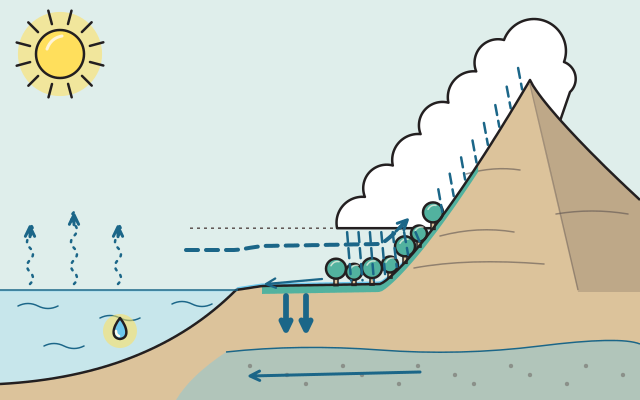
The drawing shows where it starts. It runs here once its script has loaded.El dibujo muestra dónde empieza. Funciona aquí una vez que carga su código.
Your challengeSu reto
- Make the sea give off more than five millimeters of water a day.Haga que el mar suelte más de cinco milímetros de agua al día. Not done yet.Todavía no.
- Make it snow on the mountain top.Haga que nieve en la cima de la montaña. Not done yet.Todavía no.
- Follow a drop all the way around and back to the sea.Siga una gota en todo su recorrido hasta que regrese al mar. Not done yet.Todavía no.
- Bring a heavy snowfall to the mountain top: more than twenty-five millimeters of water a day.Lleve una nevada fuerte a la cima: más de veinticinco milímetros de agua al día. Not done yet.Todavía no.
Every challenge done. Now try it for real at home.Todos los retos logrados. Ahora pruébelo de verdad en casa.
Water the sea gives offAgua que suelta el mar
Water that falls on the mountainsideAgua que cae en la ladera
It fallsCae
Cloud base:Base de la nube:
Snow line:Límite de nieve:
Rain on the land:Lluvia en la tierra:
Blue arrows are water on the move: vapor rising from the sea, the wind carrying it up the mountain, rain running off or soaking in. Dashed lines mark the cloud base and the snow line.Las flechas azules son agua en movimiento: vapor que sube del mar, el viento que lo lleva montaña arriba, lluvia que escurre o se filtra. Las líneas punteadas marcan la base de la nube y el límite de nieve.
What is happeningQué está pasando
The sun drives the water cycle. Its energy makes water evaporate from the sea as vapor, a gas you cannot see. Stronger sunshine and warmer water make it evaporate faster.El sol mueve el ciclo del agua. Su energía hace que el agua del mar se evapore como vapor, un gas que no se ve. Con más sol y agua más cálida, se evapora más rápido.
The wind carries the moist air over the land and pushes it up the mountain. Air that rises spreads out and cools. Once it has cooled to its dew point, the vapor condenses on tiny specks of dust into droplets, and a cloud appears.El viento lleva el aire húmedo sobre la tierra y lo empuja montaña arriba. El aire que sube se expande y se enfría. Cuando se enfría hasta su punto de rocío, el vapor se condensa en partículas diminutas de polvo y forma gotitas, y aparece una nube.
Droplets bump together and grow until they are heavy enough to fall. Where the air is below freezing the water falls as snow, which is why a high mountain can wear snow while the land below gets rain. The far side of the mountain stays dry, because the air has already let go of its water.Las gotitas chocan y crecen hasta pesar lo suficiente para caer. Donde el aire está bajo cero, el agua cae como nieve, y por eso una montaña alta puede tener nieve mientras la tierra de abajo recibe lluvia. El otro lado de la montaña se queda seco, porque el aire ya soltó su agua.
On the ground, rain soaks in or runs off. A forest floor drinks most of it; pavement and roofs send most of it into the river. Rivers and groundwater carry the water back to the sea, and the cycle goes on.En el suelo, la lluvia se filtra o escurre. El suelo de un bosque absorbe casi toda; el pavimento y los techos mandan casi toda al río. Los ríos y el agua subterránea regresan el agua al mar, y el ciclo continúa.
Things to tryCosas para probar
- Slide the sunshine from winter to summer and watch the vapor arrows and the rain grow.Mueva el sol de invierno a verano y vea cómo crecen las flechas de vapor y la lluvia.
- Cool the air one degree at a time and watch the snow line come down the mountain.Enfríe el aire de grado en grado y vea cómo baja el límite de nieve por la montaña.
- Change the land from forest to a city and compare how much of the rain runs off.Cambie la tierra de bosque a ciudad y compare cuánta lluvia escurre.
- Press the drop button again and again, and read what moves the water at each step.Presione el botón de la gota una y otra vez, y lea qué mueve el agua en cada paso.
This is a model. Its equations for evaporation, clouds and cooling are real, but how much moisture the air carries, the steady wind and the share of a cloud’s water that falls are set by assumptions, and the sea is taken to be as warm as the air. Real storms vary a great deal, and plants give off water too, which the model leaves out.Este es un modelo. Sus ecuaciones de la evaporación, las nubes y el enfriamiento son reales, pero la humedad que lleva el aire, el viento constante y la parte del agua de una nube que cae son supuestos, y el mar se toma tan cálido como el aire. Las tormentas reales cambian mucho, y las plantas también sueltan agua, algo que el modelo deja fuera.
Open the simulation on its own pageAbrir la simulación en su propia página
Your engineering challengeSu reto de ingeniería
Write a protocol anyone in the family can follow, keep it for a week, and report one claim with a percent change your readings really support, plus one thing the data cannot say.Escriba un protocolo que cualquiera de la familia pueda seguir, cúmplalo durante una semana, y reporte una afirmación con un cambio en porcentaje que sus lecturas de verdad respalden, más una cosa que los datos no pueden decir.
Make it an experimentConviértalo en un experimento
Science is about changing one thing and watching what happens. Write down your guess, your hypothesis, before you start.La ciencia se trata de cambiar una cosa y observar qué pasa. Escriba su suposición, su hipótesis, antes de empezar.
- Two spots, same thermometer and same times: a sunny window and a shaded hallway.Dos lugares, el mismo termómetro y las mismas horas: una ventana soleada y un pasillo sombreado.
- Same spot, two times: first thing in the morning and after dinner, for day against night.El mismo lugar, dos horas: a primera hora de la mañana y después de cenar, para comparar el día con la noche.
- For soil moisture, weigh a pot right after watering and again each day. What percent of the water is gone by the third day?Para la humedad del suelo, pese una maceta justo después de regarla y otra vez cada día. ¿Qué porcentaje del agua se ha ido al tercer día?
Use it, share it, adapt itÚsela, compártala, adáptela
The credit to copyEl crédito para copiar
Free BYRD, CC BY. “Monitor your own patch of the world and report percent change” from the Byrd Academy STEM Curriculum by Byrd EDU, byrdathome.org.Free BYRD, CC BY. “Vigile su propio rincón del mundo y reporte el cambio en porcentaje”, del Currículo STEM de Byrd Academy, de Byrd EDU, byrdathome.org.
This is free to use, share and adapt, even commercially, under the Creative Commons Attribution 4.0 International license (CC BY 4.0), with this credit. What Free BYRD means.Esto es libre de usar, compartir y adaptar, incluso con fines comerciales, bajo la licencia Creative Commons Atribución 4.0 Internacional (CC BY 4.0), con este crédito. Qué significa Free BYRD.