

ExploreExplorarBH-0039
Take apart a dead keyboard, name its mechanisms and rebuild itDesarme un teclado descompuesto, nombre sus mecanismos y vuélvalo a armar
With a grown-up checking the device first, take apart a dead keyboard, mouse or wind-up toy layer by layer, bag the screws, name three mechanisms and rebuild it, reporting honestly what still works.Con una persona adulta revisando primero el aparato, desarme capa por capa un teclado, un ratón o un juguete de cuerda descompuesto, guarde los tornillos en bolsas, nombre tres mecanismos y vuélvalo a armar, reportando con honestidad qué sigue funcionando.
- Ways in:Formas de empezar:
- Read, 3 minutesLeer, 3 minutos
- Do, 60 minutesHacer, 60 minutos
- Simulate, 5 minutesSimular, 5 minutos
- AgesEdades
- Every age. Best for ages 10 and up.Todas las edades. Ideal desde los 10 años.
- CostCosto
- Things already at homeCosas que ya hay en casa
- From the curriculumDel currículo
- STEM-JH-11
The MESH'D components this item uses:Los componentes MESH'D que usa:ManufacturingManufacturaElectronicsElectrónica
Do, about 60 minutesHacer, unos 60 minutos
Build it at homeConstrúyalo en casa
StepsPasos
- The grown-up checks the device against the safe list, cuts off any cord and takes out any alkaline cells.La persona adulta compara el aparato con la lista segura, le corta cualquier cable y le saca las pilas alcalinas.
- Photograph or sketch the outside, and then the first layer, before anything comes off.Fotografíe o dibuje el exterior, y luego la primera capa, antes de quitar nada.
- Remove the first layer's fasteners into a bag labeled one, then sketch or photograph what is now visible. Repeat, one bag per layer.Quite los tornillos de la primera capa y póngalos en una bolsa marcada uno, y luego dibuje o fotografíe lo que ahora se ve. Repita, una bolsa por capa.
- Find three mechanisms and name them with their jobs: a spring under a key, the scroll wheel's encoder, a cam in a wind-up toy.Encuentre tres mecanismos y nómbrelos con sus trabajos: un resorte bajo una tecla, el codificador de la rueda de desplazamiento, una leva en un juguete de cuerda.
- Draw the exploded view: each layer floating above the next, with lines showing where the parts go.Dibuje la vista explosionada: cada capa flotando sobre la siguiente, con líneas que muestren dónde van las piezas.
- Rebuild in reverse, bag by bag. Any screw left over or missing gets forensics: where did it belong, and how do you know?Vuelva a armar en orden inverso, bolsa por bolsa. Cualquier tornillo que sobre o falte se investiga: ¿dónde iba, y cómo lo sabe?
- Report honestly what works and what does not, and why.Reporte con honestidad qué funciona y qué no, y por qué.
- Show the poster and the device to the family.Muestre el cartel y el aparato a la familia.
What you needLo que necesita
- A dead device from the safe list, checked by a grown-upUn aparato descompuesto de la lista segura, revisado por una persona adulta
- ScrewdriversDesarmadores
- Zip bags and a marker for the fastenersBolsas con cierre y un marcador para los tornillos
- Paper and a pencil, and a camera or phone to photograph each layer if you have onePapel y lápiz, y una cámara o teléfono para fotografiar cada capa si tiene
- Safety glasses and cut-resistant glovesLentes de seguridad y guantes resistentes a cortes
- A lidded container for sharp bitsUn recipiente con tapa para las piezas filosas
Things already at home.Cosas que ya hay en casa.
A grown-up checks every device before it is opened, and only devices from the safe list come to the table: keyboards, computer mice, corded phones, DVD and VHS players, mechanical and wind-up toys, computer case fans, and hand-crank tools. A grown-up cuts off every power cord before the device reaches the table, and the rebuilt device is never plugged into a wall outlet. Never open CRT televisions or monitors, microwaves, anything with refrigerant such as refrigerators, air conditioners and dehumidifiers, anything with a heating element, power supplies and wall adapters, camera flash units, smoke detectors, or anything with batteries other than household alkaline double-A or triple-A cells; any lithium battery is a no, so no phones, laptops, cordless tools or anything rechargeable. Take the alkaline cells out before opening. If you can see capacitors, stop: only a grown-up who knows the discharge procedure may go on, or the device leaves the table. Wear cut-resistant gloves for prying and safety glasses, and put anything sharp in a lidded container. Screws and small parts stay away from children under three and anyone who still mouths things. When unsure, the answer is no, and anyone can call stop.Una persona adulta revisa cada aparato antes de abrirlo, y solo llegan a la mesa aparatos de la lista segura: teclados, ratones de computadora, teléfonos con cable, reproductores de DVD y de VHS, juguetes mecánicos y de cuerda, ventiladores de gabinete de computadora y herramientas de manivela. Una persona adulta corta todos los cables de corriente antes de que el aparato llegue a la mesa, y el aparato reconstruido nunca se conecta a un tomacorriente. Nunca abra televisores o monitores de tubo, hornos de microondas, nada con refrigerante como refrigeradores, aires acondicionados y deshumidificadores, nada que tenga un elemento calefactor, fuentes de alimentación y adaptadores de pared, flashes de cámara, detectores de humo, ni nada con baterías que no sean pilas alcalinas comunes doble A o triple A; ninguna batería de litio, nunca, así que nada de teléfonos, computadoras portátiles, herramientas inalámbricas ni nada recargable. Saque las pilas alcalinas antes de abrir. Si ve capacitores, deténgase: solo una persona adulta que conozca el procedimiento de descarga puede continuar; si no, el aparato sale de la mesa. Use guantes resistentes a cortes para hacer palanca y lentes de seguridad, y ponga cualquier pieza filosa en un recipiente con tapa. Los tornillos y las piezas pequeñas se mantienen lejos de los niños menores de tres años y de cualquiera que todavía se meta cosas en la boca. Si tiene dudas, la respuesta es no, y cualquiera puede decir alto.
Read, 3 minutesLeer, 3 minutos
The big ideaLa gran idea
Inside is not magic. Inside are mechanisms with names and jobs: gears that change speed and direction, cams that turn spinning into pushing, springs that store a push, and linkages that carry motion from one place to another. A teardown is a protocol: photograph or sketch every layer before you lift it, and bag and label the fasteners by layer, so the way back is written down. Missing screws get forensics, not shrugs. A failed rebuild is not a failed project. Honest documentation of what no longer works counts as full success, because the learning is in the record, and the exploded view you draw is how engineers show what goes where.Adentro no hay magia. Adentro hay mecanismos con nombres y trabajos: engranes que cambian la velocidad y la dirección, levas que convierten el giro en empuje, resortes que guardan un empujón y varillajes que llevan el movimiento de un lugar a otro. Un desarme es un protocolo: fotografíe o dibuje cada capa antes de levantarla, y guarde y etiquete los tornillos por capa, para que el camino de regreso quede escrito. Un tornillo perdido se investiga, no se ignora. Un rearmado fallido no es un proyecto fallido. Documentar con honestidad lo que ya no funciona cuenta como éxito completo, porque el aprendizaje está en el registro, y la vista explosionada que usted dibuja es la forma en que los ingenieros muestran qué va dónde.
Simulate, 5 minutesSimular, 5 minutos
Gears: faster or strongerEngranajes: más rápido o más fuerte
Mesh two or three gears, choose their teeth and turn the crank. See the trade between speed and turning force, and how an idler gear flips the direction.Acople dos o tres engranajes, escoja sus dientes y gire la manivela. Vea el cambio entre velocidad y fuerza de giro, y cómo un engranaje intermedio voltea el sentido.
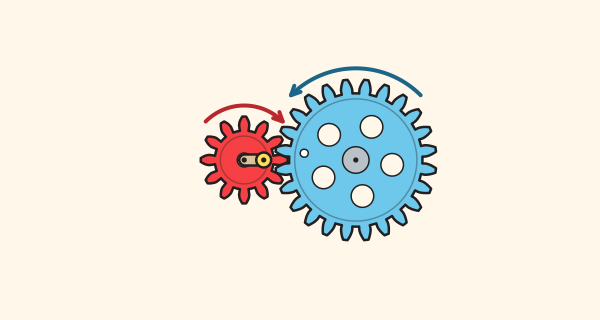
The drawing shows where it starts. It runs here once its script has loaded.El dibujo muestra dónde empieza. Funciona aquí una vez que carga su código.
Your challengeSu reto
- Make the output gear spin faster than the crank.Haga que el engranaje de salida gire más rápido que la manivela. Not done yet.Todavía no.
- Make the output turn with three times your hand’s turning force.Haga que la salida gire con tres veces la fuerza de giro de su mano. Not done yet.Todavía no.
- Put an idler between the gears so the output turns the same way as the crank.Ponga un engranaje intermedio para que la salida gire hacia el mismo lado que la manivela. Not done yet.Todavía no.
- With the idler in, make the output spin exactly twice as fast as the crank.Con el intermedio puesto, haga que la salida gire exactamente al doble de rápido que la manivela. Not done yet.Todavía no.
Every challenge done. Now try it for real at home.Todos los retos logrados. Ahora pruébelo de verdad en casa.
How fast the output turnsQué tan rápido gira la salida
How hard the output turnsQué tan fuerte gira la salida
Teeth, output to crank:Dientes, salida a manivela:
The output turnsLa salida gira
Turns counted:Vueltas contadas:
Your hand turns the crank thirty times a minute, clockwise, with a turning force of one newton meter: a push of ten newtons, about the weight of a liter of water, on a handle ten centimeters out. The arrows show which way each gear turns; rpm means turns a minute. These gears are ideal, with no rubbing.Su mano gira la manivela treinta veces por minuto, en el sentido de las manecillas del reloj, con una fuerza de giro de un newton metro: un empuje de diez newtons, más o menos el peso de un litro de agua, en una manija a diez centímetros del centro. Las flechas muestran hacia dónde gira cada engranaje; rpm quiere decir vueltas por minuto. Estos engranajes son ideales, sin roce.
What is happeningQué está pasando
Gears are wheels with teeth that push each other around. Their teeth pass one for one: when a gear with twelve teeth turns once, twelve teeth push past, and a gear with twenty-four teeth turns only half a turn.Los engranajes son ruedas con dientes que se empujan entre sí. Sus dientes pasan uno por uno: cuando un engranaje de doce dientes da una vuelta, pasan doce dientes, y un engranaje de veinticuatro dientes da solo media vuelta.
So gears trade speed for turning force. A big gear turning a small one makes it spin faster but turn more weakly; a small gear turning a big one makes it spin slower but turn harder. The gears of a bicycle and of a hand drill make this same trade.Así, los engranajes cambian velocidad por fuerza de giro. Un engranaje grande que mueve uno pequeño lo hace girar más rápido pero con menos fuerza; uno pequeño que mueve uno grande lo hace girar más despacio pero con más fuerza. Los engranajes de una bicicleta y de un taladro de mano hacen este mismo cambio.
Two meshed gears always turn opposite ways. Put an idler gear between them and the output turns the same way as the crank again, yet its speed does not change: every tooth that comes into the idler goes out the other side.Dos engranajes acoplados siempre giran en sentidos opuestos. Ponga un engranaje intermedio entre ellos y la salida vuelve a girar hacia el mismo lado que la manivela, pero su velocidad no cambia: cada diente que entra al intermedio sale por el otro lado.
Things to tryCosas para probar
- Give the crank gear and the output the same teeth. What changes, and what stays the same?Ponga los mismos dientes en el engranaje de la manivela y en el de salida. ¿Qué cambia y qué sigue igual?
- Turn the crank and count: how many turns does the output make for each turn of the crank?Gire la manivela y cuente: ¿cuántas vueltas da la salida por cada vuelta de la manivela?
- With three gears, change only the idler’s teeth. Does the output’s speed change?Con tres engranajes, cambie solo los dientes del intermedio. ¿Cambia la velocidad de la salida?
- With a grown-up, look for gears at home: in an egg beater, a can opener or an old wind-up toy.Con una persona adulta, busque engranajes en casa: en un batidor de huevos de manivela, un abrelatas o un juguete viejo de cuerda.
A model of ideal gears: nothing rubs and nothing bends. Real gears lose a little at each mesh to rubbing, and need a little room between their teeth. The teeth are drawn in the curved shape gear makers use, so they fit together the way real ones do.Un modelo de engranajes ideales: nada roza y nada se dobla. Los engranajes reales pierden un poco en cada acople por el roce, y necesitan un poco de espacio entre sus dientes. Los dientes están dibujados con la forma curva que usan quienes fabrican engranajes, así que encajan como los reales.
Open the simulation on its own pageAbrir la simulación en su propia página
Your engineering challengeSu reto de ingeniería
Make an exploded-view poster of your device, name three mechanisms with their jobs, and rebuild it with every fastener accounted for, reporting plainly what works and what does not.Haga un cartel con la vista explosionada de su aparato, nombre tres mecanismos con sus trabajos, y vuélvalo a armar con cada tornillo contado, reportando con claridad qué funciona y qué no.
Make it an experimentConviértalo en un experimento
Science is about changing one thing and watching what happens. Write down your guess, your hypothesis, before you start.La ciencia se trata de cambiar una cosa y observar qué pasa. Escriba su suposición, su hipótesis, antes de empezar.
- Count the fasteners in each layer and predict the next layer's count before you open it. Was the design consistent?Cuente los tornillos de cada capa y prediga cuántos tendrá la siguiente antes de abrirla. ¿Fue consistente el diseño?
- Compare two devices from the safe list: which has more gears and which more springs, and why might that be?Compare dos aparatos de la lista segura: ¿cuál tiene más engranes y cuál más resortes, y por qué será?
- Time the rebuild once with the layer bags and once from a mixed pile, with a toy only. How much does the documentation save?Cronometre el rearmado una vez con las bolsas por capa y otra vez con un montón revuelto, solo con un juguete. ¿Cuánto ahorra la documentación?
Use it, share it, adapt itÚsela, compártala, adáptela
The credit to copyEl crédito para copiar
Free BYRD, CC BY. “Take apart a dead keyboard, name its mechanisms and rebuild it” from the Byrd Academy STEM Curriculum by Byrd EDU, byrdathome.org.Free BYRD, CC BY. “Desarme un teclado descompuesto, nombre sus mecanismos y vuélvalo a armar”, del Currículo STEM de Byrd Academy, de Byrd EDU, byrdathome.org.
This is free to use, share and adapt, even commercially, under the Creative Commons Attribution 4.0 International license (CC BY 4.0), with this credit. What Free BYRD means.Esto es libre de usar, compartir y adaptar, incluso con fines comerciales, bajo la licencia Creative Commons Atribución 4.0 Internacional (CC BY 4.0), con este crédito. Qué significa Free BYRD.