

SimulationsSimulacionesSIM-0018
Simulate, 5 minutesSimular, 5 minutos
Mixing light and mixing paintMezclar luz y mezclar pintura
Shine red, green and blue flashlights on a wall and watch light add up, then mix cyan, magenta and yellow paint and watch it take light away. Then match a target color both ways.Ilumine una pared con linternas roja, verde y azul y vea cómo la luz se suma; luego mezcle pintura cian, magenta y amarilla y vea cómo quita luz. Después iguale un color meta de las dos maneras.
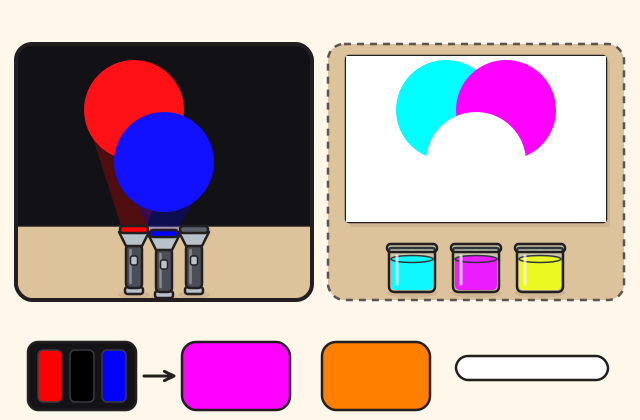
The drawing shows where it starts. It runs here once its script has loaded.El dibujo muestra dónde empieza. Funciona aquí una vez que carga su código.
Your challengeSu reto
- Mix red and green light to make yellow.Mezcle luz roja y verde para hacer amarillo. Not done yet.Todavía no.
- Turn all three lights up to make white.Suba las tres luces para hacer blanco. Not done yet.Todavía no.
- Mix cyan and yellow paint to make green.Mezcle pintura cian y amarilla para hacer verde. Not done yet.Todavía no.
- Match the target color, with light or with paint.Iguale el color meta, con luz o con pintura. Not done yet.Todavía no.
Every challenge done. Now try it for real at home.Todos los retos logrados. Ahora pruébelo de verdad en casa.
How close your mix is to the targetQué tan cerca está su mezcla de la meta
Your mix isSu mezcla es ; the target isla meta es
As a screen stores it:Como la guarda una pantalla:
A screen pixel is three tiny lights, red, green and blue, each stored as a number from none to full strength. The paints are cyan, magenta and yellow: each one soaks up one color of light.Un píxel de pantalla son tres lucecitas, roja, verde y azul, cada una guardada como un número, desde nada hasta toda su fuerza. Las pinturas son cian, magenta y amarilla: cada una absorbe un color de luz.
What is happeningQué está pasando
Light mixes by adding. Shine a red and a green flashlight on the same spot of a white wall and the spot looks yellow; add blue and it looks white. Your eye has three kinds of color sensors, tuned to red, green and blue light, and your brain reads the mix of their signals as one color.La luz se mezcla sumando. Si ilumina el mismo punto de una pared blanca con una linterna roja y una verde, el punto se ve amarillo; si agrega azul, se ve blanco. Su ojo tiene tres tipos de sensores de color, para la luz roja, la verde y la azul, y su cerebro lee la mezcla de sus señales como un solo color.
A screen uses the same trick. Every pixel is three tiny lights, red, green and blue, too small to see apart. A picture is stored as three numbers for every pixel, how bright each light should be, from zero to two hundred fifty-five.Una pantalla usa el mismo truco. Cada píxel son tres lucecitas, roja, verde y azul, demasiado pequeñas para verlas por separado. Una imagen se guarda como tres números para cada píxel, qué tan brillante debe estar cada luz, de cero a doscientos cincuenta y cinco.
Paint works the other way, by taking away. White paper bounces back every color of the light that falls on it. Cyan paint soaks up red light, magenta soaks up green, and yellow soaks up blue. Mix cyan and yellow and only green is left to bounce back, so you see green; mix all three and almost nothing bounces back, so it looks black.La pintura funciona al revés, quitando. El papel blanco devuelve todos los colores de la luz que le cae. La pintura cian absorbe la luz roja, la magenta absorbe la verde y la amarilla absorbe la azul. Si mezcla cian y amarilla, solo queda el verde para devolverse, así que ve verde; si mezcla las tres, casi nada se devuelve, así que se ve negro.
That is why a printer uses cyan, magenta and yellow ink, and a screen uses red, green and blue light.Por eso una impresora usa tinta cian, magenta y amarilla, y una pantalla usa luz roja, verde y azul.
Things to tryCosas para probar
- Turn on only red and green light, then add a little blue. What happens to the yellow?Encienda solo la luz roja y la verde, y luego agregue un poco de azul. ¿Qué le pasa al amarillo?
- Mix cyan and yellow paint. Which color of light is left to bounce back?Mezcle pintura cian y amarilla. ¿Qué color de luz queda para devolverse?
- Make the target with light, then make it again with paint, and compare the amounts.Haga la meta con luz, luego hágala otra vez con pintura, y compare las cantidades.
- Turn all three lights down to half. What happens to white?Baje las tres luces a la mitad. ¿Qué le pasa al blanco?
This is a model. Its lights are the pure red, green and blue a screen uses, and its paints are perfect inks that each soak up exactly one color of light. Real flashlights and paints are less pure: three real paints mixed together make a dark, muddy brown rather than black, which is why printers add black ink.Esto es un modelo. Sus luces son el rojo, el verde y el azul puros que usa una pantalla, y sus pinturas son tintas perfectas que absorben cada una exactamente un color de luz. Las linternas y las pinturas reales son menos puras: tres pinturas reales mezcladas dan un café oscuro y turbio en lugar de negro, y por eso las impresoras agregan tinta negra.
Use it, share it, adapt itÚsela, compártala, adáptela
The credit to copyEl crédito para copiar
Free BYRD, CC BY. “Mixing light and mixing paint” from the Byrd Academy STEM Curriculum by Byrd EDU, byrdathome.org.Free BYRD, CC BY. “Mezclar luz y mezclar pintura”, del Currículo STEM de Byrd Academy, de Byrd EDU, byrdathome.org.
This is free to use, share and adapt, even commercially, under the Creative Commons Attribution 4.0 International license (CC BY 4.0), with this credit. What Free BYRD means.Esto es libre de usar, compartir y adaptar, incluso con fines comerciales, bajo la licencia Creative Commons Atribución 4.0 Internacional (CC BY 4.0), con este crédito. Qué significa Free BYRD.