

SimulationsSimulacionesSIM-0008
Simulate, 5 minutesSimular, 5 minutos
Sound and its wavesEl sonido y sus ondas
Change a string’s length and tightness, or a straw flute’s length, and watch how fast it vibrates and how long its sound waves are in the air. Half the length, one octave higher, and a wave half as long.Cambie el largo y la tensión de una cuerda, o el largo de una flauta de popote, y vea qué tan rápido vibra y qué tan largas son sus ondas de sonido en el aire. La mitad del largo, una octava más alta, y una onda de la mitad.
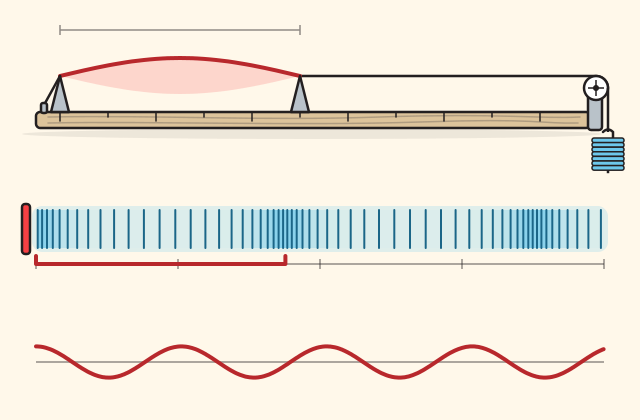
The drawing shows where it starts. It runs here once its script has loaded.El dibujo muestra dónde empieza. Funciona aquí una vez que carga su código.
Your challengeSu reto
- Cut the length in half and make the pitch go exactly one octave higher.Corte el largo a la mitad y haga que el tono suba justo una octava. Not done yet.Todavía no.
- Make the sound louder without changing its pitch.Haga el sonido más fuerte sin cambiar su tono. Not done yet.Todavía no.
- Make a sound whose wavelength in the air is shorter than thirty centimeters, about the length of a ruler.Haga un sonido cuya longitud de onda en el aire mida menos de treinta centímetros, más o menos el largo de una regla. Not done yet.Todavía no.
Every challenge done. Now try it for real at home.Todos los retos logrados. Ahora pruébelo de verdad en casa.
Pitch: vibrations each second, from low to highTono: vibraciones por segundo, de grave a agudo
Wavelength in the air, from short to longLongitud de onda en el aire, de corta a larga
Nearest noteNota más cercana
The last tryEl intento anterior
Vibrations now, compared with beforeVibraciones ahora, comparadas con antes
At the top, the shaded shape shows how far the string, or the air in the straw, moves at each place. In the middle, the sound in two meters of air: the blue layers bunch together where the air is squeezed, and the red mark on the ruler under them is one wavelength, from one squeeze to the next. At the bottom, ten milliseconds of the vibration: the solid wave is now and the dashed wave your last try. The sound plays only when you press its button.Arriba, la forma sombreada muestra cuánto se mueve la cuerda, o el aire del popote, en cada lugar. En medio, el sonido en dos metros de aire: las capas azules se juntan donde el aire se aprieta, y la marca roja en la regla de abajo es una longitud de onda, de un apretón al siguiente. Abajo, diez milisegundos de la vibración: la onda continua es ahora y la punteada su intento anterior. El sonido suena solo cuando usted oprime su botón.
The math, whereLas cuentas, donde : ;
What is happeningQué está pasando
Sound is a vibration, and its pitch is how many vibrations happen each second, counted in hertz. More vibrations each second means a higher pitch.El sonido es una vibración, y su tono es cuántas vibraciones ocurren cada segundo, contadas en hercios. Más vibraciones por segundo significan un tono más alto.
A shorter string or straw vibrates faster, and half the length makes twice as many vibrations: one octave higher. Pulling a string tighter also raises its pitch.Una cuerda o un popote más corto vibra más rápido, y la mitad del largo hace el doble de vibraciones: una octava más alta. Tensar más una cuerda también sube su tono.
In the air, every vibration pushes the air into a squeeze, and the squeezes travel away at the speed of sound, about three hundred forty three meters each second at room temperature. The distance from one squeeze to the next is the wavelength. Every pitch travels at the same speed, so a higher pitch, with more squeezes each second, packs them closer together: the higher the pitch, the shorter the wavelength.En el aire, cada vibración aprieta el aire, y esos apretones se alejan a la velocidad del sonido, unos trescientos cuarenta y tres metros por segundo a temperatura ambiente. La distancia de un apretón al siguiente es la longitud de onda. Todos los tonos viajan a la misma velocidad, así que un tono más alto, con más apretones por segundo, los junta más: entre más alto el tono, más corta la longitud de onda.
A bigger vibration is louder, not higher: the squeezes get stronger, but their pitch and their wavelength stay the same. The cup phone works because the tight string carries the vibration from one cup to the other.Una vibración más grande es más fuerte, no más alta: los apretones se hacen más fuertes, pero su tono y su longitud de onda siguen iguales. El teléfono de vasos funciona porque la cuerda tensa lleva la vibración de un vaso al otro.
Things to tryCosas para probar
- Cut the string’s length in half and compare the two waves, in time and in the air.Corte el largo de la cuerda a la mitad y compare las dos ondas, en el tiempo y en el aire.
- Hang a heavier weight and watch the pitch go up and the wavelength get shorter.Cuelgue una pesa más pesada y vea cómo sube el tono y se acorta la longitud de onda.
- Switch to the straw flute and compare its wavelength with its length.Cambie a la flauta de popote y compare su longitud de onda con su largo.
- Make it louder: does the pitch change? Does the wavelength?Súbale el volumen: ¿cambia el tono? ¿Y la longitud de onda?
The drawing is slowed down two hundred times so your eyes can follow it, and only the lowest note is shown; a real pluck also sounds higher overtones, and a real straw sounds a little lower than the rule says. The speed of sound changes a little with the air’s temperature. The tone plays only when you press the button, made in your browser, never a file.El dibujo está doscientas veces más lento para que sus ojos lo puedan seguir, y solo se muestra la nota más baja; un rasgueo real también suena con armónicos más altos, y un popote real suena un poco más grave de lo que dice la regla. La velocidad del sonido cambia un poco con la temperatura del aire. El tono suena solo cuando presiona el botón, hecho en su navegador, nunca un archivo.
Use it, share it, adapt itÚsela, compártala, adáptela
The credit to copyEl crédito para copiar
Free BYRD, CC BY. “Sound and its waves” from the Byrd Academy STEM Curriculum by Byrd EDU, byrdathome.org.Free BYRD, CC BY. “El sonido y sus ondas”, del Currículo STEM de Byrd Academy, de Byrd EDU, byrdathome.org.
This is free to use, share and adapt, even commercially, under the Creative Commons Attribution 4.0 International license (CC BY 4.0), with this credit. What Free BYRD means.Esto es libre de usar, compartir y adaptar, incluso con fines comerciales, bajo la licencia Creative Commons Atribución 4.0 Internacional (CC BY 4.0), con este crédito. Qué significa Free BYRD.