ExploreExplorarBH-0037
Load a craft-stick bridge until it fails and explain whyCargue un puente de palitos hasta que falle y explique por qué
Build a craft-stick bridge on a budget to cross a set gap, add load in small steps while measuring how far it bends, then find where it failed and defend one design choice with your numbers.Construya un puente de palitos con un presupuesto para cruzar un claro fijo, agregue carga en pasos pequeños midiendo cuánto se dobla, y luego encuentre dónde falló y defienda una decisión de diseño con sus números.
- Ways in:Formas de empezar:
- Read, 3 minutesLeer, 3 minutos
- Do, 60 minutesHacer, 60 minutos
- Simulate, 5 minutesSimular, 5 minutos
- AgesEdades
- Every age. Best for ages 10 and up.Todas las edades. Ideal desde los 10 años.
- CostCosto
- Under a few dollarsMenos de unos pocos dólares
- From the curriculumDel currículo
- STEM-JH-07
The MESH'D components this item uses:Los componentes MESH'D que usa:ManufacturingManufacturaHolistic DesignDiseño integral
Do, about 60 minutesHacer, unos 60 minutos
Build it at homeConstrúyalo en casa
StepsPasos
- Feel it: hold your arms in an arch and push your palms together; name what is pulled and what is squeezed. Make a small triangle and a square of sticks and push on each.Siéntalo: ponga los brazos en arco y empuje las palmas una contra otra; diga qué se jala y qué se aprieta. Haga un triángulo pequeño y un cuadrado de palitos y empuje cada uno.
- Set the span: two book stacks a sheet of paper apart. Set the budget: thirty sticks.Fije el claro: dos pilas de libros separadas por el ancho de una hoja de papel. Fije el presupuesto: treinta palitos.
- Sketch the design and count the sticks before any glue.Dibuje el diseño y cuente los palitos antes de usar pegamento.
- Build, and let the glue dry fully.Construya y deje que el pegamento seque por completo.
- Put on safety glasses, tape the drop zone and hang the cup from the middle of the bridge. Before any load, measure the height of the bridge's middle above the floor.Póngase los lentes de seguridad, marque la zona de caída con cinta y cuelgue el vaso del centro del puente. Antes de cualquier carga, mida la altura del centro del puente sobre el piso.
- Add load in small steps, say ten washers at a time, and after each step measure the middle's height again. Write the load and the deflection in a table.Agregue carga en pasos pequeños, digamos diez arandelas a la vez, y después de cada paso vuelva a medir la altura del centro. Anote la carga y la deflexión en una tabla.
- Keep going until it fails. Note exactly where it broke and which parts were in tension or compression.Siga hasta que falle. Anote exactamente dónde se rompió y qué partes estaban en tensión o en compresión.
- Draw a graph of load against deflection, and write notes for a redesign.Dibuje una gráfica de carga contra deflexión y escriba notas para un rediseño.
- Hold a family vote for a people's choice bridge, then defend one design choice with your numbers.Hagan una votación familiar para elegir el puente favorito del público, y luego defienda una decisión de diseño con sus números.
What you needLo que necesita
- Craft sticksPalitos de madera
- School glue or wood glue, or hot glue for the grown-upPegamento escolar o para madera, o pegamento caliente para la persona adulta
- String and a rulerCuerda y una regla
- Two stacks of books of the same height to make the gapDos pilas de libros de la misma altura para formar el claro
- A cup or a bag hung from string, and washers, coins or dry beans as the loadUn vaso o una bolsa colgados de una cuerda, y arandelas, monedas o frijoles secos como carga
- Safety glasses and tape for the drop zoneLentes de seguridad y cinta para la zona de caída
Under a few dollars.Menos de unos pocos dólares.
Wear eye protection while loading structures to failure, because sticks and glue can snap and fly. Mark a drop zone with tape and keep hands and feet out of it; lift masses into place and never toss them, and load over the floor or a tray, never over a table edge with feet below. A grown-up handles any hot glue, which burns, and cools a burn with water right away; school glue needs no heat. Washers, coins and other small loads stay away from children under three and anyone who still mouths things.Use protección para los ojos mientras carga las estructuras hasta que fallen, porque los palitos y el pegamento pueden quebrarse y salir volando. Marque con cinta adhesiva una zona de caída y mantenga manos y pies fuera de ella; coloque las pesas con las manos y nunca las lance, y cargue sobre el piso o una charola, nunca sobre el borde de una mesa con pies debajo. Una persona adulta maneja cualquier pegamento caliente, que quema, y enfría una quemadura con agua de inmediato; el pegamento escolar no necesita calor. Las arandelas, monedas y otras cargas pequeñas se mantienen lejos de los niños menores de tres años y de cualquiera que todavía se meta cosas en la boca.
Read, 3 minutesLeer, 3 minutos
The big ideaLa gran idea
Every part of a bridge is either pulled or pushed. Tension pulls a part longer and compression squeezes it, and you can feel both in your own arms held in an arch. Strong does not mean rigid everywhere: some flex is good design, and measuring how far a bridge bends under each load, its deflection, shows where it bends and still holds. Loading in small steps and keeping a table turns a crash into data. Failure analysis is not blame. It is how engineers learn where and why a structure gave way, so the next design is better, and a design choice defended with numbers beats one defended with a shrug.Cada parte de un puente está jalada o empujada. La tensión estira una parte y la compresión la aprieta, y usted puede sentir las dos en sus propios brazos puestos en arco. Fuerte no significa rígido en todas partes: algo de flexión es buen diseño, y medir cuánto se dobla un puente con cada carga, su deflexión, muestra dónde se dobla y aun así aguanta. Cargar en pasos pequeños y llevar una tabla convierte un desplome en datos. Analizar la falla no es buscar culpables. Así aprenden los ingenieros dónde y por qué cedió una estructura, para que el siguiente diseño sea mejor, y una decisión de diseño defendida con números vale más que una defendida con un encogimiento de hombros.
Simulate, 5 minutesSimular, 5 minutos
How shape makes paper strongCómo la forma hace fuerte al papel
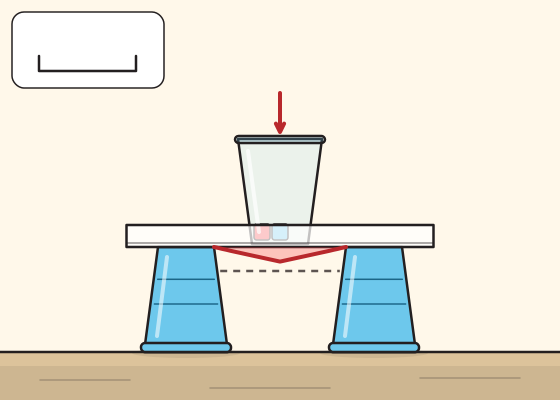
Fold one sheet of paper four ways, set it across two cups and load it block by block. Watch where the bridge bends hardest and where it gives way, then move the cups and try again.Doble una hoja de papel de cuatro maneras, póngala entre dos vasos y cárguela bloque por bloque. Observe dónde se dobla más el puente y dónde cede, y luego mueva los vasos y pruebe otra vez.
The drawing shows where it starts. It runs here once its script has loaded.El dibujo muestra dónde empieza. Funciona aquí una vez que carga su código.
Your challengeSu reto
- Find a gap where even a flat sheet holds the empty cup.Encuentre una distancia en la que hasta una hoja plana aguante el vaso vacío. Not done yet.Todavía no.
- Load a folded bridge until it crumples, and see where it gives way.Cargue un puente doblado hasta que se aplaste, y vea dónde cede. Not done yet.Todavía no.
- Fold the sheet so it holds ten blocks.Doble la hoja para que aguante diez bloques. Not done yet.Todavía no.
- With the cups as far apart as they go, hold five blocks.Con los vasos lo más separados posible, aguante cinco bloques. Not done yet.Todavía no.
Every challenge done. Now try it for real at home.Todos los retos logrados. Ahora pruébelo de verdad en casa.
Strength used in the middleResistencia usada en el centro
The load, cup and blocksLa carga, vaso y bloques
How far it sagsCuánto se hunde
The most it holds hereLo más que aguanta aquí
The red wedge under the bridge shows how hard the paper is bent at each place: hardest in the middle, under the cup. The dashed line is as much bending as this fold can take; past it, the bridge gives way. The box in the corner shows the sheet from its end.La cuña roja bajo el puente muestra cuánto se dobla el papel en cada lugar: más en el centro, debajo del vaso. La línea punteada es lo más que aguanta este doblez; si la pasa, el puente cede. El recuadro de la esquina muestra la hoja vista desde un extremo.
What is happeningQué está pasando
A sheet of paper laid flat across two cups bends under almost nothing. It is so thin that even its own weight makes it sag. Folding it over into a thicker strip barely helps, because the loose layers slide past each other and each one bends on its own.Una hoja de papel puesta plana entre dos vasos se dobla casi con nada. Es tan delgada que hasta su propio peso la hace hundirse. Doblarla para hacer una tira más gruesa casi no ayuda, porque las capas sueltas se deslizan una sobre otra y cada una se dobla sola.
Folding walls up its edges, or folding it into zigzags, stands paper up, away from the middle of the sheet. That is what makes a bridge stiff: the farther the paper sits from the middle, the harder it is to bend, and that distance counts three times over.Doblar paredes en sus bordes, o doblarla en zigzag, pone el papel de pie, lejos del centro de la hoja. Eso es lo que hace rígido a un puente: entre más lejos del centro queda el papel, más cuesta doblarlo, y esa distancia cuenta tres veces.
A bridge is bent hardest in the middle, right under the load, so that is where it gives way. A flat sheet sags until it folds through; a folded one crumples where the tops of its folds are squeezed the most.Un puente se dobla más en el centro, justo debajo de la carga, así que ahí es donde cede. Una hoja plana se hunde hasta doblarse por completo; una doblada se aplasta donde la parte de arriba de sus dobleces se aprieta más.
Every bridge gets weaker as the gap grows. With the cups twice as far apart, a folded bridge holds about half as much before it crumples, and a flat one sags eight times as far.Todo puente se debilita a medida que crece la distancia. Con los vasos al doble de separación, un puente doblado aguanta como la mitad antes de aplastarse, y uno plano se hunde ocho veces más.
Things to tryCosas para probar
- Start with walls and press Add a block until it crumples. Watch the red wedge reach the dashed line first.Empiece con paredes y presione Agregar un bloque hasta que se aplaste. Observe cómo la cuña roja llega primero a la línea punteada.
- Switch to zigzags at the same gap: how many blocks does it hold now?Cambie a zigzag con la misma distancia: ¿cuántos bloques aguanta ahora?
- Choose a flat sheet, then move the cups as close as they go.Escoja la hoja plana y luego acerque los vasos lo más que se pueda.
- Look at the box in the corner: the deeper the fold seen from the end, the stronger the bridge.Mire el recuadro de la esquina: entre más alto es el doblez visto desde el extremo, más fuerte es el puente.
This is a model. The bending uses the real beam formulas for paper, with the sheet's own weight, but the squeeze at which folded paper crumples is a rule of thumb chosen so the folds rank the way they did in the episode, not a measurement. Each block counts as ten grams, and the blocks are drawn smaller than real ones. Real paper also slips on the cups and its walls spread apart, so your own bridge will hold a different number.Esto es un modelo. El doblez usa las fórmulas reales de una viga de papel, con el peso de la propia hoja, pero el apretón con el que el papel doblado se aplasta es una regla práctica elegida para que los dobleces queden en el mismo orden que en el episodio, no una medición. Cada bloque cuenta como diez gramos, y los bloques se dibujan más pequeños que los reales. El papel real también se resbala sobre los vasos y sus paredes se abren, así que su puente aguantará otro número.
Open the simulation on its own pageAbrir la simulación en su propia página
Your engineering challengeSu reto de ingeniería
Cross a gap the width of a sheet of paper with no more than thirty craft sticks, hold the most load you can, and present a load table, the failure point and one choice you can defend with data.Cruce un claro del ancho de una hoja de papel con no más de treinta palitos, aguante la mayor carga posible, y presente una tabla de cargas, el punto de falla y una decisión que pueda defender con datos.
Make it an experimentConviértalo en un experimento
Science is about changing one thing and watching what happens. Write down your guess, your hypothesis, before you start.La ciencia se trata de cambiar una cosa y observar qué pasa. Escriba su suposición, su hipótesis, antes de empezar.
- Same stick budget, two shapes, triangles against squares. Which bends less at the same load?El mismo presupuesto de palitos, dos formas, triángulos contra cuadrados. ¿Cuál se dobla menos con la misma carga?
- Same bridge, different glue drying time: an hour against a whole day.El mismo puente, distinto tiempo de secado del pegamento: una hora contra un día entero.
- Change where the load hangs, the middle against near one end, measuring deflection at the same spot.Cambie dónde cuelga la carga, en el centro contra cerca de un extremo, midiendo la deflexión en el mismo punto.
Use it, share it, adapt itÚsela, compártala, adáptela
The credit to copyEl crédito para copiar
Free BYRD, CC BY. “Load a craft-stick bridge until it fails and explain why” from the Byrd Academy STEM Curriculum by Byrd EDU, byrdathome.org.Free BYRD, CC BY. “Cargue un puente de palitos hasta que falle y explique por qué”, del Currículo STEM de Byrd Academy, de Byrd EDU, byrdathome.org.
This is free to use, share and adapt, even commercially, under the Creative Commons Attribution 4.0 International license (CC BY 4.0), with this credit. What Free BYRD means.Esto es libre de usar, compartir y adaptar, incluso con fines comerciales, bajo la licencia Creative Commons Atribución 4.0 Internacional (CC BY 4.0), con este crédito. Qué significa Free BYRD.