

ExploreExplorarBH-0045
Fill out a dataset card before you trust a chartLlene una ficha de datos antes de confiar en una gráfica
Take one dataset you can find at home or in the news, write its card first, who collected it, why and what is missing, then make one honest chart and state your finding with the limit that costs you something.Tome un conjunto de datos que encuentre en casa o en las noticias, escriba primero su ficha, quién lo reunió, por qué y qué le falta, y luego haga una gráfica honesta y diga su hallazgo con el límite que le cuesta algo.
- Ways in:Formas de empezar:
- Read, 3 minutesLeer, 3 minutos
- Do, 45 minutesHacer, 45 minutos
- Simulate, 10 minutesSimular, 10 minutos
- AgesEdades
- Every age. Best for ages 13 and up.Todas las edades. Ideal desde los 13 años.
- CostCosto
- Things already at homeCosas que ya hay en casa
- From the curriculumDel currículo
- AI-HS-04
The MESH'D components this item uses:Los componentes MESH'D que usa:SoftwareSoftwareHolistic DesignDiseño integral
Do, about 45 minutesHacer, unos 45 minutos
Build it at homeConstrúyalo en casa
StepsPasos
- Fill out the dataset card: who collected the data, why, when, how, who is left out and what is missing. No chart until it is done.Llene la ficha de datos: quién reunió los datos, por qué, cuándo, cómo, a quién dejaron fuera y qué falta. Ninguna gráfica hasta terminarla.
- Clean: find duplicates, blanks and impossible values; decide about each and log the decision with its reason.Limpie: busque duplicados, espacios vacíos y valores imposibles; decida sobre cada uno y registre la decisión con su razón.
- Summarize: the count, the mean, the median, the smallest, the largest and the spread.Resuma: la cantidad, la media, la mediana, el más pequeño, el más grande y la dispersión.
- Make one honest chart: axis from zero, labeled units, and the claim as its title.Haga una gráfica honesta: el eje desde cero, las unidades escritas y la afirmación como título.
- Spot the trick: take turns with the ads and news charts saying what each one does to make you believe something.Descubra el truco: túrnense con las gráficas de anuncios y noticias para decir qué hace cada una para convencerlos de algo.
- Write the finding in one sentence, then give what the data cannot say a paragraph of its own.Escriba el hallazgo en una oración, y luego dé a lo que los datos no pueden decir un párrafo propio.
- Give the three-minute talk; the family asks where the data came from.Dé la charla de tres minutos; la familia pregunta de dónde salieron los datos.
What you needLo que necesita
- A small dataset: a month of daily use from a utility bill, a sports table from the newspaper, a public table an adult picked, or a family logUn conjunto de datos pequeño: un mes de consumo diario de un recibo de servicios, una tabla deportiva del periódico, una tabla pública que eligió un adulto, o un registro familiar
- Paper for the dataset card and the cleaning logPapel para la ficha de datos y el registro de limpieza
- Graph paper, a ruler and markersPapel cuadriculado, una regla y marcadores
- Charts cut from ads or the news for the spot-the-trick gameGráficas recortadas de anuncios o noticias para el juego de descubrir el truco
Things already at home.Cosas que ya hay en casa.
An adult chooses and checks any public dataset, and nothing in it identifies a person; a family dataset leaves out names and anything private, and nothing with personal details is posted anywhere. If a cloud notebook or an AI tool is used, an adult sets it up and supervises, and tools that can act are always supervised.Un adulto elige y revisa cualquier conjunto de datos público, y nada en él identifica a una persona; un conjunto de datos familiar deja fuera los nombres y todo lo privado, y nada con datos personales se publica en ningún lado. Si se usa un cuaderno en la nube o una herramienta de IA, un adulto lo prepara y supervisa, y las herramientas que pueden actuar siempre se supervisan.
Read, 3 minutesLeer, 3 minutos
The big ideaLa gran idea
Before any analysis, question the data: who collected it, why, how, and what is missing. A dataset card answers that, and no chart is drawn until the card is done, because where the data came from decides what the numbers can say. Cleaning data is not cheating; cleaning nobody wrote down is. Log every decision and you can defend each one. Two things moving together does not show that one causes the other, so correlation is not the story. And the chart never speaks for itself: every chart is an argument, and its axes and baselines can make the same data say different things. A finding comes with its limits attached, and a limit that costs you something is the honest kind.Antes de cualquier análisis, cuestione los datos: quién los reunió, por qué, cómo y qué les falta. Una ficha de datos responde eso, y no se dibuja ninguna gráfica hasta terminar la ficha, porque de dónde vienen los datos decide lo que los números pueden decir. Limpiar datos no es hacer trampa; hacer trampa es una limpieza que nadie anotó. Registre cada decisión y podrá defender cada una. Que dos cosas se muevan juntas no demuestra que una cause la otra, así que la correlación no es la historia. Y la gráfica nunca habla por sí sola: cada gráfica es un argumento, y sus ejes y sus líneas base pueden hacer que los mismos datos digan cosas distintas. Un hallazgo viene con sus límites, y un límite que le cuesta algo es el honesto.
Simulate, 10 minutesSimular, 10 minutos
Roll the dice: what chance looks likeTire los dados: cómo se ve la probabilidad
Roll one die or two, once, ten times or a thousand, and watch your tally settle onto the shape that chance predicts.Tire uno o dos dados, una vez, diez veces o mil, y vea cómo su conteo se acomoda a la forma que predice la probabilidad.
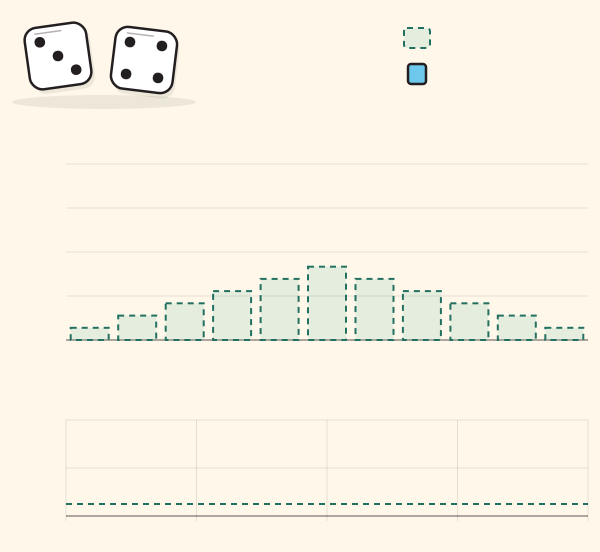
The drawing shows where it starts. It runs here once its script has loaded.El dibujo muestra dónde empieza. Funciona aquí una vez que carga su código.
Your challengeSu reto
- Roll ten times and compare the bars with the green boxes.Tire diez veces y compare las barras con las cajas verdes. Not done yet.Todavía no.
- Roll two dice at least a hundred times. Which sum comes up most?Tire dos dados al menos cien veces. ¿Qué suma sale más? Not done yet.Todavía no.
- Roll until the bars are off from the expected shape by less than five percent.Tire hasta que las barras estén a menos del cinco por ciento de la forma esperada. Not done yet.Todavía no.
- With one die, find a run of ten rolls with no six at all.Con un dado, encuentre una serie de diez tiradas sin ningún seis. Not done yet.Todavía no.
Every challenge done. Now try it for real at home.Todos los retos logrados. Ahora pruébelo de verdad en casa.
Last rollÚltima tirada
Comes up most so farLa que más ha salido
Off from the expected shapeLejos de la forma esperada
Run numberNúmero de serie
A green dashed box is the expected shape: how tall each bar would be if every result came up exactly as often as its chance says. A blue bar is your rolls, as a share of all of them. The red line is how far off the bars are: the share of rolls that would have to move to another bar to match the green boxes.Una caja verde punteada es la forma esperada: qué tan alta sería cada barra si cada resultado saliera exactamente tan seguido como dice su probabilidad. Una barra azul son sus tiradas, como parte del total. La línea roja es qué tan lejos están las barras: la parte de las tiradas que tendría que pasar a otra barra para igualar las cajas verdes.
What is happeningQué está pasando
A fair die gives each face the same chance: one in six. If you could roll forever, each face would come up on one roll out of every six, and the tally would be flat.Un dado justo le da a cada cara la misma probabilidad: una entre seis. Si pudiera tirar para siempre, cada cara saldría en una de cada seis tiradas, y el conteo sería plano.
Two dice are different. They can land in thirty-six ways. Six of those ways add up to seven (one and six, two and five, three and four, and each of those turned around), but only one way makes two and only one makes twelve. So the expected shape is a triangle with seven at the top.Dos dados son distintos. Pueden caer de treinta y seis maneras. Seis de esas maneras suman siete (uno y seis, dos y cinco, tres y cuatro, y cada una al revés), pero solo una da dos y solo una da doce. Por eso la forma esperada es un triángulo con el siete arriba.
A few rolls almost never look like the expected shape: luck decides a lot. As the rolls pile up, each bar’s share of all the rolls comes closer and closer to its chance. That is the law of large numbers. The counts keep wandering, but as a share of more and more rolls, the wandering matters less and less.Unas pocas tiradas casi nunca se parecen a la forma esperada: la suerte decide mucho. Al juntarse las tiradas, la parte de cada barra se acerca más y más a su probabilidad. Esa es la ley de los grandes números. Los conteos siguen variando, pero como parte de cada vez más tiradas, esa variación importa cada vez menos.
How far off the bars are is measured as the share of rolls that would have to move to another bar for the bars to match the expected shape exactly. Ten rolls are usually far off. A thousand rolls are usually off by only a few percent.Qué tan lejos están las barras se mide como la parte de las tiradas que tendría que pasar a otra barra para que las barras igualen exactamente la forma esperada. Diez tiradas suelen estar muy lejos. Mil tiradas suelen estar a solo unos pocos por ciento.
Things to tryCosas para probar
- Roll two dice ten times, then try another run and roll ten again. Do the two runs look alike? Now do the same with a thousand rolls.Tire dos dados diez veces, luego pruebe otra serie y tire diez más. ¿Se parecen las dos series? Ahora haga lo mismo con mil tiradas.
- Slide the rolls from one all the way to ten thousand and watch the red line fall.Deslice las tiradas desde una hasta diez mil y observe cómo baja la línea roja.
- At the same number of rolls, switch between one die and two dice and compare the shapes.Con el mismo número de tiradas, cambie entre un dado y dos dados y compare las formas.
- Roll two real dice thirty-six times at home and tally the sums. How close did you come to the triangle?Tire dos dados de verdad treinta y seis veces en casa y cuente las sumas. ¿Qué tanto se acercó al triángulo?
This is a model. The rolls come from a computer recipe that only looks random, and each run always gives the same rolls. Real dice are a little uneven and real throws are messy, but with fair dice you should see the same shapes.Este es un modelo. Las tiradas vienen de una receta de computadora que solo parece al azar, y cada serie siempre da las mismas tiradas. Los dados reales son un poco disparejos y los tiros reales son desordenados, pero con dados justos debería ver las mismas formas.
Open the simulation on its own pageAbrir la simulación en su propia página
Your engineering challengeSu reto de ingeniería
Present one finding in three minutes with the dataset card, the cleaning log, one honest chart and a stated limit that weakens your own claim.Presente un hallazgo en tres minutos con la ficha de datos, el registro de limpieza, una gráfica honesta y un límite declarado que debilite su propia afirmación.
Make it an experimentConviértalo en un experimento
Science is about changing one thing and watching what happens. Write down your guess, your hypothesis, before you start.La ciencia se trata de cambiar una cosa y observar qué pasa. Escriba su suposición, su hipótesis, antes de empezar.
- Same data, two baselines: an axis starting at zero against one starting just under the smallest value. Show both and name the claim each one makes.Los mismos datos, dos líneas base: un eje que empieza en cero contra uno que empieza justo debajo del valor más pequeño. Muestre los dos y nombre la afirmación que hace cada uno.
- Two groups the data lets you compare: does a difference survive when you look at the spread, not only the average?Dos grupos que los datos le permitan comparar: ¿la diferencia sobrevive cuando mira la dispersión, y no solo el promedio?
- Drop one odd value with a logged reason, then put it back. Does the finding change?Quite un valor raro con una razón anotada, y luego vuelva a ponerlo. ¿Cambia el hallazgo?
Use it, share it, adapt itÚsela, compártala, adáptela
The credit to copyEl crédito para copiar
Free BYRD, CC BY. “Fill out a dataset card before you trust a chart” from the Byrd Academy STEM Curriculum by Byrd EDU, byrdathome.org.Free BYRD, CC BY. “Llene una ficha de datos antes de confiar en una gráfica”, del Currículo STEM de Byrd Academy, de Byrd EDU, byrdathome.org.
This is free to use, share and adapt, even commercially, under the Creative Commons Attribution 4.0 International license (CC BY 4.0), with this credit. What Free BYRD means.Esto es libre de usar, compartir y adaptar, incluso con fines comerciales, bajo la licencia Creative Commons Atribución 4.0 Internacional (CC BY 4.0), con este crédito. Qué significa Free BYRD.