

ExploreExplorarBH-0056
Keep a Moon diary for a monthLleve un diario de la Luna durante un mes
Draw the Moon's shape and where it sits in the sky on every day you can find it for a month, and discover the pattern that repeats about every twenty-nine and a half days.Dibuje la forma de la Luna y dónde está en el cielo cada día que la encuentre durante un mes, y descubra el patrón que se repite más o menos cada veintinueve días y medio.
- Ways in:Formas de empezar:
- Read, 3 minutesLeer, 3 minutos
- Do, 10 minutesHacer, 10 minutos
- Simulate, 5 minutesSimular, 5 minutos
- AgesEdades
- Every age. Best for ages 5 and up.Todas las edades. Ideal desde los 5 años.
- CostCosto
- Free, nothing to gatherGratis, sin nada que reunir
The MESH'D components this item uses:Los componentes MESH'D que usa:SoftwareSoftwareHolistic DesignDiseño integral
Do, about 10 minutesHacer, unos 10 minutos
Build it at homeConstrúyalo en casa
StepsPasos
- Make a page with a box for every day of the month, and write the date in each box.Haga una hoja con un cuadro para cada día del mes y escriba la fecha en cada cuadro.
- Each day, look for the Moon in the evening, at night or in the daytime sky. A grown-up comes outside with you after dark.Cada día, busque la Luna en la tarde, en la noche o en el cielo de día. Una persona adulta sale con usted cuando ya está oscuro.
- Draw a circle in that day's box and shade the dark part, so the white part matches what you see.Dibuje un círculo en el cuadro de ese día y sombree la parte oscura, para que la parte blanca se parezca a lo que ve.
- Write the time, and draw a little landmark, such as a tree or a roof, to show where in the sky the Moon was.Anote la hora y dibuje una pequeña referencia, como un árbol o un techo, para mostrar en qué parte del cielo estaba la Luna.
- If clouds hide it, or you cannot find it, write that down too. A missing day is still data.Si las nubes la tapan, o no la encuentra, anótelo también. Un día sin Luna también es un dato.
- At the end of the month, look at all the boxes in order and name the phases you saw.Al final del mes, vea todos los cuadros en orden y nombre las fases que vio.
- Mark the full moon and the new moon, and count the days between them.Marque la luna llena y la luna nueva, y cuente los días que hay entre ellas.
What you needLo que necesita
- A notebook, or a sheet with a box for each day of the monthUn cuaderno, o una hoja con un cuadro para cada día del mes
- A pencilUn lápiz
- A window or a safe spot outdoors with a view of the skyUna ventana o un lugar seguro al aire libre desde donde se vea el cielo
Free, nothing to gather.Gratis, sin nada que reunir.
A grown-up comes along for every look after dark, from a yard, a porch or a window, never from a street. When you look for the Moon in the daytime, never look at the Sun: it is not safe for eyes, even with sunglasses. Stand so a wall or a tree blocks the Sun, or turn your back to it.Una persona adulta acompaña cada vez que salga a mirar de noche, desde un patio, un porche o una ventana, nunca desde la calle. Cuando busque la Luna de día, nunca mire el Sol: no es seguro para los ojos, ni siquiera con lentes de sol. Párese donde una pared o un árbol tape el Sol, o dele la espalda.
Read, 3 minutesLeer, 3 minutos
The big ideaLa gran idea
The Moon makes no light of its own; moonlight is sunlight reflecting off it. The Sun always lights half of the Moon, the half that faces the Sun. As the Moon travels around the Earth, we see that lit half from a changing angle, so its shape seems to change: from the new moon, when the lit side faces away from us, through a growing crescent, the first quarter and a fat gibbous moon, to the full moon, and then shrinking back the other way. The whole cycle repeats about every twenty-nine and a half days. The Moon is also up in daylight on many days, so a diary can include the morning and afternoon sky.La Luna no produce luz propia; la luz de la luna es luz del sol que se refleja en ella. El Sol siempre ilumina la mitad de la Luna, la mitad que mira hacia el Sol. Mientras la Luna viaja alrededor de la Tierra, vemos esa mitad iluminada desde un ángulo que cambia, así que su forma parece cambiar: desde la luna nueva, cuando el lado iluminado no mira hacia nosotros, pasando por una luna creciente, el cuarto creciente y una luna gibosa, hasta la luna llena, y luego se achica de regreso por el otro lado. Todo el ciclo se repite más o menos cada veintinueve días y medio. Muchos días la Luna también está en el cielo de día, así que un diario puede incluir el cielo de la mañana y de la tarde.
Explore, 5 minutesExplorar, 5 minutos
The phases of the MoonLas fases de la Luna
Move through a month and watch the Moon go around the Earth in the Sun's light, beside the Moon as it looks from home each night.Avance por un mes y vea a la Luna girar alrededor de la Tierra bajo la luz del Sol, junto a la Luna como se ve desde casa cada noche.
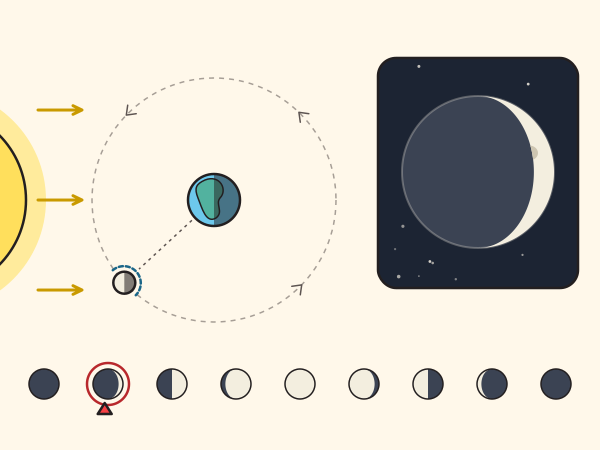
The drawing shows where it starts. It runs here once its script has loaded.El dibujo muestra dónde empieza. Funciona aquí una vez que carga su código.
Your challengeSu reto
- Find the full moon, when the whole face is lit.Encuentre la luna llena, cuando toda la cara está iluminada. Not done yet.Todavía no.
- Find the first quarter, when half of the face is lit and growing.Encuentre el cuarto creciente, cuando la mitad de la cara está iluminada y creciendo. Not done yet.Todavía no.
- Watch from the southern half of the Earth and see the Moon turned around.Mire desde la mitad sur de la Tierra y vea la Luna al revés. Not done yet.Todavía no.
- Find a waning crescent, the thin Moon of the early morning.Encuentre una luna menguante, la luna delgada de la madrugada. Not done yet.Todavía no.
Every challenge done. Now try it for real at home.Todos los retos logrados. Ahora pruébelo de verdad en casa.
Part of the face we see that is litParte iluminada de la cara que vemos
Phase:Fase:
The Sun always lights half of the Moon.El Sol siempre ilumina la mitad de la Luna.
On the left, the Earth and the Moon's path seen from far above the North Pole, with the Sun's light coming from the left; the dark half of each is its night. The blue dashed edge marks the half of the Moon that faces the Earth. On the right, the Moon as it looks from the Earth that day. Below, the whole month, with a red mark on today. The distances are squeezed to fit.A la izquierda, la Tierra y el camino de la Luna vistos desde muy arriba del polo norte, con la luz del Sol llegando desde la izquierda; la mitad oscura de cada una es su noche. La orilla azul punteada marca la mitad de la Luna que mira hacia la Tierra. A la derecha, la Luna como se ve desde la Tierra ese día. Abajo, todo el mes, con una marca roja en el día de hoy. Las distancias están apretadas para que quepan.
What is happeningQué está pasando
The Moon makes no light of its own. The Sun lights it, and at every moment the Sun lights exactly half of the Moon: the half that faces the Sun.La Luna no produce luz propia. El Sol la ilumina, y en todo momento el Sol ilumina exactamente la mitad de la Luna: la mitad que mira hacia el Sol.
As the Moon goes around the Earth, we see that lit half from a changing side. When the Moon is between the Earth and the Sun, the lit half faces away and we see a dark new moon. A week later we see half of the lit half, the first quarter. When the Earth is between the Sun and the Moon, the whole lit half faces us: a full moon.Mientras la Luna gira alrededor de la Tierra, vemos esa mitad iluminada desde un lado que cambia. Cuando la Luna está entre la Tierra y el Sol, la mitad iluminada mira hacia el otro lado y vemos una luna nueva oscura. Una semana después vemos la mitad de la mitad iluminada, el cuarto creciente. Cuando la Tierra está entre el Sol y la Luna, toda la mitad iluminada nos mira: luna llena.
The whole pattern takes about twenty-nine and a half days, then starts again. It is not the Earth's shadow: that falls on the Moon only during an eclipse.Todo el patrón tarda unos veintinueve días y medio, y luego empieza otra vez. No es la sombra de la Tierra: esa cae sobre la Luna solo durante un eclipse.
The pattern lets you predict. A Moon growing from a crescent is seen in the evening; a shrinking Moon is up late at night and in the morning.El patrón permite predecir. Una luna que crece desde una orilla delgada se ve en la tarde; una luna que se achica sale tarde en la noche y se ve en la mañana.
Things to tryCosas para probar
- Press Next phase again and again and say each name out loud.Oprima Siguiente fase una y otra vez y diga cada nombre en voz alta.
- Look at the left side of the drawing: how much of the blue dashed half is in sunlight? Compare it with the Moon on the right.Mire el lado izquierdo del dibujo: ¿cuánto de la mitad con orilla azul punteada está bajo la luz del Sol? Compárelo con la Luna de la derecha.
- Keep a Moon log: draw the real Moon's shape at the same time every clear night for two weeks, and predict tomorrow's shape before you look.Lleve un registro de la Luna: dibuje la forma de la Luna real a la misma hora cada noche despejada durante dos semanas, y prediga la forma de mañana antes de mirar.
- In a dark room, hold a ball at arm's length and turn slowly in front of one lamp. Watch the lit part of the ball change shape.En un cuarto oscuro, sostenga una pelota con el brazo estirado y gire despacio frente a una lámpara. Observe cómo cambia de forma la parte iluminada de la pelota.
The shapes come from the angle between the Sun and the Moon on each day of an average month. The drawing squeezes the distances, draws the Moon's path as a flat circle, and gives rising and setting times as a rule of thumb that can be off by an hour or more depending on where you live and the season.Las formas salen del ángulo entre el Sol y la Luna en cada día de un mes promedio. El dibujo aprieta las distancias, dibuja el camino de la Luna como un círculo plano y da las horas de salida y puesta como una regla práctica que puede fallar por una hora o más según dónde viva y la época del año.
Open the simulation on its own pageAbrir la simulación en su propia página
Your engineering challengeSu reto de ingeniería
Use your diary to predict. After two weeks, forecast the shape you will see one week later and about when it will be up, then check. Can you predict the date of the next full moon?Use su diario para predecir. Después de dos semanas, pronostique la forma que verá una semana después y más o menos a qué hora estará en el cielo, y luego compruébelo. ¿Puede predecir la fecha de la próxima luna llena?
Make it an experimentConviértalo en un experimento
Science is about changing one thing and watching what happens. Write down your guess, your hypothesis, before you start.La ciencia se trata de cambiar una cosa y observar qué pasa. Escriba su suposición, su hipótesis, antes de empezar.
- Change nothing but the day: look at the same time every evening for a week and draw where the Moon sits against a tree or a roofline. Which way does it shift from one night to the next?Cambie solo el día: mire a la misma hora cada tarde durante una semana y dibuje dónde está la Luna junto a un árbol o un techo. ¿Hacia dónde se corre de una noche a la siguiente?
- Change only the time: look at the Moon twice on one night, early and a few hours later, and draw how far it moved.Cambie solo la hora: mire la Luna dos veces en una misma noche, temprano y unas horas después, y dibuje cuánto se movió.
- Change only evening for morning: in the second half of the month, look for the Moon in the morning sky, and note which side of it is lit.Cambie solo la tarde por la mañana: en la segunda mitad del mes, busque la Luna en el cielo de la mañana y anote qué lado está iluminado.
Use it, share it, adapt itÚsela, compártala, adáptela
The credit to copyEl crédito para copiar
Free BYRD, CC BY. “Keep a Moon diary for a month” from the Byrd Academy STEM Curriculum by Byrd EDU, byrdathome.org.Free BYRD, CC BY. “Lleve un diario de la Luna durante un mes”, del Currículo STEM de Byrd Academy, de Byrd EDU, byrdathome.org.
This is free to use, share and adapt, even commercially, under the Creative Commons Attribution 4.0 International license (CC BY 4.0), with this credit. What Free BYRD means.Esto es libre de usar, compartir y adaptar, incluso con fines comerciales, bajo la licencia Creative Commons Atribución 4.0 Internacional (CC BY 4.0), con este crédito. Qué significa Free BYRD.