

ExploreExplorarBH-0047
Float an egg in salt waterHaga flotar un huevo en agua con sal
Watch a raw egg sink in plain water, then stir in salt a spoonful at a time until it rises, and find out why salt water holds it up.Observe cómo un huevo crudo se hunde en agua sola, luego agregue sal de cucharada en cucharada hasta que suba, y descubra por qué el agua con sal lo sostiene.
- Ways in:Formas de empezar:
- Read, 3 minutesLeer, 3 minutos
- Do, 20 minutesHacer, 20 minutos
- Simulate, 10 minutesSimular, 10 minutos
- AgesEdades
- Every age. Best for ages 5 and up.Todas las edades. Ideal desde los 5 años.
- CostCosto
- Things already at homeCosas que ya hay en casa
The MESH'D components this item uses:Los componentes MESH'D que usa:ManufacturingManufactura
Do, about 20 minutesHacer, unos 20 minutos
Build it at homeConstrúyalo en casa
StepsPasos
- Fill the jar about two thirds full with plain tap water.Llene el frasco con agua de la llave hasta unas dos terceras partes.
- A grown-up lowers the egg in gently on the spoon. Watch where it goes, and draw it.Una persona adulta mete el huevo con cuidado sobre la cuchara. Observe a dónde va y dibújelo.
- Lift the egg out with the spoon and rest it in the bowl.Saque el huevo con la cuchara y déjelo en el tazón.
- Stir in one tablespoon of salt until the water is clear again. Lower the egg back in and look.Revuelva una cucharada de sal hasta que el agua vuelva a verse clara. Meta otra vez el huevo y observe.
- Keep going, one tablespoon at a time and counting each one, until the egg lifts off the bottom.Siga así, una cucharada a la vez y contando cada una, hasta que el huevo se despegue del fondo.
- Add a spoonful or two more until a little of the shell rides above the water. Write down how many spoonfuls it took.Agregue una o dos cucharadas más hasta que un poco del cascarón quede por encima del agua. Anote cuántas cucharadas hicieron falta.
- Pour the salt water down the sink, throw the egg away, and wash your hands, the spoon and the counter with warm soapy water.Tire el agua con sal en el fregadero, tire el huevo y lave con agua tibia y jabón sus manos, la cuchara y la mesa.
What you needLo que necesita
- A tall clear glass or jar that holds about two cups of waterUn vaso alto o un frasco transparente donde quepan unas dos tazas de agua
- A raw egg in its shellUn huevo crudo con cascarón
- Table salt, about half a cupSal de mesa, como media taza
- A tablespoon and a small bowlUna cuchara sopera y un tazón chico
- Paper and a pencilPapel y un lápiz
Things already at home.Cosas que ya hay en casa.
A grown-up handles the raw egg and stays within arm's reach of the water. Raw eggs can carry germs, so wash hands, the spoon and the counter with warm soapy water after touching the egg, and throw the egg away when you finish: it is not for eating. Check for egg allergies first. Salt stings eyes and cuts, so keep wet hands away from faces, taste nothing, and wipe up spills so no one slips.Una persona adulta maneja el huevo crudo y se queda al alcance de su brazo cerca del agua. Los huevos crudos pueden traer gérmenes, así que lave con agua tibia y jabón las manos, la cuchara y la mesa después de tocar el huevo, y tire el huevo al terminar: no es para comer. Revise primero si alguien es alérgico al huevo. La sal arde en los ojos y en las cortaduras, así que mantenga las manos mojadas lejos de la cara, no pruebe nada y seque lo que se derrame para que nadie se resbale.
Read, 3 minutesLeer, 3 minutos
The big ideaLa gran idea
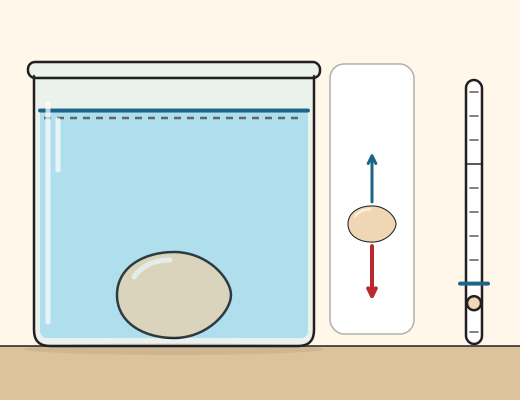
Whether something sinks or floats depends on its density: how much stuff is packed into each bit of space. Water pushes up on anything in it, and the push equals the weight of the water the thing moves out of its way. A fresh egg is a little denser than plain water, so the water it moves aside weighs less than the egg, and it sinks. Dissolved salt adds weight to the water without taking up much more space, so salt water is denser. Stir in enough and the water the egg moves aside weighs more than the egg, so up it comes. That is why salty sea water holds things up a little better than a lake.Que algo se hunda o flote depende de su densidad: cuánta materia hay en cada pedacito de espacio. El agua empuja hacia arriba todo lo que tiene adentro, y ese empuje es igual al peso del agua que el objeto quita de su camino. Un huevo fresco es un poco más denso que el agua sola, así que el agua que aparta pesa menos que el huevo, y se hunde. La sal disuelta agrega peso al agua sin ocupar mucho más espacio, así que el agua con sal es más densa. Si agrega suficiente, el agua que el huevo aparta pesa más que el huevo, y este sube. Por eso el agua salada del mar sostiene las cosas un poco mejor que un lago.
Simulate, 10 minutesSimular, 10 minutos
Sink or float¿Se hunde o flota?
Drop a cork, an apple, an egg and more into fresh water, salt water or cooking oil, and see why each one sinks or floats: its density against the liquid’s, and the push of the liquid it moves aside.Ponga un corcho, una manzana, un huevo y más en agua sin sal, agua con sal o aceite de cocina, y vea por qué cada uno se hunde o flota: su densidad contra la del líquido, y el empuje del líquido que aparta.
The drawing shows where it starts. It runs here once its script has loaded.El dibujo muestra dónde empieza. Funciona aquí una vez que carga su código.
Your challengeSu reto
- In fresh water, test three things and find one that floats and one that sinks.En agua sin sal, pruebe tres cosas y encuentre una que flote y una que se hunda. Not done yet.Todavía no.
- Stir salt into the water until the egg floats.Disuelva sal en el agua hasta que el huevo flote. Not done yet.Todavía no.
- Put the ice cube in cooking oil. Does it float?Ponga el cubo de hielo en aceite de cocina. ¿Flota? Not done yet.Todavía no.
- Float the grape with the least salt that does it.Haga flotar la uva con la menor cantidad de sal que lo logre. Not done yet.Todavía no.
Every challenge done. Now try it for real at home.Todos los retos logrados. Ahora pruébelo de verdad en casa.
Its weight, pulling downSu peso, que jala hacia abajo
The liquid’s push upEl empuje del líquido hacia arriba
Liquid it pushes asideLíquido que aparta
Its densitySu densidad
The liquid’s densityLa densidad del líquido
Under the surfaceBajo la superficie
The push up is the weight of the liquid the object pushes aside. On the density scale lighter is higher, so anything above the liquid’s blue line floats. The dashed line in the jar is where the liquid stood before.El empuje hacia arriba es el peso del líquido que el objeto aparta. En la escala de densidad lo más ligero queda más arriba, así que lo que esté sobre la línea azul del líquido flota. La línea punteada del frasco es donde estaba el líquido antes.
What is happeningQué está pasando
Density is how much stuff is packed into each bit of space. A milliliter of water has a mass of about one gram, a milliliter of cork about a quarter of a gram, and a milliliter of a coin’s metal about seven grams.La densidad es cuánta materia hay en cada pedacito de espacio. Un mililitro de agua tiene una masa de cerca de un gramo, un mililitro de corcho cerca de un cuarto de gramo, y un mililitro del metal de una moneda cerca de siete gramos.
Every liquid pushes up on whatever is in it, and the push is exactly the weight of the liquid the thing pushes out of its way. Something less dense than the liquid sinks in only until the liquid it pushes aside weighs as much as it does, so it floats. Something denser can never push aside enough: even all the way under, the liquid it moves weighs less than it does, so it sinks.Todo líquido empuja hacia arriba lo que tiene adentro, y ese empuje es justo el peso del líquido que el objeto quita de su camino. Algo menos denso que el líquido se hunde solo hasta que el líquido que aparta pesa lo mismo que él, así que flota. Algo más denso nunca logra apartar suficiente: aun completamente bajo la superficie, el líquido que mueve pesa menos que él, así que se hunde.
How deep a floater rides tells you its density: the share of it under the surface is its density divided by the liquid’s. Ice is about nine tenths as dense as water, so about nine tenths of an ice cube, or of an iceberg, stays under.Qué tan hondo flota algo dice su densidad: la parte que queda bajo la superficie es su densidad dividida entre la del líquido. El hielo tiene cerca de nueve décimos de la densidad del agua, así que cerca de nueve décimos de un cubo de hielo, o de un iceberg, quedan abajo.
Salt that dissolves in water adds mass but hardly any space, so salt water is denser than fresh water. That is why an egg that sinks in plain water floats once enough salt is stirred in, and it is evidence that the dissolved salt is still there.La sal que se disuelve en el agua le agrega masa pero casi nada de espacio, así que el agua con sal es más densa que el agua sin sal. Por eso un huevo que se hunde en agua sola flota cuando se disuelve suficiente sal, y eso es una prueba de que la sal disuelta sigue ahí.
Things to tryCosas para probar
- Test every object in fresh water, and guess before each one: sink or float?Pruebe cada objeto en agua sin sal, y antes de cada uno adivine: ¿se hunde o flota?
- Put the egg in salt water and add salt one teaspoon at a time. Count how many it takes.Ponga el huevo en agua con sal y agregue la sal de cucharadita en cucharadita. Cuente cuántas hacen falta.
- Compare one object in water and in oil: does it ride higher or lower, and why?Compare un mismo objeto en agua y en aceite: ¿flota más alto o más bajo, y por qué?
- Watch the dashed line in the jar: the liquid rises by exactly what the object pushes aside.Observe la línea punteada del frasco: el líquido sube justo lo que el objeto aparta.
This is a model. Each object gets one typical density, but real eggs, grapes and apples vary, and an egg gets lighter as it ages, so an old egg can float in plain water. Your own egg may need a little more or a little less salt than this one, and the drop into the jar is drawn, not worked out from the water’s drag.Esto es un modelo. Cada objeto tiene una densidad típica, pero los huevos, las uvas y las manzanas de verdad varían, y un huevo se hace más ligero con los días, así que un huevo viejo puede flotar en agua sola. Su huevo puede necesitar un poco más o un poco menos de sal que este, y la caída en el frasco está dibujada, no calculada a partir del roce del agua.
Open the simulation on its own pageAbrir la simulación en su propia página
Your engineering challengeSu reto de ingeniería
Make the egg hang in the middle of the jar, neither on the bottom nor at the top. A hint: it can be done with two layers, salty water on the bottom and plain water poured gently on top over the back of a spoon.Logre que el huevo quede a media altura del frasco, ni en el fondo ni arriba. Una pista: se puede con dos capas, el agua con sal abajo y el agua sola vertida con cuidado encima, sobre el dorso de una cuchara.
Make it an experimentConviértalo en un experimento
Science is about changing one thing and watching what happens. Write down your guess, your hypothesis, before you start.La ciencia se trata de cambiar una cosa y observar qué pasa. Escriba su suposición, su hipótesis, antes de empezar.
- Keep the water the same and change only the salt: make three jars with one, three and six spoonfuls, and see in which ones the egg floats.Deje igual el agua y cambie solo la sal: prepare tres frascos con una, tres y seis cucharadas, y vea en cuáles flota el huevo.
- Keep the salt water the same and change what you float: a lemon, a small potato and an apple, one at a time. Which ones need salt to float, and which float in plain water too?Deje igual el agua con sal y cambie lo que pone a flotar: un limón, una papa chica y una manzana, uno por uno. ¿Cuáles necesitan sal para flotar y cuáles flotan también en agua sola?
- Try an older egg and a fresher one in plain water. As an egg ages, water slowly escapes through its shell and the air pocket inside grows, so an old egg may float with no salt at all.Pruebe en agua sola un huevo más viejo y uno más fresco. Al envejecer, el huevo pierde agua poco a poco a través del cascarón y crece la bolsa de aire de adentro, así que un huevo viejo puede flotar sin nada de sal.
Use it, share it, adapt itÚsela, compártala, adáptela
The credit to copyEl crédito para copiar
Free BYRD, CC BY. “Float an egg in salt water” from the Byrd Academy STEM Curriculum by Byrd EDU, byrdathome.org.Free BYRD, CC BY. “Haga flotar un huevo en agua con sal”, del Currículo STEM de Byrd Academy, de Byrd EDU, byrdathome.org.
This is free to use, share and adapt, even commercially, under the Creative Commons Attribution 4.0 International license (CC BY 4.0), with this credit. What Free BYRD means.Esto es libre de usar, compartir y adaptar, incluso con fines comerciales, bajo la licencia Creative Commons Atribución 4.0 Internacional (CC BY 4.0), con este crédito. Qué significa Free BYRD.